Executive Overview
In the hyper-inflationary ecosystem of modern English football, the capacity to compete at the elite level is inextricably linked to the depth of an owner’s pockets. Gone are the days when traditional gate receipts, local commercial deals, and organic revenue growth could sustain a Premier League title challenge. Today, sustaining a perennial place in the UEFA Champions League and fighting for domestic supremacy requires an unwavering willingness to splash astronomical sums in the transfer market.
Yet, beneath the surface of blockbuster summer transfer windows—such as Liverpool’s dual £100m+ outlays on Florian Wirtz and Alexander Isak, or Manchester United’s £70m swoop for Brighton midfielder Carlos Baleba—lies a fascinating dichotomy. While transfer fees and squad valuations run parallel to on-field ambition, the actual personal wealth of the individuals steering these footballing institutions varies wildly.
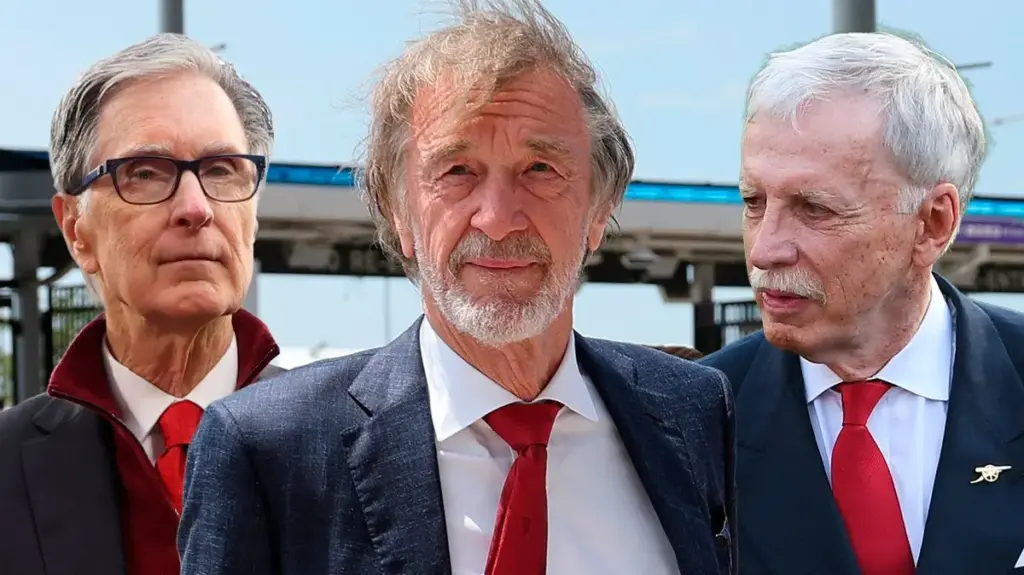
A stark financial gulf separates the custodians of three of English football’s most historic clubs: Arsenal, Manchester United, and Liverpool. From Stan Kroenke’s sprawling multi-sport empire to Sir Jim Ratcliffe’s industrial chemicals fortune, and John W. Henry’s calculated sports-investing model—augmented recently by a consortium featuring the staggering wealth of Amazon founder Jeff Bezos—the financial architectures underpinning these clubs are as diverse as they are vast. This investigative feature examines the real-world net worth of these high-profile owners, how their fortunes have fluctuated, and what their financial standing means for the future balance of power in English football.
Detailed Chronology: Ownership Shifts and Financial Milestones
To understand the current economic landscape of Arsenal, Manchester United, and Liverpool, one must trace the historical milestones and ownership trajectories that brought these billionaires to the helm. The consolidation of corporate and private equity ownership in the Premier League has evolved drastically over the past two decades.
The Kroenke Ascendancy at Arsenal (2007–Present)
American billionaire Stan Kroenke’s initial entry into the Arsenal boardroom began in 2007 when he purchased a modest stake in the club. Over the subsequent years, Kroenke steadily increased his shareholding, capitalizing on the disillusionment of other minority shareholders.
- April 2011: Kroenke increased his stake to majority status, crossing the 60% threshold by acquiring shares from Danny Fiszman and Lady Nina Bracewell-Smith.
- August 2018: The defining moment of his tenure occurred when Russian billionaire Alisher Usmanov accepted a £550m buyout offer, enabling Kroenke to acquire sole ownership of the club through Kroenke Sports & Entertainment (KSE). At this juncture, his personal net worth was roughly half of what it is today, and the takeover was met with widespread fan skepticism regarding debt-financed acquisition models.
- 2021–2026: Having weathered early fan protests, Kroenke’s fortunes soared alongside his broader sporting portfolio—highlighted by the Los Angeles Rams’ Super Bowl victory in 2022 and aggressive real estate developments. His net worth more than doubled from his early sole-shareholder days, stabilizing at a colossal $24.3bn (£17.82bn) by mid-2026.
Sir Jim Ratcliffe’s Late-Stage Entry at Manchester United (2023–2026)
For over a decade, Manchester United supporters lived under the contentious ownership of the Glazer family, whose leveraged buyout saddled the club with persistent debt. The narrative shifted dramatically following a protracted and intensely scrutinized strategic review initiated in late 2022.
- November 2022: The Glazer family announced they were exploring "strategic alternatives" to enhance the club’s growth, opening the door for full or partial sale bids.
- December 2023: After months of competing against Qatari banker Sheikh Jassim bin Hamad Al Thani, British petrochemicals magnate Sir Jim Ratcliffe reached an agreement to acquire a 27.7% stake in Manchester United via his INEOS group, alongside operational control of the club’s football department.
- February–March 2024: The deal received official ratification from both the Premier League and the Football Association, injecting an initial $300m in infrastructure capital. Despite Ratcliffe’s entry, his personal wealth experienced marginal contractions, shifting from a peak of $22.9bn in 2023 to a stabilized $18.2bn (£15.92bn) by 2026, mirroring minor adjustments in global industrial valuations.
Fenway Sports Group, John W. Henry, and the Bezos Factor at Liverpool (2010–2026)
Liverpool’s modern era was forged in the fires of near-administration under the deeply unpopular previous American ownership of Tom Hicks and George Gillett.
- October 2010: New England Sports Ventures (later rebranded as Fenway Sports Group, or FSG), spearheaded by principal owner John W. Henry and chairman Tom Werner, successfully acquired Liverpool FC through a high-stakes legal battle, rescuing the club from financial ruin.
- 2021–2024: FSG oversaw a golden era of on-field success under manager Jürgen Klopp, characterized by data-driven recruitment and self-sustainability. During this period, Henry’s personal net worth more than doubled, climbing past the $5bn threshold.
- Late 2025 – Early 2026: Recognizing the escalating financial arms race in the Premier League—typified by state-backed ownership models—FSG altered its capital strategy. In a landmark development behind the scenes, a high-profile consortium involving Amazon founder Jeff Bezos secured a strategic investment tier within Liverpool. This move dramatically altered the club’s financial ceiling, juxtaposing John Henry’s comparatively modest $5.7bn (£4.18bn) personal wealth against Bezos’s staggering $224bn (£164.3bn) titan fortune, making the latter the fourth-richest person on the planet.
Supporting Context & Metrics: Breaking Down the Billionaire Portfolios
While headline-grabbing net worth figures provide a snapshot of an owner’s total estimated wealth, the mechanisms through which these fortunes are generated—and how readily liquid capital can be deployed into a football club—vary significantly.
1. Stan Kroenke (Arsenal)
- Estimated Net Worth: $24.3bn (£17.82bn)
- Forbes Global Ranking: 12th richest sports club owner globally.
- Primary Wealth Sources: KSE (Kroenke Sports & Entertainment), extensive North American real estate holdings (shopping plazas, commercial developments, and massive agricultural ranches), and marriage to Walmart heiress Ann Walton Kroenke.
- Sporting Portfolio: Arsenal FC (Premier League), Los Angeles Rams (NFL), Denver Nuggets (NBA), Colorado Avalanche (NHL), Colorado Rapids (MLS), and various esports franchises.
- Analysis: Kroenke’s wealth is heavily tied to hard assets (real estate and sports franchises) that appreciate steadily over time. Although Arsenal historically operated under a strict self-sustaining financial model, KSE has increasingly demonstrated a willingness to back managerial projects with significant cash injections, as evidenced by heavy investments in recent transfer windows.
2. Sir Jim Ratcliffe (Manchester United)
- Estimated Net Worth: $18.2bn (£15.92bn)
- Primary Wealth Sources: INEOS, one of the world’s largest petrochemicals, specialty chemicals, and oil products manufacturers.
- Sporting Portfolio: Manchester United (27.7% stake with sporting control), OGC Nice (Ligue 1), FC Lausanne-Sport (Swiss Super League), and the INEOS Grenadiers cycling team (formerly Team Sky).
- Analysis: Ratcliffe’s fortune is deeply rooted in heavy industry and manufacturing. While his personal wealth has experienced slight downward pressure from a 2023 peak of $22.9bn, his operational oversight at Old Trafford has prioritized aggressive cost-cutting, structural modernization, and strategic recruitment rather than purely throwing uncontrolled capital at the squad.
3. John W. Henry & The FSG Consortium (Liverpool)
- Estimated Net Worth (John W. Henry): $5.7bn (£4.18bn)
- Associated Investment Power (Jeff Bezos Consortium): $224bn (£164.3bn)
- Primary Wealth Sources: Fenway Sports Group, sports media, real estate, and principal ownership of legacy media assets (such as The Boston Globe).
- Sporting Portfolio: Liverpool FC (Premier League), Boston Red Sox (MLB), Pittsburgh Penguins (NHL), and RFK Racing (NASCAR stake).
- Analysis: Henry possesses by far the lowest individual net worth among the primary trio of English club leaders highlighted. For years, FSG operated Liverpool as an enterprise that relied on clever amortization, player trading profits, and commercial revenue generation. However, the introduction of the Jeff Bezos-backed consortium in 2025 has entirely rewritten Liverpool’s financial ceiling, fusing FSG’s operational acumen with virtually limitless capital reserves.
Official Statements and Institutional Perspectives
The intersection of private wealth and public sporting heritage invariably invites intense scrutiny from regulatory bodies, fan trusts, and the club boards themselves.

Reflecting on the shifting financial parameters of modern football ownership, financial fair play (FFP) regulations—now transitioning into UEFA’s squad cost ratios and the Premier League’s new financial sustainability rules—have forced owners to pivot from reckless spending to structured investment.
Speaking on the introduction of strategic minority partners and institutional capital, Fenway Sports Group released a joint operational statement emphasizing the balance between commercial viability and competitive hunger:
"The global landscape of football requires continuous evolution. While historical models of organic growth built our foundations, maintaining elite-tier competitiveness on a European scale demands progressive partnerships, technological integration, and resilient financial backing that protects the club’s long-term future without compromising its identity."
Similarly, addressing the restructuring at Manchester United following INEOS’s arrival, club executives reinforced Sir Jim Ratcliffe’s mandate to restore sporting excellence:
"Sir Jim’s investment is not merely financial; it is a structural commitment to operational excellence. The focus remains steadfast on returning Manchester United to the summit of English and European football through rigorous management, modern facilities, and a clear footballing philosophy."
Financial analysts, however, remain cautious regarding the widening wealth gap. Representatives from the Football Supporters’ Association (FSA) have repeatedly voiced concerns over the disparity between clubs backed by multi-tens-of-billions-pound industrial titans and those reliant on traditional revenue models:
"When individual wealth scales to the heights of multi-billion-dollar empires, football risks becoming an exclusive playground where success is dictated solely by the size of an owner’s balance sheet rather than footballing merit."
Future Outlook: The Arms Race Ahead
As the Premier League marches deeper into the late 2020s, the battle lines among English football’s traditional elite are drawn clearer than ever. The financial gulf between owners is no longer just a trivia point for Forbes lists; it is the primary engine driving squad construction, managerial appointments, and infrastructural development.
- Arsenal’s Sustained Ambition: With Stan Kroenke’s net worth comfortably above $24bn and a fully consolidated sporting empire, the Gunners have transitioned from top-four contenders to genuine, perennial title challengers under Mikel Arteta. KSE’s willingness to absorb high wage bills and invest heavily in elite talent indicates that Arsenal will remain major players in the transfer market for the foreseeable future.
- Manchester United’s Transitional Rebuild: Sir Jim Ratcliffe faces the monumental task of steering Manchester United out of a post-Ferguson sporting wilderness. While INEOS commands immense industrial wealth, Ratcliffe’s approach emphasizes operational efficiency and smarter recruitment over sheer financial brute force. Whether this method can bridge the gap with state-backed clubs and KSE’s Arsenal remains the defining question of his tenure.
- Liverpool’s New Financial Frontier: By blending John W. Henry’s proven sports-management model with the earth-shattering capital of the Jeff Bezos-associated consortium, Liverpool has future-proofed its ability to compete with any financial juggernaut in world football. The transition from a strictly self-sustaining model to one augmented by trillion-dollar tech wealth signals a new era at Anfield—one where record-breaking transfer outlays for stars like Wirtz and Isak are no longer anomalies, but the new baseline.
Ultimately, while wealth does not automatically guarantee trophies, the financial disparity between English football’s elite owners ensures that the modern arms race will only accelerate. In this high-stakes arena, having a billionaire owner is no longer enough—you need the right billionaire, backed by the right strategy, to conquer the Premier League.