Executive Overview
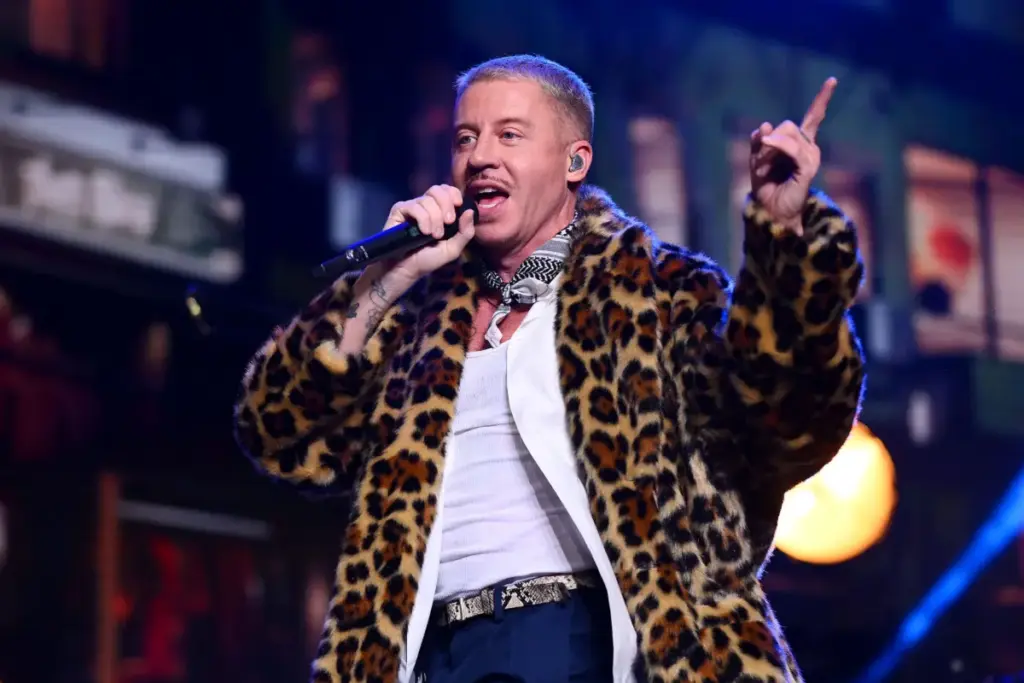
The intersection of popular music, mass entertainment, and international geopolitics has once again stepped into the crosshairs of public debate following a high-profile incident at New Jersey’s MetLife Stadium. During an opening performance for global pop superstar Ed Sheeran on a Friday evening, four-time Grammy-winning rapper Macklemore addressed tens of thousands of concertgoers, publicly declaring, “Free Palestine.”
This on-stage declaration immediately reverberated far beyond the confines of the stadium, igniting a firestorm across digital media platforms, drawing sharp rebukes from advocacy groups, and prompting a formal petition campaign demanding his removal from the remainder of the tour. The controversy intensified the following evening when the artist doubled down on his remarks during a subsequent appearance, offering an extended clarification aimed at separating his geopolitical criticisms from antisemitism while broadening his critique to encompass a wide array of global conflicts and domestic policies.
The incident highlights a growing tension within the modern entertainment industry: the shrinking boundary between the private space of commercial entertainment and the public sphere of political protest. For decades, artists have utilized large platforms to spotlight humanitarian crises, human rights abuses, and social justice causes. However, the scale of contemporary stadium tours—amplified by instantaneous social media dissemination—transforms localized statements into global flashpoints.
Critics, including the Israeli American Council (IAC), argue that utilizing a shared, multi-artist concert platform for one-sided political messaging disrespects ticket-holders who paid to experience music rather than participate in a political rally. Conversely, supporters and free-speech advocates champion the artist’s right to utilize his platform to raise awareness about ongoing humanitarian disasters in Gaza, the West Bank, Lebanon, and beyond. This report provides an exhaustive investigation into the chronology of the event, the official statements and reactions, the broader context of artist activism, and the potential long-term ramifications for the live music industry.
Detailed Chronology
Friday Night: The MetLife Stadium Performance
The controversy began to take shape on Friday night at MetLife Stadium in East Rutherford, New Jersey, where Macklemore was serving as a supporting act for Ed Sheeran’s sprawling international stadium run. Midway through his set, the rapper paused his musical performance to address the packed venue.
Speaking directly to the audience, Macklemore stated that he wanted the residents of Gaza and the West Bank to know that they had not been forgotten. Emphasizing a universalist framework of human rights, he told the crowd, “I believe that every human being walking on this earth deserves exactly the same freedom.” He then uttered the phrase that would catalyze the subsequent backlash: “Free Palestine.”
Audience reactions within the stadium were mixed, ranging from vocal support to stunned silence, but the digital echo chamber amplified the moment within minutes. Video clips captured by attendees circulated rapidly across platforms like X (formerly Twitter), TikTok, and Instagram, drawing millions of views and immediately dividing public opinion.
The Backlash and the IAC Petition
By Saturday morning, the fallout from the Friday night performance had materialized into organized opposition. The Israeli American Council (IAC) launched a formal online petition directed at tour organizers and promoters, demanding that Macklemore be immediately dropped from the remainder of Ed Sheeran’s "Mathematics Tour."
The petition articulated a central grievance concerning the appropriateness of political discourse within commercial entertainment venues:
“This was an Ed Sheeran concert — not a political rally, not a protest, and not an activist event. The issue is not whether Macklemore has the right to hold political views. The question is where the line should be drawn when an opening act uses a global concert platform to advance a one-sided political agenda.”
The IAC and allied community groups argued that such remarks alienate significant portions of the concert-going public, particularly Jewish and Israeli-American fans who may feel targeted or unsafe in environments intended for communal leisure. The petition quickly gathered thousands of signatures, placing immense pressure on tour management and venues to address the conduct of supporting acts.
Saturday Night: Macklemore’s Public Clarification
Rather than retreating from the controversy, Macklemore used his stage presence the following night—Saturday evening—to address the unfolding backlash directly. Speaking to another packed audience, the rapper sought to contextualize his remarks and draw a distinct line between political critique and bigotry.
“To all of my Jewish brothers and sisters: criticism of Israel, criticism of apartheid, being against genocide in no way is a criticism of you,” Macklemore stated, as reported by Newsweek. “My message is for peace; love for all human beings to be treated with dignity, respect, and equality.”
He then expanded the scope of his political commentary, connecting the situation in the Middle East to other international crises and domestic civil liberties concerns:
“So I say free Palestine, I say free Lebanon, I say free Cuba, I say free Congo, free Sudan, I say free all people in America living in fear of this terrorist organization, ICE. None of us will be free until we are all free.”
This broader list of grievances transformed his initial statement on the Israeli-Palestinian conflict into an expansive, intersectional critique of global imperialism, state violence, and domestic immigration enforcement. This strategic pivot aimed to frame his activism not as an isolated attack on a single nation, but as part of a consistent, lifelong commitment to universal human rights.
Supporting Context & Metrics
The Economics and Reach of Modern Stadium Tours
To understand the gravity of Macklemore’s statements, one must examine the sheer scale of the platform he utilized. Ed Sheeran’s tours routinely rank among the highest-grossing concert enterprises in music history. Venues like MetLife Stadium routinely host upward of 80,000 to 90,000 attendees per night.
When an artist addresses a crowd of this magnitude, the immediate physical audience surpasses the population of many mid-sized American towns. However, the physical audience is merely the catalyst. In the digital age, a 30-second clip recorded on a smartphone can achieve viral velocity, reaching tens of millions of users globally within hours. This amplification dynamic creates a high-stakes environment where spontaneous remarks carry the weight of international press statements.
Macklemore’s History of Political and Social Activism
Macklemore, born Ben Haggerty, is no stranger to socio-political controversy. Unlike many mainstream pop and hip-hop artists who maintain carefully sanitized public personas to protect commercial partnerships, Haggerty has a documented history of using his art and public platform to address systemic issues.
- "Same Love" (2012): Early in his mainstream career alongside producer Ryan Lewis, Macklemore released "Same Love," an explicit advocacy anthem for marriage equality and LGBTQ+ rights, released during a crucial period when state-level ballot initiatives regarding same-sex marriage were being decided across the United States.
- Critique of Commercialism and White Privilege: In tracks like "White Privilege II," the artist openly interrogated his position as a white rapper operating within a historically Black art form, grappling with systemic racism and the responsibilities of allyship.
- Prior Statements on Palestine: The MetLife Stadium remarks were not Macklemore’s first public comments on the Israeli-Palestinian conflict. He has consistently voiced support for Palestinian rights across his social media channels and in previous musical releases, demonstrating that his stage remarks were part of an ongoing, deeply held personal conviction rather than a spur-of-the-moment outburst.
The Broader Landscape of Concert Activism
The tension between artistic expression and audience comfort is a perennial theme in entertainment history. From the anti-Vietnam War protests led by folk and rock musicians in the late 1960s to the anti-apartheid benefit concerts of the 1980s and post-9/11 controversies involving acts like the Dixie Chicks (now The Chicks), music has frequently served as a vehicle for dissent.
However, the contemporary socio-political climate—marked by intense polarization regarding the Middle East conflict—has heightened sensitivities. Concert promoters and venue operators increasingly find themselves navigating a delicate balancing act. On one hand, they must respect freedom of speech and the artistic autonomy of performers. On the other hand, they face intense economic pressures, security concerns, and public relations fallout when performances spark boycotts or community friction.
Official Statements and Stakeholder Reactions
The Israeli American Council (IAC)
The IAC’s response underscores the perspective of community stakeholders who feel that entertainment spaces should remain insulated from geopolitical strife. In their public statements surrounding the petition, IAC representatives emphasized that concerts are meant to be inclusive spaces of unity.
The organization argued that introducing highly charged, divisive political slogans like "Free Palestine" into a mainstream pop concert creates an exclusionary environment for Jewish and Israeli attendees, many of whom are dealing with the ongoing psychological trauma stemming from the October 7, 2023 attacks and the subsequent rise in global antisemitism. The IAC maintains that artists operating as supporting acts have a professional obligation to respect the collaborative nature of a shared tour and avoid hijacking the platform for partisan or unilateral geopolitical messaging.
Ed Sheeran’s Management and Tour Organizers
As of this writing, neither Ed Sheeran nor his primary tour management team has issued a formal public statement regarding Macklemore’s remarks or the IAC petition. Industry insiders note that headliners in massive stadium tours often maintain contractual agreements with supporting acts that protect artistic freedom while simultaneously insulating the primary brand from collateral controversy.
By remaining silent, tour organizers have thus far chosen a containment strategy, attempting to prevent a localized dispute from overshadowing the multi-city economic engine of the broader tour. Whether behind-the-scenes pressure is being applied to moderate on-stage commentary remains a subject of intense speculation within music industry circles.
Civil Liberties and Free Speech Advocates
Conversely, free speech organizations and civil rights advocates have rallied to defend Macklemore’s right to express political opinions. Organizations dedicated to First Amendment protections emphasize that artists do not forfeit their citizenship rights or moral responsibilities upon signing a commercial touring contract.
Proponents of artist-led activism argue that historical progress has frequently been accelerated by public figures willing to risk commercial backlash to draw attention to human rights abuses. From this viewpoint, silencing performers or demanding their removal for expressing solidarity with oppressed populations sets a dangerous precedent of corporate censorship and chilling effect within the arts community.
Future Outlook
Implications for the Remainder of the Tour
The immediate question facing tour promoters is whether the pressure from advocacy groups like the IAC will result in tangible operational changes. While removing an established artist like Macklemore mid-tour is logistically complex and rare, heightened security measures and backstage protocols are almost certainly being reviewed.
Promoters must weigh the potential financial and public relations risks of retaining an outspoken opening act against the backlash of canceling or altering a lucrative tour lineup. If further incidents occur at upcoming stops, the pressure on Ed Sheeran’s camp to make a definitive public statement will increase exponentially.
The Shifting Paradigm of Celebrity Activism
Macklemore’s MetLife Stadium controversy serves as a bellwether for the modern entertainment industry. In an era defined by hyper-connectivity and immediate digital accountability, the traditional separation between "entertainer" and "activist" has largely dissolved. Fans and critics alike increasingly demand moral transparency and political engagement from public figures, yet they react with fierce polarization when that engagement touches upon deeply entrenched geopolitical conflicts.
As global tensions continue to manifest across cultural, academic, and athletic landscapes, the live music industry will undoubtedly face ongoing challenges regarding freedom of expression. Artists will have to decide whether the personal and professional costs of speaking out on polarizing topics are worth the platform they command, while promoters and venues must navigate the treacherous waters of public safety, inclusivity, and commercial viability.
Ultimately, Macklemore’s remarks at MetLife Stadium—and the fierce debate that followed—demonstrate that the concert stage remains one of the most potent, contested arenas for modern ideological struggle. Whether viewed as an abuse of a shared platform or a courageous act of humanitarian solidarity, the incident has permanently altered the discourse surrounding the responsibilities of artists in an interconnected, turbulent world.