Executive Overview
The summer of 2014 will forever be etched into the collective memory of Liverpool Football Club supporters as a watershed moment of transition, ambition, and, ultimately, structural upheaval. Fresh off a pulsating, albeit heartbreaking, Premier League title charge fueled by the mercurial brilliance of Luis Suárez, the Anfield hierarchy faced an unenviable task: replacing a generational talent whose £65 million departure to Barcelona left an irreplaceable void in the final third.
Manager Brendan Rodgers, tasked with constructing an attacking vanguard capable of sustaining a Champions League campaign alongside domestic dominance, rolled the dice on a disparate pair of recruits. Enter Rickie Lambert—a boyhood Liverpool fan, lower-league journeyman turned Premier League prolific scorer, and the epitome of professional dedication at age 32. Opposite him arrived Mario Balotelli, the enigmatic, supremely talented, yet intensely volatile Italian forward signed from AC Milan for £16 million as a high-reward, high-risk alternative.
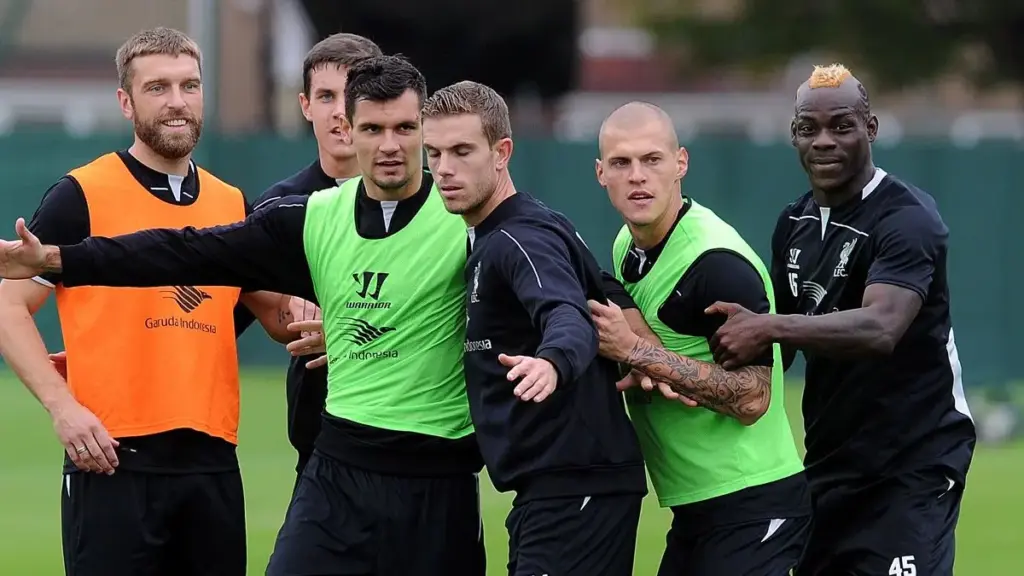
What transpired behind the closed doors of Melwood, Liverpool’s legendary former training ground, was a clash of footballing cultures, professional ethics, and psychological approaches. While Lambert viewed his late-career homecoming as the culmination of a lifelong dream—demanding absolute rigor, sweat, and application—Balotelli treated training with a capricious nonchalance that frequently tipped into active sabotage.
The friction between the two strikers became so pronounced that senior leadership, including captain Steven Gerrard, eventually intervened. Lambert famously implored Rodgers to separate them during tactical drills after reaching breaking point with the Italian’s baffling antics, which famously included scoring audacious own-goals out of pure boredom. This retrospective explores the turbulent dynamics of a partnership that symbolized a chaotic era of recruitment on Merseyside, detailing how two fundamentally opposed mindsets collided on the Melwood pitches.
Detailed Chronology: The Summer of 2014 and the Unraveling at Melwood
The Descent of Two Divergent Paths
To understand the friction that plagued Liverpool’s training sessions during the 2014/15 season, one must examine the vastly contrasting trajectories that brought Lambert and Balotelli to Merseyside.
For Rickie Lambert, pulling on the red shirt was the emotional peak of an arduous, unconventional career. Released by Liverpool as a 15-year-old schoolboy, Lambert had traversed the rugged landscapes of the lower divisions—playing for Blackpool, Macclesfield Town, Stockport County, Rochdale, and Bristol Rovers before finding stardom with Southampton. Earning his first England cap while playing in the Championship, Lambert’s inclusion in Roy Hodgson’s 2014 World Cup squad preceded his emotional £4 million homecoming to Anfield. At 32, Lambert was acutely aware that this was his one and only chance to represent the club of his heart. Every training session was treated as a trial; every drill was approached with militant intensity.
Conversely, Mario Balotelli arrived under a shroud of heavy expectation and systemic baggage. Still only 24, the Italian international possessed a CV that sparkled with Serie A titles, a Champions League medal with Inter Milan, and Premier League and FA Cup honors with Manchester City, alongside an electrifying Euro 2012 campaign with Italy. Yet, his extraordinary natural gifts had consistently been undermined by behavioral volatility, tactical indiscipline, and an apparent indifference to the monotonous grind of daily training.
When Brendan Rodgers signed Balotelli on deadline day in August 2014—having previously declared that the Italian would "never" move to Anfield—it was widely viewed as a desperate gamble following failed pursuits of other primary targets, such as Loïc Rémy and Alexis Sánchez.
The Melwood Flashpoints
From the outset, the cultural mismatch within Liverpool’s forward line was palpable. While Lambert threw himself into physical duels and tactical instructions, Balotelli’s engagement levels fluctuated wildly depending on his mood.
Speaking candidly on the Straight From the Off podcast, Lambert recalled the jarring realization of training alongside the Italian:
"He was a good lad, childish but infectious. But as soon as he stepped on the training pitch he became a different person. I’ve never seen anything like it, to be honest. At first, he gave everything when he played. But in training, I could tell he wasn’t giving his all. He was answering Brendan [Rodgers] back and my head went with that."
The psychological toll on Lambert was significant. While he accepted competition for places, watching a teammate seemingly disrespect the coaching staff and coast through sessions while still commanding a starting berth eroded his patience. The breaking point arrived during routine 10-versus-10 tactical preparations.
Balotelli, often placed on the ‘bibs’ side representing the projected substitutes or tactical alternative setup ahead of fixtures, frequently grew disillusioned during these exercises. On one infamous occasion, thoroughly bored and frustrated by the proceedings, Balotelli unleashed a jaw-dropping, audacious strike from the halfway line. The only catch? It was deliberately fired past his own reserve goalkeeper, Brad Jones, leaving onlookers, coaching staff, and exhausted teammates staring in stunned silence.
Lambert’s frustration boiled over to the point of confrontation. Recognizing that his own focus and temperament were being compromised by his growing animosity toward the Italian’s antics, Lambert took direct action. He approached Brendan Rodgers with a clear ultimatum: "Don’t put me on his team again." It soon emerged that Liverpool skipper Steven Gerrard had voiced similar grievances, highlighting how deeply Balotelli’s detached demeanor had penetrated the senior leadership group’s tolerance threshold.

Supporting Context & Metrics: The Statistical Autopsy of a Failed Experiment
The internal discord at Melwood naturally manifested on the pitch, resulting in one of the most statistically unproductive campaigns by a marquee Liverpool striker in the Premier League era.
Mario Balotelli’s 2014/15 Season Breakdown:
- Total Appearances (All Competitions): 28 matches
- Total Goals Scored: 4 goals
- Premier League Appearances: 16 matches (10 starts, 6 substitute appearances)
- Premier League Goals: 1 goal
- Shots per 90 Minutes (Premier League): 3.7 (highlighting high volume, exceptionally low conversion)
- Shot Conversion Rate: ~2.7%
- Yellow Cards: 7 (All Competitions)
To put Balotelli’s output into perspective, his solitary Premier League goal came in a 3-2 victory over Tottenham Hotspur in February 2015—a late winner that briefly promised a turning point, but ultimately proved to be a false dawn. In stark contrast, Lambert, despite his advancing years and limited starting opportunities, managed 36 appearances across all competitions, scoring 3 goals and providing crucial veteran leadership in the dressing room.
Tactical Misalignment
Brendan Rodgers’ tactical framework during the 2013/14 season relied heavily on high-intensity pressing, fluid positional rotation, and relentless vertical transitions led by Luis Suárez and Daniel Sturridge. When Suárez departed and Sturridge suffered a cascade of hamstring injuries that restricted him to just 12 appearances in 2014/15, Rodgers was forced to radically alter his attacking structure.
Balotelli, however, was fundamentally unsuited to the defensive workload demanded of a Rodgers center-forward. Preferring to drop deep into pockets of space or loiter on the shoulder of the last defender, Balotelli registered a meager defensive contribution metric compared to his peers. His reluctance to press from the front disrupted the defensive block, forcing midfielders to cover excessive ground and compounding Liverpool’s structural fragility following the departure of inspirational center-back Jamie Carragher the previous year.
Official Statements and Retrospective Insights
Years removed from the chaotic atmosphere of the 2014/15 season, those caught in the crossfire have offered candid reflections on an era that tested the institutional resilience of Liverpool Football Club.
Brendan Rodgers, who later admitted that signing Balotelli was a calculated risk that ultimately backfired, spoke about the immense difficulty of managing a player whose public persona often overshadowed his professional output. In subsequent interviews, Rodgers noted the unique pressures placed upon the club during that transitional summer, acknowledging that squad harmony is a fragile ecosystem easily disrupted by conflicting personalities.
Rickie Lambert, reflecting on his time at Anfield after retiring from professional football, maintained a nuanced perspective on Balotelli as a human being while remaining unflinchingly honest about his professional shortcomings:
"The fact that he was playing in front of me didn’t bother me at first, I thought ‘I’ll get myself in’ but just seeing the way he was in training, and then he was playing, it did affect me a little bit. My head went with him in training… he was a good lad off the pitch, but on it, it was impossible to manage expectations."
Journalistic accounts from the period, notably detailed in comprehensive investigative reports by The Standard in August 2015, painted an even wider picture of the cultural disconnect. Reports surfaced detailing how Balotelli occasionally struggled to learn the names of his new teammates during his opening weeks, isolated himself during tactical briefings, and maintained a social calendar that frequently raised eyebrows among the club’s traditionalist leadership group.
Future Outlook: Lessons Learned and Modern Parallels
The cautionary tale of Mario Balotelli and Rickie Lambert’s brief convergence at Liverpool serves as an invaluable case study for modern sporting directors, data analysts, and head coaches regarding squad construction and cultural alignment.
In contemporary football, recruitment models have evolved significantly past the scattergun, reactive approaches often forced upon clubs during sudden marquee departures. Modern institutions like Liverpool under the stewardship of Michael Edwards, Julian Ward, and Richard Hughes prioritize psychological profiling, emotional intelligence, and tactical adaptability alongside pure technical output. A player’s ability to integrate into the collective ecosystem—embracing the defensive rigors and cultural standards of the club—is scrutinized just as heavily as their goalscoring statistics.
For Balotelli, his career post-Anfield became a nomadic journey across Europe and the Middle East, featuring stints with AC Milan, Nice, Marseille, Brescia, Monza, Adana Demirspor, Sion, and Adana Demirspor once more, before his later ventures in the UAE. While intermittent flashes of his world-class technical brilliance continued to surface, the overarching narrative of unfulfilled potential remained his defining legacy.
For Liverpool, the painful lessons of 2014 laid the groundwork for a rigorous cultural overhaul. The subsequent appointments of Jürgen Klopp and the implementation of a hyper-cohesive recruitment strategy ensured that Melwood—and later the AXA Training Centre—became sanctuaries of collective accountability, high-intensity work ethics, and mutual respect.
The image of Mario Balotelli casually smashing a 40-yard wonder-strike past Brad Jones into his own net remains a bizarre, almost surreal footnote in Liverpool’s illustrious history. Yet, it stands as an enduring monument to a chaotic chapter—a stark reminder of what happens when unbridled individual eccentricity collides with the uncompromising, blue-collar demands of a historic footballing institution.