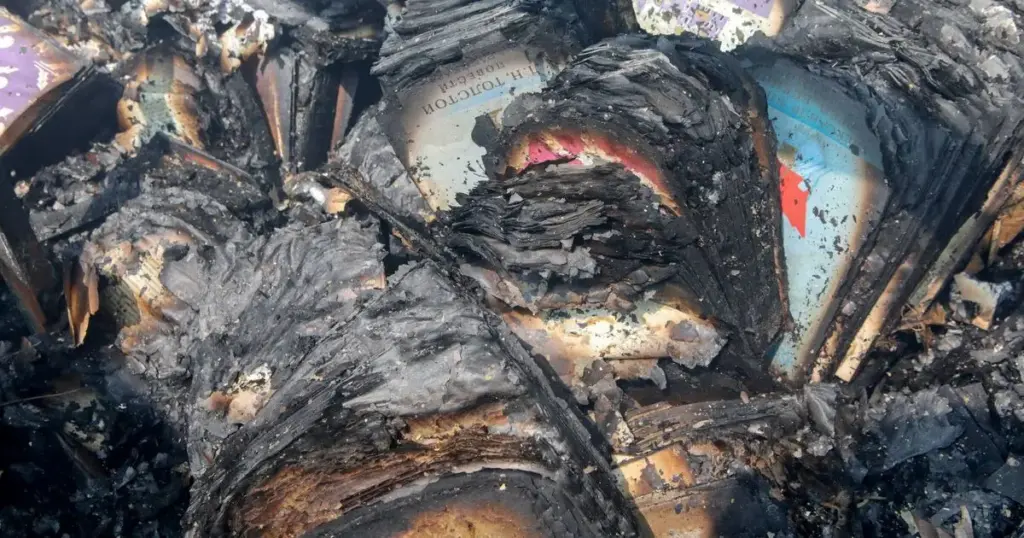
Since the full-scale invasion of Ukraine in February 2022, the conflict has expanded far beyond contested frontline trenches, strategic military hubs, and electrical power grids. Increasingly, Russian military operations have targeted the intellectual and cultural infrastructure of the Ukrainian nation. Ukrainian authorities report that Russia has launched at least 21 direct attacks specifically against the country’s publishing houses, printing presses, warehouses, and bookselling markets since the outbreak of hostilities.
The assault escalated dramatically during the summer months leading up to the school year, resulting in the destruction of an estimated 12 million books. This staggering figure means that roughly a third of all books printed in Ukraine this year have been reduced to ash, rubble, and smoldering debris before they could ever reach readers, libraries, or classrooms.
International observers, cultural preservationists, and Ukrainian officials argue that this sustained campaign is not merely collateral damage from a war of territorial conquest. Instead, they view it as a deliberate strategy of cultural erasure—an attempt to suppress the Ukrainian language, undermine national identity, and dismantle the educational foundations of a sovereign people. While Moscow consistently maintains that its military strikes are strictly limited to legitimate military targets and infrastructure supporting Kyiv’s war effort, the concentration of targeted facilities points to an intentional assault on Ukraine’s literary ecosystem.
Detailed Chronology: Anatomy of a Cultural Campaign
The systematic devastation of Ukraine’s publishing sector has unfolded through a series of calculated strikes against major urban printing hubs, distribution networks, and cultural landmarks.
The Spring and Summer Intensification (2026)
Over a grueling two-month period during the summer, the tempo of attacks against the nation’s literary supply chain intensified sharply. More than 35 publishing and logistical facilities were struck across the country. The timing—occurring weeks before the start of the academic year—dealt a severe blow to the distribution of essential educational materials.
One of the most catastrophic single incidents occurred in Kharkiv, northeastern Ukraine’s historic capital of printing and culture. A precision Russian missile strike obliterated a major publishing house, reducing an estimated eight million books to ashes. Among the lost cargo were roughly 620,000 freshly printed school textbooks destined for classrooms that autumn. For a region already battered by relentless bombardments, the loss of these educational texts represented a profound psychological and practical setback.
The Siege of Kyiv’s Logistics and Markets
The capital city of Kyiv has likewise borne the brunt of logistical targeting. In recent weeks, series of strikes hit sprawling warehouses belonging to prominent regional publishers, destroying upwards of 60,000 books stored for national distribution.
The violence struck closer to the heart of the civilian literary community when Pochaina—one of Kyiv’s most vibrant and cherished second-hand book markets located near the metro station of the same name—was hit by a Russian ballistic missile attack. The strike triggered massive fires that consumed sprawling rows of market stalls, turning decades of collected literature, rare volumes, and contemporary works into charred heaps. At least three people were injured in the fiery blast, sending shockwaves through a populace that views such public spaces as sanctuaries of communal heritage.
Historical Precedents of 21 Documented Strikes
Ukrainian cultural monitors note that these recent events are part of a continuous, methodical pattern. Since February 2022, at least 21 major attacks have been formally documented against the nation’s book industry. These include direct hits on iconic printing facilities in Kharkiv—such as the Vivat printing house, which suffered devastating losses in earlier phases of the war—as well as independent binderies, paper suppliers, and municipal libraries converted into impromptu distribution hubs.
Supporting Context & Metrics: The Scale of the Devastation
To understand the magnitude of the crisis facing Ukraine’s literary community, one must examine the raw data and the structural vulnerability of the country’s book ecosystem.
The Numbers Behind the Loss
12 Million: The estimated number of books destroyed by Russian strikes over the course of a single summer.
One-Third: The proportion of total national book production for the year wiped out in a matter of weeks.
35+: The number of publishing, printing, and logistical facilities hit over the recent wave of escalation.
8 Million: The staggering book toll from a single strike on a Kharkiv publishing facility, including 620,000 school textbooks.
21+: The official count of major attacks directly targeting the Ukrainian book industry since February 2022.
The Fragile Book Ecosystem
Oleksandra Koval, director of the Ukrainian Book Institute, has issued dire warnings regarding the cumulative impact of these strikes. Koval notes that a modern book industry relies on a delicate, interconnected web of paper manufacturers, specialized printing presses, ink suppliers, graphic designers, publishing houses, distribution logistics, and retail spaces.
When a missile destroys a major printing plant in Kharkiv or a massive warehouse on the outskirts of Kyiv, the disruption ripples across the entire sector. Publishers face insurmountable hurdles in securing insurance, replacing hyper-specialized printing machinery—much of which must be imported from Western Europe under wartime conditions—and retaining displaced editorial and technical talent. The destruction of millions of school textbooks creates an acute educational deficit, forcing schools to rely on digital alternatives or damaged copies just as children attempt to return to some semblance of academic normalcy.
Official Statements and Industry Perspectives
The attacks have provoked fierce condemnation from Ukrainian leadership, cultural figures, and publishing executives who view the destruction through the lens of historical imperialism.
Voices from the Frontlines of Publishing
Viktoria Haida, commercial director of the bombed Konvi publishing firm in Kyiv, expressed no doubt regarding the intent behind the bombardments. Speaking to international media, she stated:
"I believe it is deliberate on the part of the Russian Federation. Over the past two months, some of the largest publishing houses have lost their logistics warehouses, where very large quantities of books were stored. The Russians are also destroying printing houses in an attempt to erase Ukraine as a nation. But frankly, they will not succeed."
Publishers across the country have rallied, attempting to salvage what remains of their operations, moving digital files to secure cloud servers abroad, and partnering with international presses in Poland, Germany, and the Baltic states to temporarily outsource printing needs.
Governmental and Diplomatic Condemnation
Ukrainian Foreign Minister Andrii Sybiha offered a blunt assessment of the campaign, declaring:
"Russia is afraid of Ukrainian books."
Sybiha drew direct parallels between current military tactics and the centuries-old policies of the Russian Empire and the Soviet Union—such as the Ems Ukase and various Russification campaigns—which historically banned, burned, or heavily restricted the publication and circulation of the Ukrainian language. By systematically targeting the physical mediums of Ukrainian thought, Moscow is seen by Kyiv as attempting to revive historical programs of cultural subjugation under the guise of modern military necessity.
The Russian Position
For its part, the Russian government has consistently denied accusations of intentionally targeting cultural heritage, educational institutions, or civilian literary assets. Moscow’s official stance maintains that the Russian armed forces strike exclusively at military targets, command-and-control nodes, defense industries, and logistical infrastructure directly tied to the sustainment of Ukraine’s armed forces. Russian military spokespersons have not directly addressed the specific destruction of publishing houses, framing overall urban damage as the unfortunate byproduct of broader counter-air and precision strike campaigns against dual-use or military-industrial nodes.
Future Outlook: Resilience Amid Ruin
As the conflict grinds on with no immediate political settlement in sight, the battle for Ukraine’s cultural survival has taken on existential urgency. The simultaneous exchange of hundreds of drones and long-range missiles across the frontlines and deep into the rear underscores a war of attrition that touches every facet of society.
Despite the loss of 12 million books and the devastation of critical printing infrastructure, the Ukrainian literary community remains defiant. Grassroots fundraising campaigns, international solidarity grants from UNESCO and European publishers, and the sheer determination of local authors and printers are breathing new life into the sector. Pop-up book fairs are replacing burned markets like Pochaina, and digital publishing initiatives are bypassing physical destruction to keep the Ukrainian language vibrant and accessible.
Yet, the long-term challenge remains formidable. Rebuilding high-capacity printing hubs in secure western regions of the country, replacing millions of lost textbooks before future academic terms, and protecting cultural workers from ongoing missile barrages will require sustained international backing.
Ultimately, the campaign against Ukraine’s bookshelves has highlighted a grim reality of modern warfare: when a nation fights not only for its physical borders but for its right to exist as a distinct cultural entity, its literature becomes both a prime target for its adversary and an unbreakable shield for its people.