Executive Overview
For the better part of half a decade, the global beauty landscape has been dominated by a singular, hyper-saturated mandate: more is more when it comes to flush. Driven by viral hits from brands like Rhode and Rare Beauty, bright, highly pigmented, and unapologetically bold cheeks became the defining aesthetic of the post-pandemic makeup boom. Consumers chased a youthful, sun-kissed, or frost-bitten vigor, inadvertently stumbling into a cultural phenomenon that industry commentators wryly dubbed "blush blindness."
Yet, in the cyclical and lightning-fast ecosystem of social media beauty trends, every maximalist movement eventually demands a minimalist correction. Enter the "anti-blush"—a trend celebrating muted, neutral, beige, and rosy-brown tones that sculpt and define rather than pop and shout.
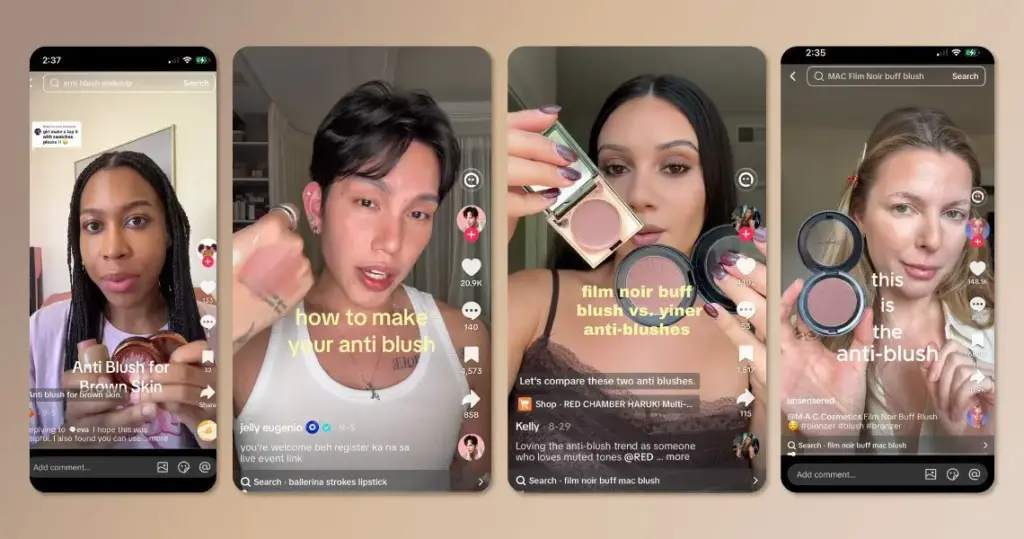
Coined on TikTok by Los Angeles-based actor and content creator Kim Senser while reviewing MAC’s Film Noir Buff blush, the term quickly burst past the confines of her modest follower count to amass millions of views, dominate international fashion publications, and leave a trail of sold-out products in its wake.
However, the rapid ascent of the anti-blush trend has done more than just clear out department store shelves; it has reignited a contentious industry-wide conversation. As corporate giants like MAC leaned into the viral phrasing to market their products, questions surrounding attribution, the ethics of creator capitalization, and the often one-sided "flirting" relationship between independent influencers and massive beauty conglomerates took center stage.
This is the inside story of how a passing phrase in a smartphone video catalyzed a macroeconomic shift in prestige cosmetics, exposing the frictions of digital-age trend origination.
Detailed Chronology: From a Casual Turn of Phrase to a Global Phenomenon
The Genesis: July 2026
The phenomenon traces back to a quiet moment in front of a ring light. Kim Senser was filming a routine product breakdown for MAC’s Film Noir Buff, a rosy-brown blush shade that defied the era’s bright pinks and corals. Searching for a descriptor that would capture the unique, understated appeal of the color, she initially muttered to herself, "This is the most interesting blush I’ve ever used." Realizing that such a bland assessment wouldn’t hook viewers scrolling through an endless sea of short-form video content, she pivoted.
"I was thinking for a second and just said, ‘This is the anti-blush,’" Senser recalls. "And then I knew in that moment, this is what I’m going to go with."
That editorial instinct paid off immediately. Uploaded to TikTok in July, the video featuring the "anti-blush" nomenclature rapidly crossed 2 million views, supplemented by an additional 1 million views on Instagram.
The Tipping Point: August to September 2026
Within weeks, the term metastasized far beyond Senser’s roughly 30,000 followers. Mega-creators with massive digital footprints—including Aditya Madiraju and Melissa Murdick—weighed in, dissecting the trend and offering their own interpretations. Content creators across platforms began generating hyper-specific variations of the look, offering anti-blush recommendations tailored specifically for deeper skin tones and olive undertones.
International fashion bibles took note. Style publications ranging from Vogue Adria to Harper’s Bazaar Singapore rushed to cover the sudden consumer craze for neutral, desaturated, and beige-toned makeup applications.
By August, the institutional adoption of the term was cemented when MAC itself leveraged the phrase on its official global Instagram account to market its blush portfolio. Concurrently, retail partners Ulta and Sephora saw their stock of MAC’s Film Noir Buff evaporate, with the product completely selling out nationwide.
The Backlash and the Dialogue on Credit
As the phrase became ubiquitous in beauty circles, the comments sections of brand posts turned into battlegrounds. Followers who had tracked the trend’s trajectory from its infancy began calling out MAC for utilizing the term without attribution. Commenters flooded the brand’s social media feeds, tagging Senser and demanding that the cosmetics giant formally credit her for originating the cultural shorthand.
Senser, for her part, found herself navigating uncharted waters. While she expressed profound gratitude for the grassroots support from fellow creators, she noted that she received zero direct communication from MAC, despite having shared her original video with the brand via direct message.
In September, Senser released a playful follow-up video addressing the trend’s explosive corporate adoption. She drew pointed comparisons to how wellness brand Lemme famously treated content creator Christina Kirkman—rewarding her with an all-expenses-paid trip to Coachella after her video promoting sleep gummies went viral.
"Anyone in the world can use ‘anti-blush,’" Senser reflected in interviews. "I more so wanted to let the main company know, like, ‘Hey, if you didn’t see my original video, I am the one that started this.’ I think a lot of people did buy it from this huge trend out there, and if they did want to say hi or give me any credit or anything like that, I’d be open to it. But alas, that I don’t think is going to happen."
Supporting Context & Metrics: The Macro Economics of Blush
To understand why the anti-blush struck such a massive nerve, one must examine the staggering commercial dominance of blush over the preceding half-decade.
According to data from market research firm Circana, U.S. prestige beauty sales for blushes and bronzers posted remarkable double-digit gains during the first half of 2026. This surge was all the more striking given that the broader prestige makeup segment grew by a modest 3% overall during the same period. Brands like Rhode and Rare Beauty successfully trained a generation of consumers to view blush not merely as a finishing touch, but as the foundational anchor of a healthy, energized face.
"Blush just makes you look full and fresh, and it never looks like too much, or it doesn’t look muddy," explains renowned makeup artist and KJH Brand founder Katie Jane Hughes, reflecting on the category’s enduring appeal. "Blush is an easy one to really create that glowy look."
However, market saturation inevitably breeds fatigue. As streets and feeds filled with heavily flushed cheeks, a counter-movement took root. September data from retail trend forecasters Spate revealed that consumer interest in beige blush—measured across Google search queries and social platforms—spiked by a staggering 274.9% year-over-year.
Professional makeup artists, meanwhile, point out that the underlying aesthetic is far from historically novel. Industry veterans have long deployed neutral, muted tones to ground complex editorial looks.
"I think the anti-blush thing is coming from a place of, like, the Gabbriettes and these girls with this super, kind of, ’90s, slightly beautifully tired, little bit grungy, less kind of coverage under their eyes," Hughes says, referencing the resurgence of grunge-era, lived-in beauty aesthetics. "I think that it is just a trend with a new nickname. I think that’s what most of the trends are, right?"
That "new nickname," however, is precisely what ignited the digital conversation, turning a timeless makeup technique into an unmissable, monetizable cultural moment.
Official Statements and Industry Response
When approached for comment regarding the phenomenon, MAC provided formal statements that highlighted both the commercial triumph of the product launch and the brand’s philosophical stance on trend cultivation.
A spokesperson for MAC revealed that the Skinfinish Colourstruck Blush in Film Noir Buff dramatically outperformed internal projections, pulling in sales that exceeded initial launch plans by an astonishing 4x.
"This is exactly how beauty should move: creatively, collectively and without rules," the MAC spokesperson stated via email. "Consumers come to MAC when they want permission to play — to try on a trend, make it their own and find products that flex with their mood, style and self-expression. With a blush portfolio that spans bright, bold shades alongside softer, neutral-toned options, MAC continues to be a destination for artistry and experimentation — and we’ve seen that in action from the blush trio that surged around our Painted By Esther x Olandria MACzine cover to Kim Senser’s anti-blush movement."
While the brand explicitly acknowledged "Kim Senser’s anti-blush movement" in its official remarks, the statement sidestepped questions regarding direct creator compensation or formal partnerships, framing the trend as an organic, collective manifestation of consumer play.
Future Outlook: The Precarious Economics of Creator Attribution
The friction surrounding the anti-blush trend is emblematic of a broader, systemic tension within the contemporary creator economy. Attribution disputes on social media are becoming a frequent flashpoint. Just months prior to Senser’s viral moment, Patrick Ta’s "Transition Blush" launch drew fierce criticism from consumers who argued the brand appropriated a technique pioneered and popularized by makeup artist Ngozi Esther Edeme, widely known as Painted By Esther.
For independent, micro- and mid-tier influencers, posting enthusiastic product reviews and tagging major corporations has become a standard operational gamble. At industry events like Glossy’s POP NYC conference, emerging content creators openly refer to this uncompensated advocacy as "flirting" with brands—a strategic display of talent and audience capture performed in the faint hope of catching the eye of a corporate marketing team for a paid collaboration.
Occasionally, this organic courtship yields long-term dividends. For instance, in March, Vaseline flew lifestyle creators Jen Chae and Lauren Luke to Thailand to promote its new Vaseline Originals collection, distributing a cut of direct sales to the creators who had first popularized using the petroleum jelly as a beauty hack all the way back in 2008.
Yet, such equitable partnerships remain the exception rather than the rule. As algorithmic distribution models continue to empower smaller, unrepresented creators to achieve overnight virality, multi-national beauty conglomerates no longer strictly require formalized agency negotiations or pre-vetted ambassador contracts to launch a product into the stratosphere.
For Senser, the ordeal has been a profound masterclass in the realities of modern digital fame.
"It’s definitely a learning experience," Senser reflects. "Once again, [MAC] doesn’t owe me anything. It’s not like I trademarked anything. People in the comments were like, ‘I would sue.’ I’m like, ‘I never thought about any of that.’"
As digital fatigue sets in regarding hyper-accelerated micro-trends—with users on community forums like Reddit openly expressing exhaustion at the relentless churn of newly invented cosmetic sub-genres—industry veterans suggest that the antidote lies in accessibility rather than consumerism. Hughes points out that beauty enthusiasts eager to trial the anti-blush look need not empty their wallets on sold-out prestige inventory; the aesthetic can easily be replicated by cross-purposing existing items in one’s personal collection, such as blending a dab of neutral nude lipstick with standard bronzer.
As for Senser, her personal relationship with the very product that launched a thousand headlines has irrevocably changed. Though she remains committed to the anti-blush aesthetic, she admits that reaching into her makeup bag brings complicated feelings.
"I think I feel a little some type of way whenever I see the color in my bag. I look at it like a lover that treated me bad," she says with a laugh. "Currently, my mission is to find a good dupe and just continue getting back into my normal posting."
Whether the anti-blush endures as a permanent fixture in the modern makeup lexicon or fades away like so many fleeting TikTok fads, it leaves behind an indelible blueprint of how language, commerce, and digital community collide in the 21st-century beauty market—and the heavy price of being the one who writes the dictionary.