Executive Overview
As Saturday Night Live (SNL) kicked off its milestone Season 52, the iconic late-night sketch comedy institution wasted no time diving headfirst into the political and cultural zeitgeist. Anchored by the reliable, deadpan delivery of Colin Jost and Michael Che, the season’s premiere episode delivered sharp political satire, timely pop culture commentary, and standout character work. Among the most anticipated returns of the evening was comedian Jeremy Culhane, who brought back his viral, fan-favorite impression of conservative media personality Tucker Carlson.
Making his third overall appearance as the polarizing pundit—and following a widely celebrated breakout during Season 51—Culhane’s Carlson stepped up to the Weekend Update desk to deliver a blistering, absurd, and undeniably funny critique of the summer’s biggest cinematic releases. From high-minded historical epics to superhero blockbusters, animated family features, and romantic thrillers, Carlson’s satirical review offered a masterclass in modern political parody, filtering everyday moviegoing experiences through an exaggerated, perpetually indignant right-wing media lens.
Culhane’s performance has quickly cemented itself as a staple of contemporary SNL political commentary. By mimicking Carlson’s signature bewildered facial expressions, rapid-fire rhetorical questions, and sudden tonal shifts, the segment successfully lampooned the intersection of American political discourse and Hollywood entertainment. This in-depth report explores the mechanics of the sketch, details the specific film targets skewered during the segment, analyzes the broader cultural context of SNL’s political satire, and examines what this recurring character means for the trajectory of Season 52.
Detailed Chronology of the ‘Weekend Update’ Segment
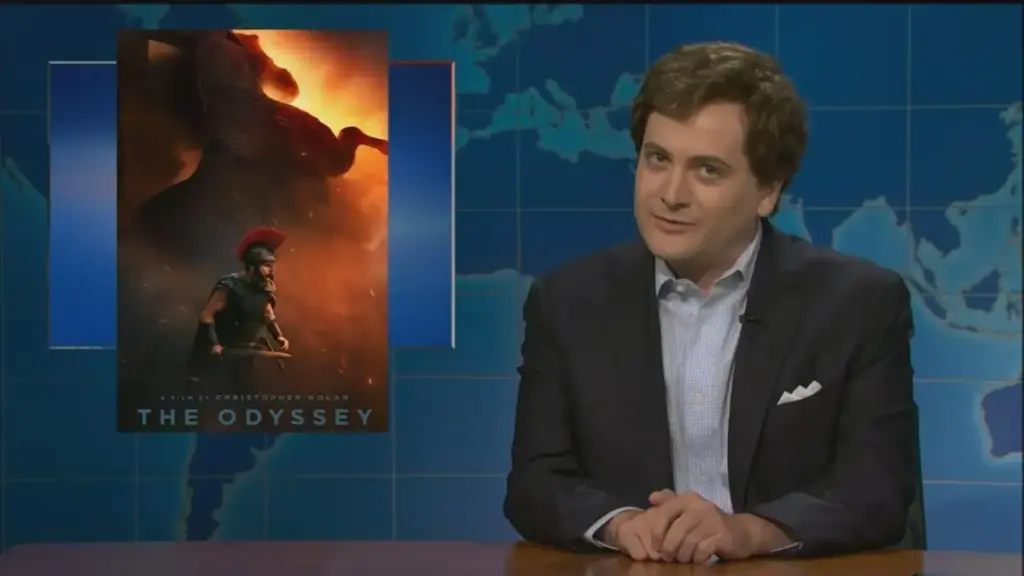
The Weekend Update segment began with standard news items before Colin Jost introduced a guest whose presence immediately shifted the comedic energy of the studio audience. Stepping up to the desk with his trademark slumped posture, furrowed brow, and wide-eyed, incredulous stare, Jeremy Culhane fully inhabited Tucker Carlson. The audience erupted into cheers, instantly recognizing the cadence and mannerisms that had made Culhane’s previous impressions a viral sensation.
Targeting the Big Screen: From IMAX to Epics
Carlson wasted no time pivoting to his primary subject for the evening: a retrospective, highly politicized review of the summer box office. He immediately zeroed in on the specialty cinematic format of IMAX 70mm, framing it through a characteristically bizarre cultural grievance.
“The Hollywood cabal shoots its filth with millimeters—or as I like to call it, the gay inch,” Carlson declared deadpan, eliciting a sharp mixture of groans and laughter from the studio audience.
Moving swiftly through his curated list of summer films, Carlson expressed a guarded appreciation for the historical epic The Odyssey. However, his endorsement came with an immediate, culturally loaded caveat:
“I like The Odyssey. It’s so nice to see Greek people do something other than make women feel uncomfortable.”
The Superhero Culture War and the "Spider-They" Gag
The centerpiece of Carlson’s cinematic critique was directed at the year’s undisputed box office juggernaut, the latest installment in the Marvel-Sony webslinging franchise. Rather than using the film’s actual title, Carlson intentionally misnamed it to mock modern conversations surrounding gender and inclusivity.
“Everybody loves Spider-Man: Brand New Gender,” Carlson announced.
When Colin Jost attempted to correct him from behind the anchor desk by noting, “That’s not what it’s called,” Carlson completely ignored the correction. Instead, he seamlessly began improvising a conservative protest anthem to the tune of the classic Spider-Man theme song:
“Spider-They, Spider-Them uses whatever bathroom it feels like.”
The bit continued as Carlson attempted to congratulate the movie’s real-life stars on their high-profile marriage, only to run into a linguistic and ideological roadblock regarding surnames.
“I now pronounce you Mr. and Mrs.—huh? She refused to take his last name.”
As Jost interjected to remind him that Zendaya “doesn’t have a last name,” Carlson spiraled down a rabbit hole of mock-existential panic:
“But where did it go? And who took it? And why? Sorry kids, you don’t get two names anymore. You only get one name, like a dog. That’s the rule. That’s the goal now.”
Romance, Politics, and a Surprise Turn on Trump
Shifting focus to the psychological thriller Obsession, Carlson framed the narrative around traditional heterosexual dynamics being treated as a threat by modern cultural institutions.
“The left’s idea of a horror movie—that a woman is forced to love a man. Oh, no, help! I’m being chased by a heterosexual relationship! Is this what we want? I don’t. Do you? You shouldn’t. But you do. Why? Is that allowed? Maybe.”
The monologue reached its chaotic climax when Carlson tied the animated feature Minions and Monsters directly to contemporary American politics. Drawing a bizarre equivalence between the yellow animated creatures and political officialdom, Carlson delivered a line that caught both the audience and co-anchor Michael Che off guard:
“That’s right. I’ve turned on Trump. I’m so brave.”
The segment concluded with a characteristically raunchy, pun-heavy jab at the forthcoming animated sequel Toy Story 5. Playing on the franchise’s iconic theme song, Carlson closed out his review with a smirk:
“You’ve got a friend in me? And his name is Woody?”
Supporting Context & Metrics: The Rise of Jeremy Culhane’s Carlson
To understand the weight of this Season 52 sketch, it is necessary to examine the trajectory of Jeremy Culhane within the Saturday Night Live ecosystem. Culhane originally debuted his Tucker Carlson impression during Season 51, a period when the show was actively reshaping its political roster following major cast departures and shifting national headlines.
The Evolution of a Viral Character
Political impressions have long served as the lifeblood of SNL’s cultural footprint. From Dana Carvey’s George H.W. Bush and Tina Fey’s Sarah Palin to Alec Baldwin’s Donald Trump and James Austin Johnson’s current iteration of the former president, the show relies on performers who can capture not just the physical appearance of public figures, but their linguistic rhythms and psychological tics.
Culhane’s Carlson immediately resonated with viewers because of his uncanny ability to capture the pundit’s signature delivery: a high-pitched incredulity paired with a deadpan stare that suggests a man trying to solve an algebra equation written in a language he does not speak.
- Debut (Season 51): Introduced as a recurring guest commentator on Weekend Update, the impression immediately went viral across TikTok, YouTube, and X (formerly Twitter).
- Sophomore Momentum: Culhane integrated tighter joke-writing into the persona, focusing less on direct historical quote-matching and more on surrealistic cultural parodies.
- Season 52 Premiere Return: Marking his third official appearance as the character, Culhane’s presence on the season opener signals that the impression has graduated from a one-off stunt to a core recurring satirical asset for the show.
Box Office Parody and Cultural Resonance
The choice to frame the Tucker Carlson segment around summer blockbusters (The Odyssey, Spider-Man, Obsession, Minions and Monsters, and Toy Story 5) was a strategic pivot by the SNL writing room. Rather than focusing strictly on cable news transcripts or congressional hearings, the sketch utilized cultural touchstones familiar to everyday moviegoers.
By filtering mainstream entertainment through the hyper-fixated, grievance-driven commentary style common in partisan media, the writers highlighted the absurdity of viewing standard pop culture artifacts through an ideological microscope. This approach broadens the comedic appeal of the sketch, making it accessible even to viewers who do not actively follow cable news media cycles.
Official Statements and Industry Reactions
Following the broadcast of the Season 52 premiere, the segment drew significant attention across digital media platforms, trade publications, and social media commentary channels.
Industry analysts noted that Saturday Night Live’s decision to lean heavily into recurring satirical characters during the Weekend Update segment represents a stabilizing creative choice for executive producer Lorne Michaels and his team. Weekend Update, anchored smoothly by Colin Jost and Michael Che, continues to serve as the structural anchor of the show, providing a reliable platform for breakout comedic talent like Culhane.
While official representatives for Tucker Carlson have historically declined to comment directly on late-night television parodies—recognizing that engagement often amplifies the reach of the satire—media critics have praised Culhane’s performance for its precision.
- Variety highlighted the segment’s sharpness, noting how Culhane successfully balances broad physical comedy with biting cultural critique.
- The Hollywood Reporter emphasized that the inclusion of the Carlson impression in the Season 52 premiere demonstrates SNL’s ongoing commitment to versatile political and media satire as the nation heads into subsequent election cycles.
- Social Media Metrics: Within 24 hours of the broadcast, the official YouTube upload of the segment accumulated hundreds of thousands of views, with clips circulating widely across short-form video platforms, confirming the enduring digital viability of Culhane’s character work.
Future Outlook: What Season 52 Holds for SNL Satire
As Saturday Night Live marches deeper into its historic 52nd season, the success of Jeremy Culhane’s Tucker Carlson impression sets a high benchmark for the show’s political and cultural commentary. The ability to seamlessly blend real-world media personalities with pop culture reviews demonstrates a maturation in the writers’ room approach to modern satire.
Looking ahead, several key questions remain regarding the trajectory of the show’s political humor:
- Expansion of Recurring Figures: Will Culhane’s Carlson be integrated into full cold-open sketches alongside other political heavyweights, or will the character remain primarily housed within the safer, more reactive confines of the Weekend Update desk?
- Evolving Media Landscapes: As independent media, streaming podcasts, and digital-first commentators continue to reshape political discourse in the United States, SNL faces the ongoing challenge of keeping its targets relevant to a rapidly fragmenting television audience.
- Cast Development: For featured players like Culhane, recurring standout bits on Weekend Update have historically served as the primary springboard toward main cast repertory status. The enthusiastic reception of his Carlson impression suggests a bright future within the institutional hierarchy of the show.
Ultimately, the Season 52 premiere proved that Saturday Night Live remains acutely attuned to the absurdities of contemporary American life. By sending up cable news talking heads through the lens of summer blockbusters, the show reaffirmed its status as a vital, enduring mirror of our cultural and political anxieties.