Executive Overview
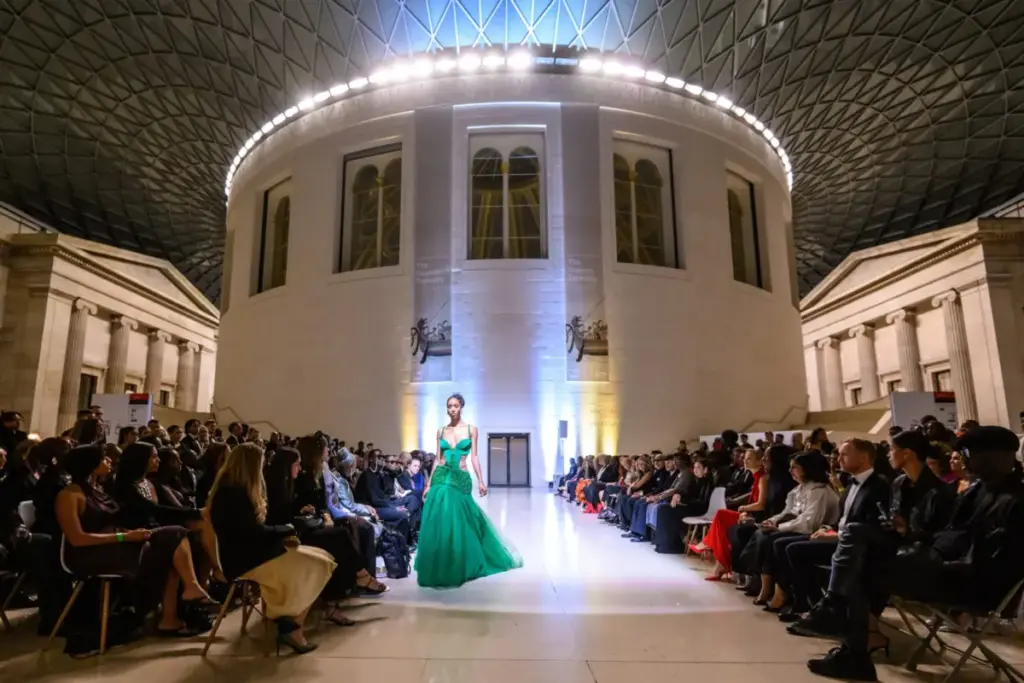
In an era defined by glowing screens, frantic livestreams, and the relentless pursuit of viral social media moments, London Fashion Week played host to an unexpected counter-movement. At the prestigious British Museum, visual discovery platform Pinterest teamed up with rising couturier Claudia Smith for her eponymous brand’s debut show, titled BEYOND R.E.G.A.R.D. Together, they executed a rare and intentional experiment: a strictly phone-free runway experience.
As 50 exclusive guests took their seats beneath the historic architecture of the museum, they were asked to place their smartphones into bespoke, ruby-red beaded bags designed collaboratively by Pinterest and Smith. For the duration of the runway presentation, screens were replaced by human presence. Attendees could not instantly tweet, story, or scroll; instead, they were forced to do something radical in modern fashion—they had to simply watch the clothes.
While luxury brands increasingly chase instant gratification—such as the "see-now, buy-now" models deployed by brands like M&S and eBay at the same fashion week—Pinterest is making a calculated bet on the exact opposite. By removing the digital barrier between the eye and the garment, Pinterest and Smith sought to capture a sacred, unhurried moment of early-stage consumer inspiration.
This partnership serves a dual purpose. For Pinterest, it represents a strategic push to cement its value among luxury houses by demonstrating how early the platform enters a designer’s creative process. For Claudia Smith—who made history as the first Black British female couturier to secure an exclusive solo partnership with the British Museum—the collaboration provided a high-profile launchpad for her architectural, gem-inspired couture. Yet, as industry experts note, trading immediate digital clout for deep, offline brand resonance carries unique risks. Will the cultural ripple effect of a phone-free show translate into long-term commercial success, or will the novelty of the activation overshadow the clothes themselves?
Detailed Chronology: How the Phone-Free Debut Unfolded
Pre-Show Conception and the Digital-to-Physical Pipeline
The genesis of BEYOND R.E.G.A.R.D. began long before guests stepped foot inside the British Museum. For Claudia Smith, a former model with a background in furniture and product design from London Metropolitan University, Pinterest was more than just a marketing tool; it was the primary infrastructure of her creative process.
Before founding her label CenturyB4 in 2021 or appearing in Nick Knight’s SHOWstudio Couture Walks series in 2023, Smith utilized Pinterest to visually organize her thoughts. She collected disparate ideas regarding color palettes, tactile textures, and striking silhouettes, eventually translating them into sculptural couture defined by intricate embroidery, cascading crystals, and meticulous beading.
The collection itself draws heavy historical inspiration from the traditional "Alphabet of Gems"—a Victorian-era concept where gemstones were utilized to encode private messages.
"Pinterest gave me a space to explore that language visually and intuitively before it became couture," Smith explained in an interview.
Recognizing this deeply symbiotic relationship, Pinterest approached Smith with a proposition: they would sponsor and curate a phone-free format for her official namesake label debut on September 20.
The Runway Experience: Immersed in the Present
On Sunday, the theory of unplugged inspiration was put into practice. Fifty carefully curated guests arrived at the British Museum. As they took their seats, they were handed the custom ruby-red beaded bags—designed to be kept as permanent mementos of the evening.
As the first look emerged, the typical sea of raised smartphones, glowing screens, and blocked sightlines was entirely absent. Assigned professional photographers stationed at the end of the runway captured every angle of the 12-look collection. To ensure guests didn’t leave empty-handed digitally, a discreet QR code placed on each seat granted them access to the official imagery immediately following the show.
Rules relaxed slightly toward the end of the presentation: guests were permitted to retrieve their phones for the finale, where all 12 sculptural looks appeared simultaneously, and keep them out for the post-show celebration. However, the core of the presentation—the intimate introduction to the collection—occurred entirely offline.
Supporting Context & Metrics: The Economics of Early-Stage Inspiration
Rethinking the Consumer Journey
While the prevailing commercial current at London Fashion Week leaned heavily toward instantaneous conversion—such as M&S streaming its debut for immediate purchase and eBay’s Endless Runway allowing live-stream shopping—Pinterest’s strategy operated on a entirely different timeline.
According to Heather Clark, head of fashion and luxury at Pinterest U.K., the phone-free initiative was designed to mirror how consumers naturally interact with the Pinterest platform: during the early, unbranded phases of taste formation.
Pinterest data reveals a staggering statistic: 96% of searches on the platform are unbranded. This means that the vast majority of users are browsing for broad concepts—such as "sculptural couture," "ruby beading," or "historic gemstone palettes"—long before they have decided which specific designer or label to purchase from.
"They’re very interested in being there while taste is still forming, before the brand preference is fixed," Clark noted, describing the mindset of the luxury brands that partner with the platform. Luxury houses, she emphasized, are increasingly seeking "more than reach." They want to understand the psychological arc of a consumer—specifically, whether images discovered and saved on digital mood boards months prior ultimately dictate high-value luxury acquisitions down the road.
Evaluating Success Without Immediate Sales Targets
Despite the high-profile nature of the activation, Pinterest did not establish rigid pre-show benchmarks or direct sales targets. The company did not disclose the financial investment required to sponsor the show, nor has it immediately reported whether the partnership yielded concrete customer inquiries or direct B2B client acquisition for Smith.
Instead, the success of the activation is being measured through a layered matrix of qualitative and quantitative metrics:
- Platform Engagement: Pinterest will actively track whether Smith’s dedicated boards experience an uptick in saves, follower growth, and overall engagement following the upload of the runway photography.
- Cultural Resonance: The company is evaluating the broader cultural footprint of the event. Did the phone-free show register as a defining, standout moment of London Fashion Week?
- Media and Peer Conversation: Beyond platform analytics, Pinterest’s marketing team is monitoring industry discourse across trade publications like FashionNetwork, Luxury London, and professional networks like LinkedIn.
Clark acknowledged that the inspiration for the London Fashion Week activation partly stemmed from Pinterest’s previous phone-free experiments, such as those tested at the Coachella Valley Music and Arts Festival.
Official Statements and Industry Perspectives
The Pinterest Perspective: Purposeful Friction
For Pinterest, introducing friction into a hyper-connected environment was a deliberate play to alter consumer behavior. Heather Clark highlighted the deeply ingrained, almost compulsive nature of digital documentation at modern events.
"People being on phones in fashion shows is a reflex," Clark told Glossy. While many designers privately express a desire for audiences to put their devices away once the lights dim, Clark remained realistic about the power of modern tech habits: "I’m not as optimistic about that happening […] without an invitation."
While luxury giants like The Row have previously enforced no-phone policies to protect the exclusivity of their presentations, Pinterest sought to elevate the concept by turning the restriction into an interactive, branded touchpoint via the custom beaded bags.
The Designer’s Dilemma: Balancing Buzz with Business
For Claudia Smith, stepping onto the international fashion stage as the first Black British female couturier to partner exclusively with the British Museum carried profound significance. Yet, transitioning from an independent digital creator to a premier physical house requires navigating delicate commercial realities.
Hannah Alley, a luxury marketing consultant and former brand partnerships manager at Selfridges, offered a cautionary perspective on the risks inherent in high-concept stunts for emerging labels.
"You want people leaving with Claudia Smith in their heads rather than simply the buzz of ‘the Pinterest phone-free show,’" Alley warned.
The ultimate test for Smith’s brand will not be how many column inches are dedicated to the phone-free beaded bags, but whether wealthy clients and buyers inquire about the clothes, request private viewings, and book appointments.
Smith herself remains grounded in this long-term vision. Reflecting on the debut, she emphasized that while digital platforms played an instrumental role in her creative genesis, physical execution remains paramount.
"Attention [from Pinterest] has its place for the brand, but what matters more is whether this debut establishes a true foundation for the house," Smith stated.
Future Outlook: The Ripple Effect on Luxury Marketing
As the dust settles on London Fashion Week, the partnership between Pinterest and Claudia Smith offers a compelling glimpse into the evolving dynamics between tech platforms and high-end fashion houses.
By demonstrating that luxury marketing can pivot away from instantaneous, screen-mediated validation toward immersive, present-moment engagement, Pinterest has carved out a unique positioning. The experiment suggests that the future of luxury discovery may not solely lie in shortening the distance between the runway and the checkout cart, but rather in capturing the imagination of the consumer months before a purchase is even conceptualized.
Whether other luxury houses will follow Pinterest’s lead in enforcing phone-free environments remains to be seen. However, the cultural ripple effect of BEYOND R.E.G.A.R.D. has successfully sparked a much-needed industry-wide conversation about presence, attention, and the true value of a shared physical experience in an increasingly digitized world. For Claudia Smith, the show has laid down an unmistakable marker: a brilliant intersection of historical narrative, digital intuition, and uncompromised physical artistry.