Executive Overview
For decades, Jennifer Aniston has stood as an enduring icon of Hollywood glamour, cultural influence, and timeless vitality. Yet, her most enduring legacy may no longer be defined solely by her iconic television and film roles, but rather by her evolution as an authoritative voice in modern health and wellness. In an era saturated with extreme fitness fads, rapid-fire weight-loss promises, and the exhausting cultural mantra of "no pain, no gain," Aniston has gracefully pivoted toward a philosophy rooted in longevity, sustainability, and functional strength.
Central to this paradigm shift is her longtime dedication to Pvolve, an innovative functional fitness program that emphasizes controlled resistance, intentional movement, and biomechanical efficiency. Breaking away from the high-impact, joint-punishing routines of her earlier career, Aniston has embraced a methodology designed to support everyday life, optimize physical performance, and protect the body over the long haul.
This comprehensive report explores the scientific principles underlying functional fitness, analyzes the strategic shift in Aniston’s personal health philosophy, details her signature arms-and-abs training routine, and examines the broader cultural implications of moving away from aesthetic-driven punishment toward sustainable physical autonomy.
Detailed Chronology: From High-Impact Exhaustion to Sustainable Functional Movement
The Early Decades: The Era of "No Pain, No Gain"
To fully appreciate Jennifer Aniston’s current wellness philosophy, one must understand the landscape of physical fitness that dominated the entertainment industry through the late 1990s and 2000s. During the height of Friends and her subsequent box-office successes, Aniston, like many high-profile performers, subscribed to the traditional Hollywood fitness dogma. This era was characterized by grueling, high-intensity cardiovascular regimens, heavy reliance on momentum, repetitive impact running, and punishing strength workouts designed primarily for immediate aesthetic results rather than structural integrity.
Reflecting on those years, Aniston has been candid about the physical and mental toll of her former regimen. "I used to look at workouts where it had to be this intense, ‘no pain, no gain’ situation," she shares. This mindset, while common, frequently led to burnout, joint inflammation, and an unsustainable relationship with exercise—where physical activity felt less like self-care and more like a daily penance.
The Turning Point: The Search for Longevity
As fitness science evolved in the 2010s and 2020s, a broader cultural awakening began to challenge the "crush yourself" workout mentality. Exercise physiologists and physical therapists increasingly emphasized joint health, movement quality, and neuromuscular connection over sheer caloric burn.
For Aniston, this shift coincided with a personal reassessment of what her body needed to maintain its vitality while navigating a demanding professional schedule. The realization was simple yet profound: fitness should enhance life, not deplete it. This realization prompted her to step away from joint-degrading high-impact routines and gravitate toward methodologies that prioritized structural longevity.
The Pvolve Partnership: A Paradigm Shift in Resistance Training
Aniston’s formal integration into the Pvolve ecosystem marked a significant milestone in her wellness journey. Initially drawn to the method as a client seeking relief from past injuries and a smarter way to condition her body, her relationship with the brand deepened over the years, ultimately culminating in an active partnership as both a practitioner and a creative collaborator.
Pvolve’s methodology diverges sharply from traditional weightlifting or generic calisthenics. By utilizing specialized resistance bands, stability equipment, and controlled micro-movements, the program targets underactive stabilizing muscles that traditional gym routines frequently ignore. For Aniston, this style of functional training provided the missing link: a way to build lean muscle mass, protect her joints, and cultivate core stability without running herself into the ground.
Supporting Context & Metrics: The Science of Functional Fitness
To understand why Aniston’s current routine yields such profound physical and mental results, it is necessary to examine the underlying exercise science. Functional fitness is fundamentally designed to train and develop your muscles to make it easier and safer to perform daily activities—such as carrying groceries, picking up children, maintaining proper posture at a desk, or preventing slips and falls.
The Three Planes of Motion
Traditional weight training often occurs primarily in the sagittal plane (forward and backward movements like bicep curls or standard squats). However, human life happens across all three dimensions. Dani Coleman, Aniston’s personal trainer and vice president of training at Pvolve, emphasizes the importance of multidimensional conditioning.
“We build upper body and core strength through progressive overload, resistance, and dynamic movement in all three planes of motion,” Coleman explains.
By incorporating transverse (rotational) and frontal (side-to-side) movements, practitioners build robust joint capsules, improve bone density, and enhance neuromuscular coordination, drastically reducing the risk of injury both inside and outside the gym.
The Psychology of Consistency Over Intensity
From a physiological perspective, consistency trumps intensity every single time. A moderate workout performed four to five times a week yields far greater cumulative cardiovascular, metabolic, and musculoskeletal benefits than an all-out, punishing workout performed once every ten days followed by days of debilitating soreness.
Aniston notes that her internal metric for success is no longer how exhausted she feels after a session, but rather how the movement influences her daily life.
- Mood Regulation: Exercise stimulates the release of endorphins and neurotransmitters like serotonin and dopamine, buffering against stress and anxiety.
- Sustained Energy: Proper cardiovascular and muscular conditioning improves mitochondrial density, enhancing cellular energy production and fighting afternoon fatigue.
- Body Composition & Posture: Sustainable resistance training preserves lean muscle tissue, supports metabolic health, and prevents the structural degradation associated with sedentary lifestyles.
“When I don’t work out, I feel such a difference,” Aniston admits. “My mood dips, I don’t have as much endurance during the day, my clothes fit differently. You just don’t feel good because you’re not being good to yourself.”
Official Statements and Expert Insights
Dani Coleman on Intentional Movement and Core Supremacy
The philosophy behind Aniston’s routine is anchored in precision. According to Dani Coleman, the primary differentiator between casual exercising and transformative functional training is intentionality.
Rather than relying on momentum or rushing through repetitions to finish a set, practitioners are instructed to focus intently on the specific muscle fibers engaged in the movement.
“By focusing on the muscles doing the work, you can develop intentional strength that not only improves performance in your workouts, but also helps you look and feel your best in daily life,” says Coleman.
This mind-muscle connection ensures that stabilizing muscles—particularly deep core stabilizers like the transversus abdominis—are fully recruited, maximizing the efficiency of every session.
Jennifer Aniston on Simplicity and the 15-Minute Rule
One of the greatest barriers to regular physical activity is the psychological friction of time management. Many individuals skip workouts because they feel they do not have a dedicated hour to spare. Aniston combats this hurdle through radical simplification.
“Wake up 15 minutes earlier and get it in. When you simplify it for yourself, it makes it more digestible,” she advises.
By shrinking the barrier to entry, Aniston maintains her routine even during intense filming schedules, promotional tours, and international travel. This micro-habit approach proves that consistency does not require hours in a commercial gym; it requires psychological flexibility and intentional commitment.
Jennifer Aniston’s Signature Arms and Abs Routine
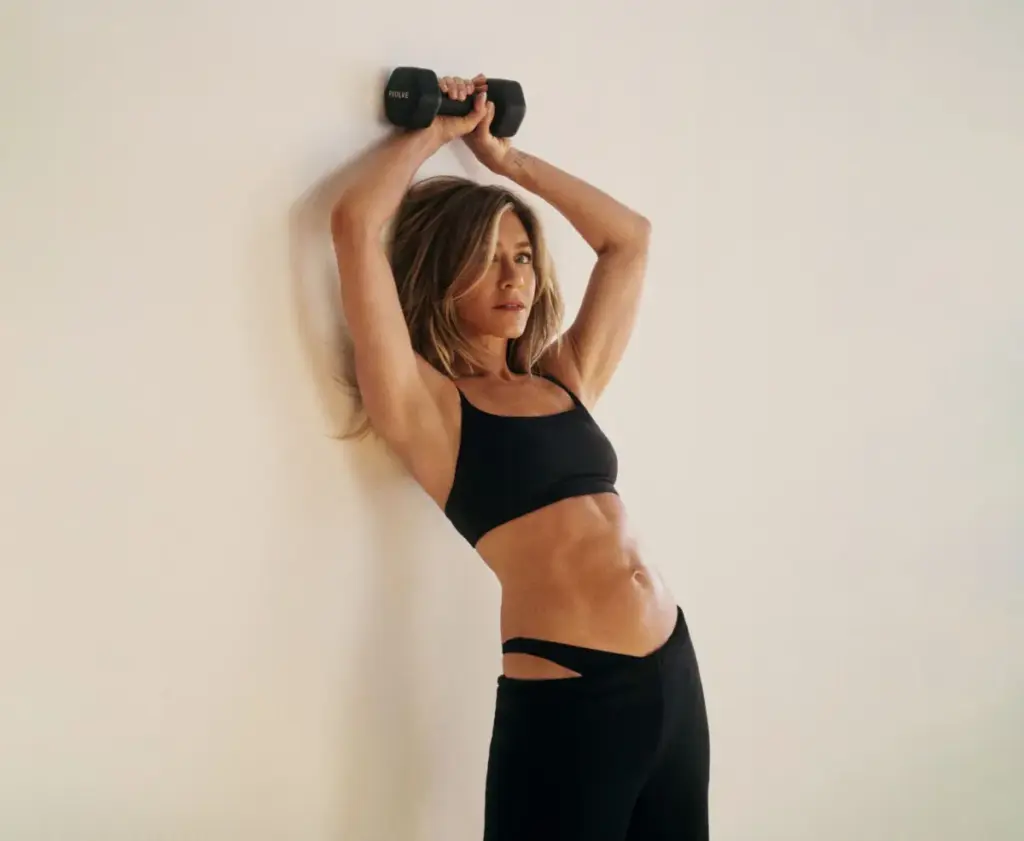
As the absolute center of gravity for physical balance, rotation, and structural support, the core plays a vital role in Aniston’s training philosophy. “This routine specifically targets arms and abs because that’s sort of our center of gravity—and our arms are what we see a lot,” Aniston notes. “And I love a strong core. For me, core is everything.”
Below is a detailed breakdown of the favorite Pvolve movements that Aniston incorporates into her regimen to build functional strength, mobility, and stability.
Equipment Required
To properly execute this routine, practitioners will need:
- A high-density yoga or exercise mat
- A stability ball
- A Pvolve resistance band or standard fitness resistance band
1. Curl Over Ball
- Objective: Strengthens the abdominal wall through an extended range of motion while safeguarding the lumbar spine.
- Execution: Position the lower back comfortably over a stability ball. Engage the core, draw the ribs toward the hips, and execute a controlled spinal curl, lifting the upper torso while maintaining continuous tension on the abdominal muscles.
- Trainer Insight: “This move strengthens the abs through a fuller range of motion while the ball supports the lower back,” says Coleman.
2. Elevated Deadbug
- Objective: Enhances deep core stability, bilateral coordination, and neuromuscular control.
- Execution: Lying supine on the mat with knees bent at a 90-degree angle (often elevated on a platform or ball for increased challenge), slowly lower opposite arms and legs toward the floor while keeping the lower back firmly pressed into the mat.
- Trainer Insight: “This is a powerful core stability move that improves coordination and teaches the body to stay steady while the arms and legs move in tandem,” notes Coleman.
3. Golf Swing
- Objective: Targets the oblique musculature while engaging the outer hips to promote rotational stability and balance.
- Execution: Utilizing a resistance band anchored securely, assume an athletic stance and execute a controlled, rotational twisting movement mimicking a golf swing. The power must originate from the core and hips rather than the lower back or arms.
- Trainer Insight: “This is a dynamic core exercise that strengthens the obliques while activating the outer hips for improved balance and stability,” explains Coleman.
4. Stability Ball Plank
- Objective: Elevates the classic isometric plank by introducing structural instability, forcing deep core and shoulder stabilizers to recruit maximal muscle fibers.
- Execution: Place forearms atop a stability ball while balancing in a standard plank position. Maintain a neutral spine, avoiding any sagging in the hips or lifting of the glutes, while resisting the natural roll of the ball.
- Trainer Insight: “This exercise takes the classic plank up a notch by adding instability, forcing the core to work harder to stay controlled,” says Coleman.
5. Prone Back Extension With Lat Pull
- Objective: Counteracts the postural deterioration associated with prolonged sitting by strengthening the posterior chain, thoracic spine, and latissimus dorsi.
- Execution: Lying face down on the mat, lift the chest slightly off the floor while engaging the glutes and lower back muscles, simultaneously pulling the elbows down toward the ribs in a simulated lat pull movement.
- Trainer Insight: “This targets the muscles along the spine to build back strength, support better posture, and counteract the effects of long hours of sitting,” states Coleman.
Future Outlook: The Evolution of Celebrity Wellness Culture
Jennifer Aniston’s long-term endorsement and personal evolution with functional fitness signal a broader, highly encouraging transformation in modern celebrity wellness culture. For decades, public figures were pressured to promote rapid transformations, extreme caloric restriction, and punishing exercise regimens that set unrealistic and dangerous standards for the general public.
As consumers become more sophisticated and health literacy improves, the demand for sustainable, scientifically backed wellness practices has skyrocketed. Aniston’s partnership with Pvolve and her vocal advocacy for mental well-being, consistency, and body listening represent a mature phase in cultural health discourse.
Looking forward, the metrics of success in personal fitness are shifting permanently away from aesthetic conformity and toward functional longevity. By demonstrating that strength, mobility, and vitality can be cultivated through manageable, intentional movements rather than physical exhaustion, Jennifer Aniston continues to redefine what it means to age gracefully, powerfully, and vibrantly in the public eye.