Executive Overview
The advent of GLP-1 receptor agonists—such as Mounjaro, Wegovy, and Ozempic—has fundamentally transformed the global landscape of weight management. Millions of individuals are now experiencing unprecedented success in shedding excess pounds, effectively rewriting the medical and societal playbook on obesity. However, rapid weight loss rarely comes without a physiological trade-off. Beneath the headline-grabbing statistics of pounds lost lies a critical, yet frequently overlooked, concern: the concurrent loss of lean muscle mass and bone density.
When the body enters a steep caloric deficit facilitated by medication, it does not discriminate strictly between adipose tissue (fat) and functional muscle tissue. Without targeted intervention, up to 40% of the weight lost on severe caloric restriction can originate from lean mass. For individuals in their 40s, 50s, and beyond—a demographic already battling age-related sarcopenia and declining bone mineral density—this muscle attrition can have severe consequences for long-term health, metabolic rate, and functional independence.
This report explores the vital intersection of GLP-1 pharmacotherapy and resistance training. Through a detailed case study, expert physiological analysis, and a specialized, full-body kettlebell conditioning program, we examine how intentional strength training can safeguard muscle tissue, enhance physical confidence, and secure enduring metabolic health during and after medical weight loss.
Detailed Chronology: A Patient’s Journey from Inactivity to Empowerment
To understand the transformative power of coupling GLP-1 medications with resistance training, one must look at real-world application.
Month 0: The Starting Line
Approximately one year ago, a female client walked into a community circuits class with a unique background: she had never engaged in structured exercise or resistance training in her life. Having successfully lost 59.5 lbs (27 kg) utilizing the weight-loss medication Mounjaro, she arrived seeking a way to reclaim her physical agency.
Her initial presentation highlighted a common psychological and physical paradox of rapid weight loss. While the scale reflected immense progress, her physical reality felt foreign. She described her body as feeling "very soft." Even routine daily actions, such as sitting down on a hard chair, had become physically uncomfortable due to the sudden reduction of natural fat padding. More concerning to her, however, was a palpable sense of muscular depletion. She felt weak, lacked physical resilience, and doubted her ability to survive an hour-long, high-intensity exercise class.
Month 1 to Month 3: Breaking the Barrier
Facing profound intimidation, she stepped onto the gym floor. Despite her initial fears, she completed the entire 60-minute session. Buoyed by the supportive environment and a growing internal drive, she did not wait until the following week; she returned for two more classes within those same seven days.
During these foundational weeks, the focus was not on maximum loads, but on movement patterns, body awareness, and nervous system adaptation. Simple movement mechanics—learning how to hinge at the hips, squat with proper depth, and engage the core—served as the building blocks for her physical reinvention.
Month 4 to Month 9: The Metabolic and Structural Transformation
Fast forward to the present day: this client has maintained an unyielding consistency of three classes per week for over nine months. Her personal evolution has broken past mere weight loss into the realm of true physical conditioning.
- Physical Changes: Her body composition has experienced a radical shift. She has developed visible muscle definition in her shoulders, back, and legs. The "softness" she initially lamented has been replaced by firm, resilient lean tissue.
- Symptom Alleviation: Chronic lower back pain—a frequent byproduct of weak glutes, a deconditioned core, and altered posture—has significantly subsided.
- Psychological Impact: Beyond the physical metrics, her self-efficacy has soared. She navigates everyday physical tasks with ease and approaches new challenges with athletic confidence. Her journey underscores a vital truth: pharmacotherapy can open the door to weight loss, but physical training is what makes that new body functional and sustainable.
Supporting Context & Metrics: The Science of Muscle Preservation on GLP-1s
To fully grasp why the integration of strength training is non-negotiable for GLP-1 users, one must analyze the underlying physiology of weight loss.
The Anatomy of Caloric Deficit
GLP-1 receptor agonists work primarily by mimicking the incretin hormone glucagon-like peptide-1, which suppresses appetite, slows gastric emptying, and targets areas of the brain that regulate appetite and food intake. While remarkably effective at creating the caloric deficit necessary for weight loss, this rapid reduction in energy intake triggers adaptive thermogenesis.
When the body perceives a prolonged energy shortage, it looks for ways to conserve energy. Because maintaining metabolically active muscle tissue demands significant caloric expenditure, the body readily catabolizes (breaks down) muscle protein for energy alongside fat stores.
The Double Threat of Aging
For adults over the age of 40, this process is exacerbated by natural biological shifts:
- Sarcopenia: Humans naturally begin to lose muscle mass and strength at a rate of roughly 3% to 8% per decade after the age of 30, a decline that accelerates past age 60.
- Osteopenia and Osteoporosis: Bone mineral density similarly begins a gradual descent, particularly in post-menopausal women due to falling estrogen levels.
When rapid pharmaceutical-assisted weight loss is superimposed over this natural decline, the risk of developing functional limitations skyrockets. Losing weight without preserving muscle leads to a lower basal metabolic rate (BMR), making weight regain (the infamous "rebound effect" or metabolic slowdown) much more likely once the medication is tapered or stopped. Furthermore, lower muscle mass correlates directly with poorer balance, higher fall risks, and increased frailty later in life.
The Protective Shield of Resistance Training and Protein
Clinical guidelines increasingly recommend concurrent resistance training and a high-protein diet for patients prescribed anti-obesity medications.
- Mechanical Tension: Resistance training applies mechanical tension to muscle fibers, signaling the central nervous system and endocrine system that the tissue is actively required for survival and function. This "use it or lose it" signal protects lean tissue from being broken down for energy.
- Nutritional Synergy: Pairing this training stimulus with adequate protein intake provides the necessary amino acids (specifically leucine) to stimulate muscle protein synthesis, ensuring the body repairs and builds stronger fibers even while operating in a net caloric deficit.
Official Statements and Expert Perspectives
Fitness professionals, endocrinologists, and bariatric specialists are increasingly vocal about the need for a multidisciplinary approach to weight-loss management.
Dr. Robert Sterling, a leading metabolic health physician, notes: "GLP-1 medications are arguably the most powerful pharmaceutical tools we have ever introduced to combat the obesity epidemic. However, prescribing them in isolation—without addressing physical activity, and specifically resistance training—is an incomplete intervention. We risk trading obesity for sarcopenic obesity, a condition characterized by low muscle mass combined with high fat percentage, which carries its own severe health risks."
Strength coaches working directly with this demographic echo these sentiments. Physical conditioning experts emphasize that patients must shift their mindset away from simply watching the digits on the bathroom scale drop.
"The goal shouldn’t just be to weigh less; the goal should be to be stronger, more stable, and more metabolically robust," explains lead fitness educator and circuit trainer Sarah Jenkins. "When our clients embrace resistance training, they realize that their bodies are capable of incredible transformations. They stop feeling fragile and start feeling athletic."
Future Outlook: Integrating Fitness into the GLP-1 Era
As the societal adoption of GLP-1 medications continues to expand into mainstream healthcare, the fitness industry must evolve to meet the unique needs of this demographic. The future of weight management will no longer belong to endless cardio sessions or extreme, muscle-wasting starvation diets. Instead, it will be defined by intelligent, structured resistance training protocols tailored to protect metabolic health.
Healthcare providers, nutritionists, and personal trainers must forge collaborative ecosystems. Patients stepping onto a weight-loss medication regimen should, as a standard protocol, receive a concurrent prescription for resistance training.
By prioritizing muscle preservation, we ensure that the millions of individuals transforming their bodies today are building a foundation of strength, mobility, and vitality that will support them for decades to come.
The Full-Body Kettlebell Workout for GLP-1 Users
To bridge the gap between theory and practical application, the following full-body kettlebell routine has been specifically designed to build strength, stability, and functional fitness for individuals navigating weight loss on GLP-1 medications.
Why Kettlebells?
The design of a kettlebell is inherently unique: its center of mass sits away from the handle, creating a continuous destabilizing force. This requires your stabilizing muscles to work overtime to control the weight. Consequently, kettlebell training recruits a vast array of secondary and stabilizing muscles, making it an extraordinarily efficient tool for building all-over functional strength, core stability, and neuromuscular coordination.
Workout Guidelines
- Equipment Needed: A medium-to-heavy kettlebell for lower-body and pulling movements, and a slightly lighter kettlebell for overhead pressing (depending on your individual strength level).
- Protocol: Perform each exercise for 40 seconds, followed by 20 seconds of complete rest before transitioning to the next movement.
- Volume: Complete the entire circuit 3 to 5 times, depending on your fitness level and experience.
Exercise Guides
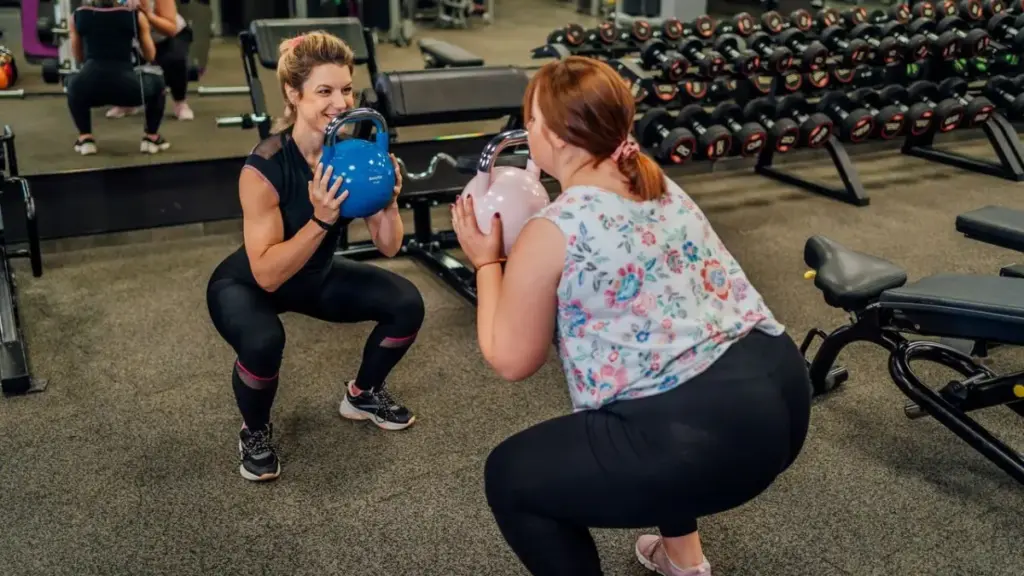
1. Goblet Squat
- Time: 40 seconds | Rest: 20 seconds
- How to do it: Hold the kettlebell by the horns (the sides of the handle) close to your chest with your elbows pointing down. Stand with your feet slightly wider than shoulder-width apart. Inhale as you push your hips back and bend your knees, lowering your torso into a deep squat while keeping your chest proud and heels flat on the floor. Drive through your mid-foot to return to the starting position.
- Why: Squats target the major lower-body muscle groups—including the quadriceps, glutes, and hamstrings. These muscles are vital for maintaining functional independence during weight loss. Building lower-body strength makes everyday physical tasks, such as climbing stairs, standing up from a chair, and carrying groceries, considerably easier and safer.
2. Romanian Deadlift
- Time: 40 seconds | Rest: 20 seconds
- How to do it: Stand tall holding the kettlebell with both hands in front of your thighs. Keeping a soft bend in your knees and a neutral spine, hinge backward at your hips, sending your glutes toward the wall behind you. Lower the kettlebell down the front of your shins until you feel a deep stretch in your hamstrings. Squeeze your glutes to drive your hips forward and return to the starting position.
- Why: The Romanian deadlift focuses on the posterior chain—the powerful muscles running down the backside of your body, including the glutes and hamstrings. Strengthening these muscles encourages your body to retain lean tissue during a caloric deficit. It also builds core and spinal stability, improving movement efficiency and keeping you active and mobile.
3. Single-Arm Row
- Time: 40 seconds per side | Rest: 20 seconds
- How to do it: Place your left hand and left knee on a sturdy bench or chair, keeping your back flat and parallel to the floor. Hold the kettlebell in your right hand hanging straight down. Pull your elbow up and back toward your hip, squeezing your shoulder blade at the top of the movement. Lower the weight slowly with control. Switch sides after 40 seconds.
- Why: The single-arm row targets muscles frequently neglected during standard weight-loss routines: the upper back, shoulders, and lats. Pulling against a challenging load generates mechanical tension, signaling your body that upper-body muscle tissue is essential and must be preserved, even during rapid weight reduction.
4. Goblet Reverse Lunge
- Time: 40 seconds | Rest: 20 seconds
- How to do it: Hold the kettlebell securely at your chest in the goblet position. Stand tall with your feet hip-width apart. Take a large step backward with your right foot and lower your hips until both knees are bent at approximately a 90-degree angle. Push off your front foot to return to the standing position, then alternate legs.
- Why: Like squats and deadlifts, reverse lunges recruit the glutes and quadriceps while introducing an element of unilateral (single-leg) stability. This improves balance, corrects left-to-right strength imbalances, and reinforces lower-body muscle retention.
5. Single-Arm Overhead Press
- Time: 40 seconds per side | Rest: 20 seconds
- How to do it: Hold a lighter kettlebell in the "rack" position—resting against the back of your forearm and shoulder, with your elbow tucked in close to your ribs. Brace your core tightly, squeeze your glutes, and press the kettlebell straight overhead until your arm is fully extended. Lower it back down with absolute control to the rack position. Complete all reps on one side before switching.
- Why: The overhead press builds robust shoulder stability, tricep strength, and core integration. Because pressing overhead requires total-body tension, it challenges the nervous system and stimulates upper-body muscle retention, ensuring balanced physical development as your weight-loss journey progresses.