Executive Overview
In January, when most of Northern Europe retreats indoors to escape the biting midwinter freeze, Jonny Holmes and Eline Joling made a life-altering pivot. Swapping the comfort of their stable jobs and apartment in Bristol, UK, for the unknown, the couple packed a minimalist existence onto two touring bicycles: a tent, three changes of clothes each, a water filter, a camp stove, and an insatiable appetite for the horizon.
Their objective was clear, if daunting: cycle unsupported from the bustling, high-altitude sprawl of Bogotá, Colombia, down to Ushuaia, Argentina—the southernmost city on Earth, standing as a windswept threshold where South America meets the Antarctic.
Eight months and over 14,000 kilometers later, Holmes and Joling have traversed grueling mountain passes, weathered torrential Andean downpours, tasted the vibrant street food of culinary capitals, and navigated the delicate, punishing realities of high-altitude travel. Their journey is more than a personal rite of passage; it serves as a vivid case study in the booming global phenomenon of "slow tourism" and bikepacking—a self-supported travel discipline blending off-road cycling with lightweight camping.

As the global adventure travel market commands hundreds of billions of dollars, ordinary travelers like Holmes and Joling are proving that transformative travel is less about luxury and ticking off checklist landmarks, and more about the raw, unfiltered "in-between" moments that traditional transport completely misses.
Detailed Chronology: From the Equatorial Highlands to the Salt Flats
The Launch: Bogotá and the Kindness of Strangers
The expedition commenced on January 16, kicking off with an arrival in Colombia’s sprawling capital, Bogotá. Within days, the harsh realities and profound rewards of South American geography introduced themselves.
In a remote, nameless mountain village deep in the Colombian interior, the cyclists experienced their first taste of local hospitality. Welcomed by residents who poured traditional tinto coffee and grated tennis-ball-sized chunks of raw sugar directly into their mugs, a local woman named Soyla invited the weary travelers into her home to wash off the mountain dust and enjoy fresh fruit.

"People might not have much here," Holmes and Joling reflect, "but whatever they have, they’ll share."
That initial warmth was counterbalanced instantly by the terrain. On one of their earliest days navigating the mountainous Colombian interior, the duo was caught in a torrential downpour. Confronted by a flooded, rocky road skirting a sheer cliff edge—where a single miscalculation meant a catastrophic drop—their panic dissolved into bemusement when a local motorcyclist casually pulled over, hoisted both heavily laden touring bikes onto his shoulders, and waded effortlessly across. It was a humbling baptism by fire, casting immediate doubt on their life choices while simultaneously cementing the kindness of the locals as a foundational pillar of the trip.
Ecuador: Andean Splendor and the Equator
Pushing south into Ecuador, the journey unfolded across striking contrasts. The couple rolled through Cuenca, a UNESCO World Heritage city famed for its immaculate Spanish colonial architecture, leafy central squares, and relaxed Andean pace of life.

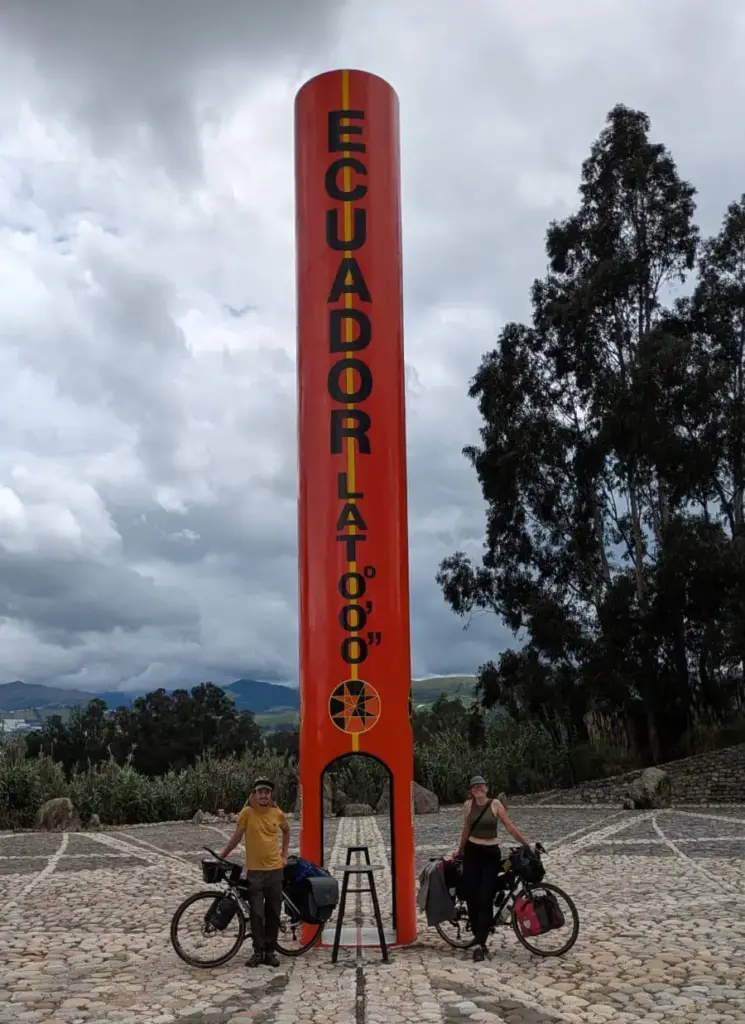
Just beyond the city limits lay Cajas National Park, a rugged, high-altitude nature reserve punctuated by glassy glacial lakes. Words, the cyclists note, fail to capture the atmospheric majesty of the park, where weather systems shift by the hour. Further along their Ecuadorean leg, they paused at the literal center of the Earth to straddle the equator before winding through the El Ángel Ecological Reserve, surrounded by alien, towering frailejón plants that create an ecosystem feeling more primeval than modern.
Peru: Culinary Delights and High-Altitude Reality Checks
Crossing into Peru, the topography shifted dramatically once more. The route took them along the sun-bleached northwest coast through the surf town of Máncora, before climbing steeply toward Cusco, the historic heart of the Inca Empire and the geographical gateway to Machu Picchu, the Sacred Valley, and Rainbow Mountain.
It was in Peru, however, that the expedition met its most formidable physical barrier. The route across the legendary Peru Great Divide—a brutal 1,600-kilometer dirt-road touring trail widely celebrated as one of the premier cycling routes on the continent—proved too punishing to complete in full. While the high-altitude vistas of the Peruvian Andes were nothing short of breathtaking, the severe threat of altitude sickness forced the couple to alter their itinerary. With the highest points soaring to an unforgiving 16,372 feet above sea level, physiological limits forced a pragmatic retreat from the highest ridges.

Bolivia: The Mirror of the World
Eight months into the expedition, Holmes and Joling achieved one of the major milestones of their route: crossing the Salar de Uyuni in Bolivia. Spanning an astonishing 3,860 square miles, the world’s largest salt flat is a geological marvel formed by the evaporation of prehistoric lakes.
During the dry season, the landscape transforms into an endless, blindingly white crust of crystallized salt. In the winter months, however, seasonal rains coat the surface with a thin layer of water, turning the massive flat into the world’s largest natural mirror, reflecting the sky with seamless perfection. Traversing this surreal expanse on two wheels stands out as one of the definitive visual masterpieces of the entire journey.
Supporting Context & Metrics: The Economics of Bikepacking
While the physical demands of long-distance cycling are monumental, the financial reality of executing a year-long South American expedition surprises many observers.

Budgeting on Two Wheels
Outside of the initial transatlantic flight—with one-way direct fares from Europe to Colombia averaging roughly £510—South America operates as an exceptionally affordable destination for self-supported travelers.
- Lodging: Basic local hotels frequently charge as little as £5 per night, while wild camping in the vast, unpopulated rural expanses remains entirely free.
- Nutrition: Dining along the route is remarkably budget-friendly. In rural areas, hearty, calorie-dense street meals routinely cost around £2 per person.
This low cost of living allows travelers to stretch their savings, transforming a luxury-tier travel budget into a multi-year expedition fund.
The Culinary Renaissance
South America’s gastronomic reputation has undergone a seismic shift in recent years. Lima, Peru’s coastal capital, was recently crowned the world’s best city for food, drawing global praise for its innovative fusion cuisine and deep-rooted culinary traditions.

For bikepackers burning thousands of calories a day, however, the real treasure lies in roadside and street-side culinary staples:
- Pork Chicharrón: Crispy, golden-fried pork belly seasoned generously with salt and local spices.
- Trucha Frita: Whole freshwater trout harvested from Andean streams, marinated in fresh lime juice, garlic, salt, pepper, and cumin, then deep-fried.
While undeniably greasy and heavy, these dishes provide the vital caloric surplus required for mountain ascents, all while keeping food expenditure to a minimum.
Essential Gear: What to Pack and What to Drop
The learning curve for lightweight travel is notoriously steep. Holmes and Joling admitted to starting their journey weighed down by unnecessary home comforts, including dedicated camp chairs and travel pillows. Within weeks, both items were abandoned, swapped for natural rock faces and spare clothing rolled up to serve as cushions.

However, survival and safety depend on a strictly vetted list of non-negotiables:
- Water Purification: A reliable, high-grade water filter is mandatory to combat waterborne pathogens in remote areas.
- Camp Stoves: Essential for boiling water and cooking high-energy meals when civilization is days away.
- Satellite Communication: The single most critical piece of equipment is a Garmin inReach Mini. This pocket-sized satellite communicator enables two-way text messaging, real-time GPS location tracking, and—most importantly—the ability to trigger a 24/7 emergency rescue beacon from anywhere on the planet, regardless of cellular coverage.
Official Statements and Industry Metrics: The Rise of Slow Tourism
The journey undertaken by Holmes and Joling mirrors a broader, structural shift in global consumer behavior. Modern travelers are increasingly rejecting sterile, pre-packaged resort tourism in favor of experiential, high-immersion adventures.
According to recent industry data compiled by the Adventure Travel Trade Association (ATTA):

- Market Valuation: The global adventure travel market is valued at an estimated £871.6 billion.
- Consumer Demand: Online searches for specialized adventure tourism have surged by 75% year-over-year.
- The Bikepacking Niche: The specialized bikepacking sector alone is now valued at approximately £1.06 billion, driven by digital communities like Bikepacking.com, which logs millions of monthly visitors searching for remote routes and gear guides.
Industry analysts attribute this boom to a collective cultural exhaustion with fast-paced, checklist-driven tourism. Backpackers traveling by bus or train often consume landscapes through glass windows, moving too fast to engage with the spaces between major landmarks.
Bikepackers, by contrast, move at human scale. By traveling at an average speed of 10 to 15 kilometers per hour, cyclists become active participants in the environment rather than passive observers. They experience the changing microclimates, share meals with remote farming communities, and encounter wildlife in numbers that vastly exceed human populations.
Future Outlook: Toward Ushuaia and Beyond
With Bolivia successfully behind them, Holmes and Joling are turning their front wheels toward the final stretch of their odyssey. Their upcoming route will see them criss-crossing the dramatic, high-altitude borderlands between Argentina and Chile, navigating the windswept steppe of Patagonia before descending toward their ultimate endpoint: Ushuaia, Argentina.

As they pedal closer to the edge of the world, their reflections offer a compelling manifesto for modern wanderlust. The journey is no longer defined by the geographic coordinates on a map, but by the rhythm of the pedals, the unexpected generosity of strangers in remote mountain villages, and the quiet realization that the most rewarding paths are often the ones completely unpaved.
For those inspired to follow their tracks, the message is unequivocal: leave the chairs behind, pack a reliable water filter, secure a satellite communicator, and prepare to discover the world at the speed of a bicycle.