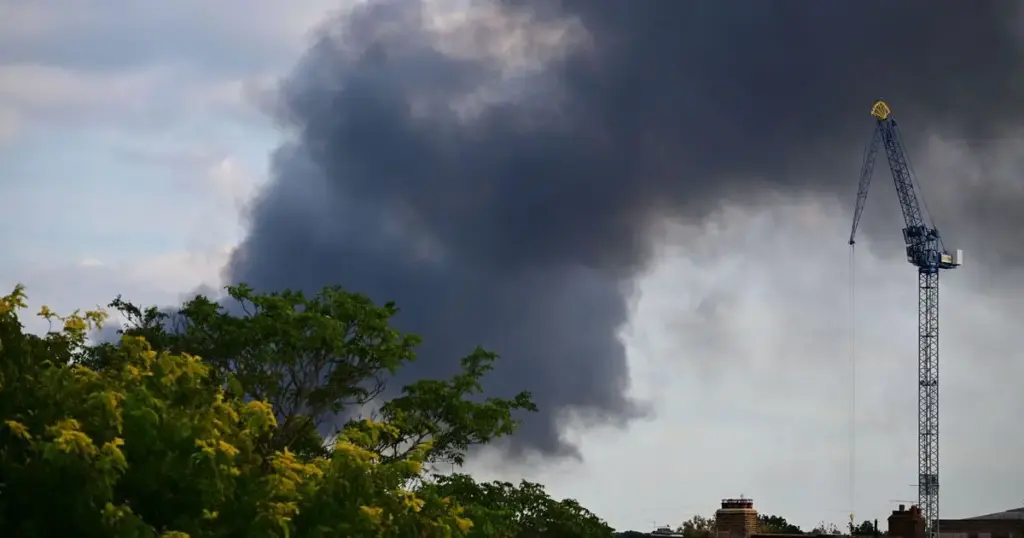
LONDON — A major emergency response unfolded in South London on Wednesday afternoon, August 26, 2026, as a ferocious grass fire broke out in the Mitcham area, sending towering plumes of dense, black smoke billowing across the capital’s skyline. The London Fire Brigade (LFB) mobilized a massive force—deploying 20 fire engines and approximately 125 firefighters—following a surge of emergency calls from alarmed residents.
The incident, centered near Carshalton Road, erupted during the late afternoon, immediately threatening local properties, disrupting traffic, and plunging the surrounding neighborhoods into a haze of acrid smoke. Authorities issued urgent safety warnings, instructing residents within a wide radius to seal their homes by keeping all windows and doors firmly shut to prevent smoke inhalation and mitigate health risks.
While emergency crews worked tirelessly into the evening to contain the aggressive blaze, the incident has once again highlighted the extreme vulnerability of urban green spaces during dry summer conditions. This comprehensive report details the timeline of the response, the operational challenges faced by emergency services, official statements, and the broader context surrounding the increasing frequency of grass fires in the UK.
Detailed Chronology: How the Disaster Unfolded
The First Alarms: 4:27 PM
The emergency began unfolding shortly before the evening rush hour. At precisely 4:27 PM on Wednesday, August 26, 2026, the London Fire Brigade’s 999 Control Room received its first emergency call. Within minutes, the switchboard was overwhelmed, ultimately logging more than 70 frantic calls from eyewitnesses, motorists on nearby arterial roads, and local residents who watched in horror as a wall of flames tore through dry vegetation.
The initial callers reported a rapidly expanding column of smoke visible for miles across South London. The sheer volume of reports signaled to LFB dispatchers that this was no ordinary rubbish or small refuse fire, but a rapidly escalating major incident requiring an immediate, heavy resource commitment.
Immediate Mobilization: 4:30 PM
Recognizing the severity of the threat, LFB Control Officers rapidly escalated the response level. Crews from local fire stations—including Mitcham, Wallington, and Norbury, alongside reinforcements from surrounding boroughs—were scrambled to the scene.
By 4:30 PM, the brigade had officially authorized the deployment of 20 fire engines and roughly 125 operational firefighters. Specialized wildfire tactical units and command support vehicles were also dispatched to coordinate containment strategies along the perimeter of the blaze, which was actively consuming dry grass, scrubland, and threatening boundary fences near residential zones.
Containment and Ongoing Operations
Upon arrival, firefighters faced intense heat, shifting winds, and dense smoke that severely hampered visibility along Carshalton Road and its adjoining residential turnoffs. Crews established a defensive perimeter, deploying high-pressure hose reels and main jets to beat back the advancing fire front.
By early evening, LFB personnel were still actively dampening hot spots and working to prevent reignition. The rapid escalation of the fire forced local police to implement temporary road closures, diverting public transport and private vehicles away from the danger zone to clear pathways for incoming emergency appliances.
Official Statements and Emergency Guidance
London Fire Brigade’s Statement
The London Fire Brigade released formal updates through its digital channels as the crisis unfolded. In an official statement, the brigade emphasized the sheer scale of the operation and the primary hazard facing the local population:
"Twenty fire engines and around 125 firefighters have been called to a grass fire near Carshalton Road in Mitcham.
The fire is producing a significant amount of smoke and local residents should keep their windows and doors closed.
Control Officers took the first of over 70 calls at 16:27 and have mobilised crews from Mitcham, Wallington, Norbury and surrounding fire stations to the scene."
Public Health and Safety Directives
Public health officials and emergency responders reiterated the critical importance of self-isolation within homes located downwind of the fire. Inhaling particulate matter from burning grass, plastics, and urban refuse can cause severe respiratory irritation, particularly for vulnerable demographics such as the elderly, young children, and individuals suffering from asthma or chronic obstructive pulmonary disease (COPD).
Residents were advised to:
Keep all windows, ventilation bricks, and external doors tightly sealed.
Turn off mechanical ventilation systems or air conditioning units that draw outside air directly into living spaces.
Avoid traveling through the Carshalton Road corridor to allow unhindered access for emergency vehicles.
Report any secondary flare-ups immediately via 999.
Supporting Context, Metrics, and Environmental Factors
The Growing Threat of Urban and Peri-Urban Grass Fires
The Mitcham incident is part of a troubling seasonal trend across the United Kingdom. In recent years, changing climate patterns marked by prolonged dry spells, low humidity, and high summer temperatures have transformed urban parks, commons, and roadside verges into tinderboxes.
When grass and scrubland dry out completely, even a discarded glass bottle (acting as a magnifying lens), a stray cigarette butt, or an unattended barbecue can ignite a catastrophic blaze within seconds. The speed at which grass fires travel—fueled by dry root systems and driven by ambient wind—often outpaces traditional firefighting responses, necessitating massive multi-station deployments like the one witnessed in Mitcham.
Resource Allocation and Emergency Strain
Deploying 125 firefighters and 20 engines to a single localized grass fire places an immense logistical burden on the London Fire Brigade. This level of mobilization requires pulling resources away from standard fire-safety cover across multiple boroughs.
Fire service analysts point out that every major grass fire ties up critical assets that might otherwise be required for structural fires, road traffic collisions, or medical co-responses. Consequently, public awareness campaigns have increasingly focused on prevention, urging citizens to exercise extreme caution with open flames and combustible materials during periods of dry weather.
Future Outlook and Preventative Measures
The Immediate Aftermath and Investigation
Once the Mitcham fire is completely extinguished and damping-down operations conclude, fire investigators from the LFB will initiate a formal inquiry to determine the exact origin and cause of the blaze. Determining whether the fire was accidental, weather-induced, or the result of negligence will form a key part of the post-incident review.
Local authorities are expected to maintain a watching brief over the affected area for potential flare-ups, given that smoldering embers can remain hidden beneath root systems for hours after the visible flames have been suppressed.
Long-Term Policy and Community Resilience
As extreme weather events become more frequent, emergency planners and local councils across London are re-evaluating long-term resilience strategies. Recommendations for mitigating future grass fire risks include:
Enhanced Vegetation Management: Creating fire breaks and clearing dead scrub away from residential perimeters and vulnerable infrastructure.
Public Information Campaigns: Expanding targeted safety warnings during heatwaves and dry spells to discourage dangerous behaviors in public parks and open spaces.
Early Detection Technologies: Utilizing thermal imaging cameras and automated smoke-detection sensors in high-risk suburban green spaces to catch fires in their infancy before they require a 125-person emergency response.
For the residents of Mitcham, the immediate focus remains on recovery, air quality restoration, and assessing any localized property damage once the all-clear is officially sounded by incident commanders.