In the high-stakes, hyper-visual landscape of modern cinema, few costume designers command the narrative authority and stylistic breadth of Arianne Phillips. An Oscar-nominated artisan renowned for her historical precision in epics like Once Upon a Time in Hollywood and A Complete Unknown, as well as her legendary two-decade tenure shaping Madonna’s iconic visual evolution, Phillips has long understood that a costume is never merely fabric on skin. It is character, subtext, psychology, and armor rolled into one.
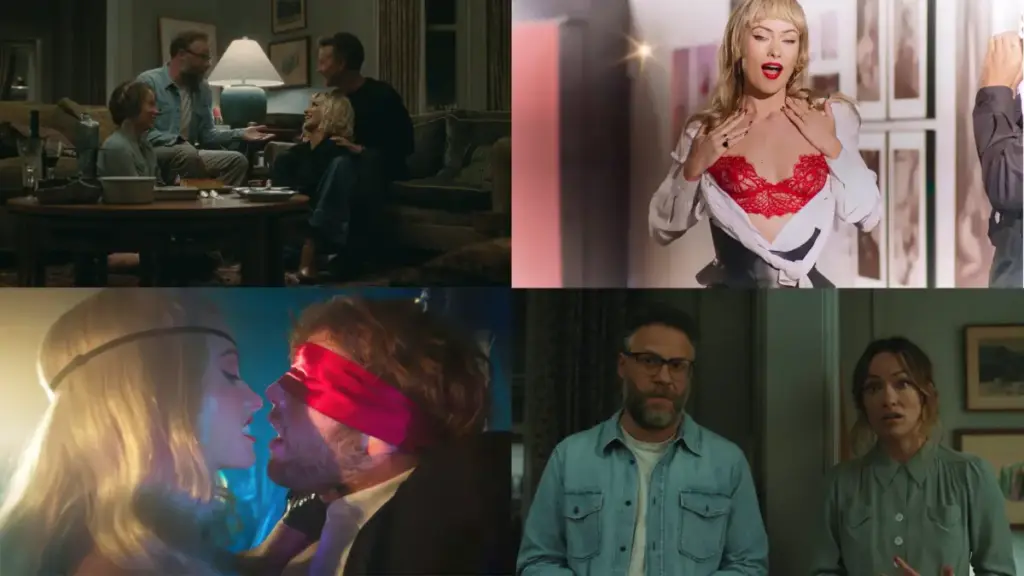
In her latest creative chapter, Phillips has undertaken a masterclass in duality. Co-designing alongside Monica Chamberlain, she recently ventured into the provocative, high-contrast world of Gregg Araki’s I Want Your Sex, a sleek psychological exploration of inverted power dynamics starring Olivia Wilde and Cooper Hoffman. Following that intense dive into latex, bondage lingerie, and BDSM couture, Phillips pivoted radically to The Invite, a tense, minimalist chamber drama directed by and starring an intimate four-person ensemble—Wilde, Seth Rogen, Penélope Cruz, and Edward Norton—confined largely to a single room over the course of one awkward, unraveling evening.
This feature explores Phillips’ methodology across these two radically divergent projects. Through an in-depth look at her source material, high-profile collaborations, artifact sourcing, and psychological styling choices, this report details how an elite costume designer translates complex interpersonal dynamics into physical garments—proving that whether an actor is encased in a custom Atsuko Kudo catsuit or wearing a single, meticulously curated thrift-store blouse, the fitting room remains cinema’s most intimate crucible.
Detailed Chronology: From the Fitting Room to the Silver Screen
The relationship between a costume designer and an actor is uniquely paradoxical. As Phillips famously observes, "The thing about being a costume designer that’s so unique is that when we meet an actor, usually for the first time, it’s like, ‘Hello, nice to meet you. Take your clothes off!’"
Phase I: Constructing the Subversive Universe of I Want Your Sex
For I Want Your Sex, directed by Gregg Araki, that introduction was expedited even further: "Hello, nice to meet you. Take your clothes off and try on this latex catsuit. Or this bondage lingerie."
Set within a sleek, contemporary corporate environment, the film flips traditional power dynamics on their head. Olivia Wilde stars as an older, dominant woman who commands the professional and personal space of a younger, submissive male subordinate, played by Cooper Hoffman. To construct this world authentically without falling into exploitative tropes, Phillips relied on a deep visual lexicon gathered over a lifetime of cultural observation.
Historical and Cinematic Influences: Phillips bypassed modern clichés, instead drawing inspiration from her teenage cinematic touchstones of the 1980s. She referenced Paul Bartel’s subversive dark comedy Eating Raoul—specifically Mary Woronov’s portrayal of a Warhol-adjacent dominatrix—alongside 1970s classics like The Story of O and Bernardo Bertolucci’s Last Tango in Paris.
The Fine Art Connection: The visual architecture expanded into the avant-garde realm via the S&M-inspired furniture of British pop artist Allen Jones. Phillips noted a personal connection to Jones’ work, recalling when fashion designer Rick Owens displayed an Allen Jones table in his Los Angeles home during the 1990s. This bridged directly into her extensive history working with Madonna, where the blurring lines of undergarments as outer garments became a foundational pop-culture language.
The Cast’s Reception: Both Wilde and Hoffman embraced the material without hesitation. Wilde undertook a staggering 28 costume changes throughout the production, seamlessly transitioning between high-powered corporate blazers and textured BDSM statements. Meanwhile, Hoffman embraced scripted role-play costumes—including a maid’s outfit and a striking pig mask—while co-star Charli XCX anchored her performance as Hoffman’s girlfriend largely from the intimate confines of a bed.
Phase II: Sourcing the Avant-Garde on a Deadline
Executing a film dense with fetish couture requires specialized resources, quick turnarounds, and robust industry relationships. Working alongside co-designer Monica Chamberlain, Phillips bypassed traditional commercial channels, calling upon personal archives, designer friends, and legendary specialty houses:
Latex and Lingerie Houses: Phillips tapped long-standing industry relationships, securing pieces from premier luxury lingerie and fetish labels including Bordelle, Fleur du Mal, Kiki De Montparnasse, Zana Bayne, and London-based latex couture house Atsuko Kudo. Los Angeles-based Vex Clothing also supplied custom latex garments.
High-Fashion Loans: The designer’s personal Rolodex yielded major contributions from the upper echelons of global fashion. Stylist B. Åkerlund loaned pieces from her Los Angeles showroom, The Residency. Daniel Del Core contributed architectural garments, while Alessandro Michele—formerly of Gucci and now at Valentino—personally loaned archival pieces. Footwear was supplied by Christian Louboutin, alongside supplemental pieces from stylists Karla Welch and Annie Psaltiras.
Phase III: The Minimalist Pivot—The Invite
Immediately following the sensory overload of I Want Your Sex, Phillips chose a path of radical aesthetic opposition by boarding The Invite.
Where Wilde enjoyed nearly three dozen wardrobe shifts in Araki’s film, her character Angela in The Invite wears essentially a single outfit for the entire duration of the picture. The film centers on a deteriorating marriage (Wilde and Seth Rogen) hosting their free-spirited upstairs neighbors (Penélope Cruz and Edward Norton) for a night of escalating psychological tension.
The Challenge of Minimalism: Operating with a near-zero costume volume and a single continuous setting, Phillips had to abandon traditional character arcs driven by changing clothes. Instead, every sartorial choice had to work on multiple psychological levels simultaneously.
The Theater Metaphor: Drawing on her extensive experience designing six major concert tours for Madonna and various theatrical stage productions, Phillips treated Penelope Cruz’s wardrobe like a theatrical performance—incorporating subtle layers that could visually metaphorize the character’s shifting truths and hidden motivations as the plot unwound.
Supporting Context & Metrics
To fully appreciate the precision of Phillips’ work, one must examine the metrics of her dual filmography and the specific semiotic choices made for each character.
Comparative Wardrobe Matrix
Metric / Parameter
I Want Your Sex (2026)
The Invite (2026)
Director
Gregg Araki
Undisclosed / Ensemble
Primary Cast Size
Ensemble (Olivia Wilde, Cooper Hoffman, Charli XCX)
4 Core Characters (Wilde, Rogen, Cruz, Norton)
Olivia Wilde’s Costume Changes
28 distinct outfits
1 primary ensemble
Dominant Textures
Latex, leather, bondage straps, fine wool tailoring
High contrast, deep jewel tones, iconic black latex
Environmental camouflage (garments matched to apartment walls)
The Semiotics of Jewelry and Accessories
In both films, accessories served as critical character anchors rather than decorative afterthoughts:
The Hermès Médor Watch: In The Invite, Phillips anchored Olivia Wilde’s character—a wealthy, non-practicing artist and stay-at-home mother—with an extremely personal artifact: her own vintage Hermès Médor watch from the early 1970s. Known for its pyramid-studded punk-rock aesthetic concealed over a watch face, the piece signaled hidden edge and collector status. Mismatched earrings sourced online from independent designer Grainne Morton completed an aesthetic explicitly modeled on the eccentric, singular style of Diane Keaton.
Detailing the Close-Up: Because The Invite relies heavily on intimate, three-quarter camera framing within a single room, hand gestures became focal points. Phillips curated specific statement rings for Penélope Cruz, utilizing pieces from Los Angeles designer Hillary Heydle—including a pearl ring and a goddess-imprinted signet ring—alongside an interlocking chain from Lizzie Mandler to subtly mirror Cruz’s character as a sexologist attempting to bind disparate personalities together.
The Lisa Eisner Contrast: For I Want Your Sex, Phillips balanced the aggressive texture of body-con latex with high-end, organic gravitas by borrowing statement jewelry pieces from designer Lisa Eisner, proving that high fashion and fetish wear can exist in striking, harmonious tension.
Official Statements & Design Philosophy
Reflecting on her creative motivations, Phillips emphasizes the necessity of reinvention and the psychological weight embedded within everyday textiles.
Discussing the cultural zeitgeist surrounding workplace power dynamics, Phillips noted the intentionality behind flipping the traditional older-man/younger-woman trope:
"Post Time’s Up/Me Too era, the idea of this inappropriate power dynamic in the workplace could be a bit antiquated and almost cliché. Initially the script was an older man and younger woman, and Gregg and [writer] Karley Sciortino switched it because it is a more provocative way to look at that power dynamic."
On her deliberate choice to move away from predictable formulas and seek out stark creative contrasts between her projects, Phillips explained:
"I’m always looking to not repeat myself and to constantly do the opposite of what I have just done. I just thought [The Invite] was the perfect contrast to what I had just done with Olivia with I Want Your Sex. And anything she wants to do, I’m there."
Addressing the unique constraints of minimalist costume design where actors wear a single outfit for an entire feature film, Phillips highlighted the collaborative harmony required with production design:
"I wanted the colors that Angela and Joe wear to be part of the apartment because that apartment is like a character. I worked a lot with the production designer, Jade Healy, in creating their costumes to match the palette of the apartment, which is the opposite of what I usually do. I typically want the actors to stand out against the background or the environment… And the denim blue and the mint green top really fought each other. In the camera tests, I wasn’t sure about it. And then I thought, ‘Well, maybe that’s a good thing because they are lacking harmony in their relationship.’ So I leaned into it."
Future Outlook
As the boundaries between contemporary fashion, fetish aesthetics, and narrative cinema continue to blur, Arianne Phillips remains at the vanguard of the industry. Her ability to transition seamlessly from the maximalist, boundary-pushing subversion of Gregg Araki’s erotic thriller universe to the intense, claustrophobic minimalism of chamber drama underscores an enduring truth: costume design is not about how many clothes an actor wears, but how precisely those garments reveal the unspoken truths of the human psyche.
Looking ahead, Phillips’ body of work on I Want Your Sex and The Invite sets a high watermark for contemporary styling in 2026 cinema. By treating latex and vintage denim with equal intellectual rigor, she ensures that the fitting room will remain the most vital, transformative space in the filmmaking process—where strangers shed their reality and step out into the light as fully realized characters.