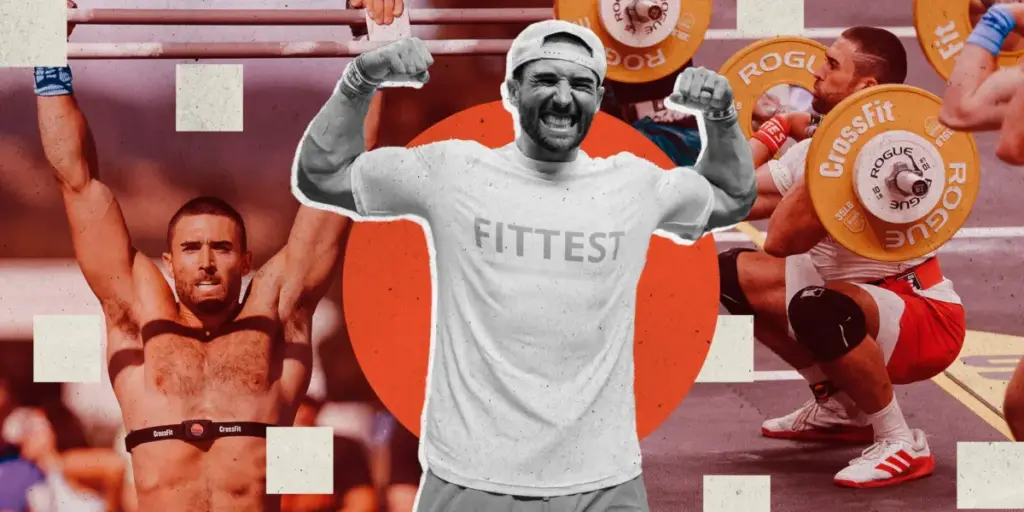
At just 24 years old, James Sprague has firmly cemented his name into the annals of functional fitness history. Capturing his second title as the "Fittest Man on Earth" at the 2026 CrossFit Games in San Jose, California, Sprague has transitioned from a promising prodigy into the definitive standard-bearer of a new generation.
Winning under a grueling, expanded format—featuring a historic 20 scored events over four punishing days—Sprague amassed 1,318 points, fending off a ferocious challenge from runner-up Dallin Pepper to secure victory by a razor-thin 27-point margin.
Yet, Sprague’s championship journey is far from a simple narrative of athletic dominance. His maiden victory in 2024 occurred under the darkest of circumstances, cast in the shadow of the tragic passing of competitor Lazar Đukić during the opening event. Two years later, standing atop the podium in San Jose under healthy, vibrant conditions, Sprague found a profound sense of closure and an authentic opportunity to celebrate.
As CrossFit celebrates its landmark 20th anniversary, the sport finds itself at a critical crossroads. The booming popularity of hybrid fitness competitions like Hyrox, the cultural explosion of recreational run clubs, and ongoing industry debates regarding accessibility and cost have forced the discipline to look inward. In an exclusive interview following his historic defense of the crown, Sprague sat down to discuss the relentless mental framing required at the elite level, the evolving landscape of fitness culture, and his unyielding blueprint for the future.
Detailed Chronology: From Tragedy to Triumph
To understand James Sprague’s mental fortitude, one must trace the stark contrast between his two championship runs. The evolution from his breakthrough performance in 2024 to his calculated defense in 2026 highlights an athlete forced to mature faster than the typical competitive lifecycle allows.
The 2024 Watershed and the Shadow of Tragedy
Sprague’s first championship in 2024 was supposed to be the culmination of a lifelong dream. Having discovered CrossFit at the tender age of 12—inspired by overcoming childhood struggles with weight and depression—his ascent through the teen divisions into the elite ranks was marked by obsessive dedication. However, the joy of victory was instantly eclipsed by tragedy when competitor Lazar Đukić tragically died during the Games’ opening event.

"The first time I became a champion, it was under a circumstance that I didn’t imagine becoming a champion under," Sprague reflects. "We had a tragedy happen at the CrossFit Games where one of our friends and competitors passed away in an event. There wasn’t a lot to be happy about. Even though I achieved this goal that I’ve set out my entire life and wrapped my entire life around being able to achieve, it didn’t feel like I achieved it."
The 2026 San Jose Endurance Test
Fast forward two years, and the atmosphere in San Jose could not have been more different. Operating in a healthy environment with heightened competitor safety protocols, the 2026 CrossFit Games presented an unprecedented physical exam: 20 grueling, scored events designed to test every facet of human capacity.
Rather than relying on flashy event wins, Sprague anchored his victory in unyielding consistency. By Saturday night, following a brutal back-to-back sequence in Events 16 and 17, Sprague knew it was time to slam the door on the competition.
"After Saturday night’s back-to-back events… I knew I had to attack with all I had and basically close the door on the guy behind me," Sprague explains. Entering Sunday with a healthy cushion, he played a tactical final round, cruising to a 10th-place finish in the finale to safely secure the overall title with 1,318 total points. "This year, under a healthy environment, with everyone safe and the competitors enjoying themselves and the atmosphere brighter and happier, this felt like something I could celebrate and really dwell on and be proud of."
Supporting Context & Metrics: Deconstructing the "Superman" of Fitness
Modern CrossFit demands a physiological profile unlike any other discipline on Earth. Athletes must embody the versatility of a decathlete, possessing the raw explosive power of an Olympic weightlifter, the spatial awareness of a gymnast, and the aerobic engine of a marathon runner.
Bridging the Gaps in Training Volume
Sprague is candid about his athletic blueprint and where he traditionally falls short compared to his peers. "CrossFit is a mix of strength, gymnastics, and monostructural cardio work," he notes. "When it comes to top-end strength, that’s where I lack compared to the other guys. Most of my training is centered around that weakness."

To bridge this gap ahead of the 2026 Games, Sprague restructured his programming. Knowing the sheer volume of 20 tests would stress recovery capacities to their absolute limits, he abandoned conventional paradigms:
- Hypertrophy and Accessory Work: Prioritizing heavy compound lifts and targeted muscle growth to build durable, resilient tissue.
- Olympic Weightlifting Precision: Refining technique under heavy loads to minimize energy leaks.
- Outside-the-Box Conditioning: Venturing far beyond the traditional barbell by incorporating hill sprints, open-water swimming, and track intervals to prepare for unpredictable event programming.
The Psychology of Self-Belief
At the elite level of the CrossFit Games, the physical fitness delta between the top twenty athletes is vanishingly small. When everyone is exceptionally fit, victory is decided between the ears.
For Sprague, the psychological shift from "chaser" to "chased" required absolute mental ownership. "When I go into each individual competition or workout, how can I maximize my own performance and not compare it to anyone else’s? It came down to self-belief," he asserts.
This mental framework involves a meticulous visualization process. Before stepping onto the competition floor, Sprague maps out every second of a workout in his mind: "What’s the best possible time? How do I get there? Can I do that? The answer is yes. Then I just have to do it on the floor. I already did it in my head, so now I can do it on the floor."
Official Statements & Industry Perspectives: Navigating a Shifting Fitness Landscape
As CrossFit marks its 20-year milestone, the fitness industry looks vastly different than it did when pioneers like Rich Froning, Annie Thorisdottir, and Jason Khalipas first lit the torch. The advent of boutique hybrid events like Hyrox and the cultural resurgence of run clubs have democratized fitness racing for the masses.
The Evolution of Fitness Racing
Sprague views these modern fitness trends not as threats, but as extensions of the very culture CrossFit pioneered two decades ago.

"We were the original fitness racing," Sprague emphasizes. "The CrossFit Games was one of the most original forms of going head-to-head with someone else to test who’s fitter. All these evolutions are super niche in their own ways… Yet we can’t forget our roots. It all came from CrossFit."
Accessibility and the Everyday Athlete
However, Sprague is pragmatic about the challenges facing CrossFit as a business and a global movement. While Hyrox and commercial racing circuits have excelled at drawing massive, mainstream participation across demographics—allowing casual participants and masters athletes to experience race-day euphoria—CrossFit has occasionally struggled with public perception regarding cost and accessibility.
"CrossFit is expensive, too. Running, training, and buying running shoes is an expensive option. I think accessibility is hard for some people who don’t have the funds to pay $150, $200 a month and then buy all the equipment," Sprague admits.
To secure its next era of growth, Sprague believes the organization must pivot its marketing lens away from exclusively spotlighting elite performers and focus more heavily on the everyday affiliate member. "Most people aren’t looking to compete. Most people are just looking to have better beach muscles and a summer body and be able to get off the toilet easier, quite frankly."
Future Outlook: The Next Era of CrossFit
Looking ahead toward the horizon of the sport—and imagining what the landscape might look like by the time the CrossFit Games reaches its 40th anniversary—Sprague’s vision is clear, focused, and deeply loyal to the community that saved his life.
Standardizing the Competitive Season
If there is one administrative aspect Sprague hopes will change over the next five years, it is the volatility of the competitive pipeline. "The thing I would like to see change is the season structure for how to get to the CrossFit Games. It’s changing every year. There’s a new way, there’s a new format. Quarterfinals, semifinals, they’re here, they’re gone. It’d be nice to have one uniform thing that doesn’t change and is always predictable for an athlete."

The Torchbearers of Tomorrow
Sprague represents a new breed of professional athlete—one who grew up watching the sport on screens, analyzing splits, and treating fitness as an exact science rather than a reckless test of attrition.
"Athletes back then kind of just attacked a workout as hard as they possibly could. It was like, let the wheels fall off. There wasn’t a lot of pacing or strategy," Sprague reflects on the earlier generations. "Nowadays, athletes are breaking down every single little piece and detail of our workouts. That’s why we’re making these big leaps."
With two titles safely secured before his mid-20s, James Sprague is far from satisfied. Far from resting on his laurels, he views his latest victory merely as a baseline. As he heads back to the drawing board to analyze his triumphs and missteps, his message to the rest of the field is chillingly simple:
"The 2027 vision is to let this year be a shell of who I’m going to be next year."