Executive Overview
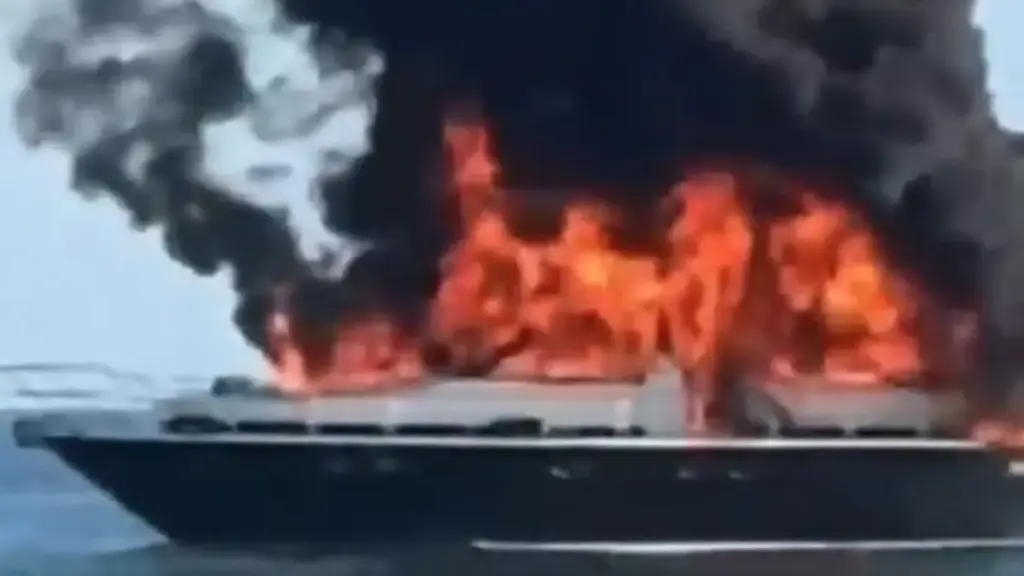
In a heart-pounding maritime emergency that unfolded just off the picturesque coastline of Jesolo, Italy, quick-thinking Good Samaritans and elite emergency services averted what could easily have been a catastrophic loss of life. Ten individuals, including at least one young child, were safely evacuated from a luxury pleasure yacht as it was consumed by a sudden and ferocious blaze. The incident, which occurred late yesterday afternoon, transformed a tranquil stretch of the Adriatic Sea into a scene of chaotic drama, complete with billowing black smoke, marine firefighting vessels, and aerial water drops from specialized rescue helicopters.
The fire, which broke out roughly 100 meters from the shoreline shortly after 6:00 PM, spread with terrifying velocity, overwhelming the vessel’s onboard suppression systems within minutes. Thanks to the immediate and courageous intervention of a nearby civilian skipper, Walter Bisiol, who was returning from a voyage to Croatia with his family, all ten passengers and crew members were pulled from the stricken bow just in time. While the human toll was mercifully mitigated by zero reported injuries, the material cost was total: despite the coordinated efforts of local firefighters, the yacht was entirely gutted by the inferno and ultimately sank to the seabed, leaving authorities grappling with an impending environmental containment operation to manage potential diesel fuel leakage.
As local, regional, and maritime authorities launch a comprehensive investigation into the origins of the disaster, early theories point toward a catastrophic electrical short-circuit. The incident has also sparked renewed discussions surrounding maritime safety protocols along the densely populated Venetian coast, while drawing high-level praise for the bravery displayed by both civilian rescuers and professional emergency responders.
Detailed Chronology: From Leisure Cruise to Maritime Inferno
The sequence of events unfolded rapidly on a late August evening, shattering the calm of a routine return voyage for hundreds of boaters enjoying the late-summer waters of the northern Adriatic.
18:00 – The Outbreak
The pleasure craft was cruising approximately 100 meters off the coast of Jesolo, a popular beach resort destination near Venice, when an anomaly occurred deep within the vessel’s hull. According to preliminary findings, a suspected electrical malfunction rapidly escalated into a full-scale fire. Witnesses on nearby vessels and the shoreline reported seeing thick, noxious plumes of black smoke erupting from the midsection of the yacht, quickly obscuring the sun and signaling an immediate distress situation.
18:05 – Escalation and Panic
Within mere minutes, the fire spiraled out of control. Walter Bisiol, a 44-year-old skipper who was navigating the waters between Croatia and Cavallino-Treporti accompanied by his partner, another couple, and two children, noticed the darkening cloud of smoke. Altering his course to investigate, Bisiol and his crew soon sighted the desperate figures of ten individuals huddled at the bow of the burning vessel, waving their arms frantically and shouting for help as the flames aggressively cut off their escape routes toward the stern.
"The fire spread with frightening speed," Bisiol recounted later, describing how the passengers had exhausted their own portable safety equipment. Recognizing the immediate peril, Bisiol maneuvered his own boat skillfully through the choppy waters, bringing his hull flush against the bow of the burning yacht. Recognizing that the onboard fire extinguishers had already been depleted, Bisiol tossed an additional extinguisher across the gap before establishing a makeshift evacuation bridge.
18:15 – The Civilian Rescue
Working swiftly under intense pressure and extreme heat, Bisiol and his companions took all ten stranded individuals—including a child—onto their own vessel. The rescue required immense precision, as the radiant heat from the burning yacht threatened both watercraft. Once every passenger was safely accounted for, Bisiol immediately contacted the Italian Coast Guard (Capitaneria di Porto) via maritime radio, confirming that he had secured all survivors and was setting a direct course for the safety of the nearest Coast Guard pier. Because of this rapid response, all ten evacuating passengers stepped onto dry land completely unharmed.
18:30 – Professional Intervention and Aerial Assault
As the civilian rescue boat cleared the hazard zone, professional emergency services flooded the scene. Firefighting crews from the Jesolo and Venice detachments arrived via high-speed marine patrol boats, deploying water cannons to drench the superheated superstructure of the yacht. Simultaneously, an aerial firefighting unit—a specialized rescue helicopter—arrived overhead, executing a series of daring low-altitude passes to drop massive payloads of seawater directly onto the center of the blaze.
Despite the overwhelming volume of water applied from both sea and air, the structural integrity of the yacht had already been fatally compromised by the extreme temperatures. The fire burned through critical bulkheads, and the vessel slowly began to list heavily to one side.
19:30 – The Sinking and Environmental Containment
Unable to conquer the stubborn blaze locked deep within the fiberglass and resin components of the hull, firefighting crews were forced to transition from active firefighting to defensive containment. Shortly after 7:30 PM, the heavily damaged yacht slipped beneath the surface of the Adriatic, coming to rest on the shallow seabed roughly 100 meters off the coast. Following the submersion, maritime environmental protection teams were immediately dispatched to lay containment booms around the wreck site, mitigating the escalating risk of a localized diesel fuel and lubricant spill.
Supporting Context & Metrics: Anatomy of a Coastal Disaster
The destruction of the Jesolo yacht highlights several critical safety, environmental, and structural factors inherent to modern recreational boating.

The Chemistry of Modern Boat Fires
Marine experts note that modern luxury yachts and pleasure craft are heavily reliant on composite materials, synthetic resins, fiberglass, and complex polyurethane furnishings. While these materials offer lightweight durability and aesthetic appeal, they possess a dangerous downside when exposed to flame: they burn at extremely high temperatures and release thick, toxic, hydrocarbon-laden smoke—a phenomenon clearly observed by beachgoers miles away from the Jesolo coast. Furthermore, once a fire reaches the fuel tanks or synthetic wiring harnesses, traditional portable extinguishers are rendered virtually useless, necessitating professional marine intervention.
Environmental Risk Metrics
The sinking of a vessel in shallow coastal waters invariably triggers environmental oversight protocols. Standard recreational yachts of this scale typically carry between several hundred to over a thousand liters of refined diesel fuel, alongside hydraulic fluids, engine oil, and onboard sewage systems. The immediate deployment of floating containment booms by the Italian Coast Guard was designed to trap surface sheen and prevent hydrocarbons from drifting toward Jesolo’s sensitive bathing beaches during peak tourism season. Environmental agencies have since initiated water quality monitoring tests around the wreck perimeter.
Comparative Maritime Safety Metrics in the Adriatic
The northern Adriatic Sea is one of the busiest recreational boating corridors in Europe, particularly during the summer months when thousands of vessels transit between Italy, Croatia, Slovenia, and Montenegro. According to historical data from Italian maritime authorities, engine and electrical faults account for nearly 45% of all reported vessel fires in the Mediterranean. However, incidents resulting in the total loss of a vessel within sight of the shoreline remain relatively rare, underscoring the vital importance of the "Good Samaritan" ethos demonstrated by skippers like Walter Bisiol, whose proximity allowed for a rescue time of under ten minutes—well before professional units could navigate through congested coastal traffic to reach the epicenter.
Official Statements and Political Reactions
The averted tragedy quickly drew the attention of regional and national figures, who praised both the spontaneous heroism of the civilian rescuers and the disciplined execution of professional emergency services.
Luca Zaia, President of the Veneto Regional Council, took to social media to express his profound gratitude to the rescue personnel involved. In a widely shared public statement, President Zaia declared:
"Thank you to all our rescuers. Always on the front line and constantly working to keep us safe."
His sentiments were echoed by local maritime commanders in Jesolo, who emphasized that the cooperation between civilian mariners and institutional emergency units serves as the gold standard for coastal safety. A representative of the local Coast Guard office noted:
"Without the immediate, courageous actions of civilian vessels in the immediate vicinity—specifically the skipper of the assisting boat—the timeline of this incident could have had a profoundly different and tragic outcome. We cannot overstate the value of community vigilance on the water."
Future Outlook: Investigations and Preventive Measures
As the immediate rescue phase concludes, attention has shifted firmly toward accountability, forensic investigation, and future preventative policies.
The Ongoing Investigation
Investigators from the Jesolo Harbour Master’s Office, in collaboration with municipal fire marshals, have launched a formal inquiry to pinpoint the exact origin of the blaze. While initial witness reports and physical evidence strongly point toward an electrical short-circuit in the forward engineering spaces or navigational console, forensic teams must wait for salvage operations to raise the hull before definitive conclusions can be drawn. Salvage engineers are currently drafting a complex extraction plan to lift the sunken yacht from the seabed without causing secondary environmental contamination to the marine ecosystem.
Policy Implications for Coastal Navigation
The incident has also prompted local municipal leaders and port authorities to review regional safety briefings provided to charter companies and private yacht owners. Discussions are underway to evaluate whether mandatory inspections for aging electrical systems on recreational vessels should be intensified, particularly for craft operating in high-density tourist zones where a sudden fire can endanger not only the passengers on board, but also swimmers, beachgoers, and nearby marine traffic.
Ultimately, while the luxury yacht is a total write-off and environmental teams remain vigilant, the Jesolo maritime incident stands as a powerful testament to human resilience, rapid civilian intervention, and the enduring importance of preparedness on the open water.