Executive Overview
What was supposed to be a night of joyous coastal revelry quickly degenerated into a scene of absolute lawlessness on the shores of southern Italy. In the early hours of Saturday, August 23, 2026, a massive and brutal brawl erupted on a packed public beach in Fiumarella, Mondragone, located within the province of Caserta. The confrontation, which began over a trivial and seemingly insignificant dispute, rapidly snowballed into an out-of-control melee involving flying deckchairs, splintered wooden crates, and, alarmingly, knives.
Occurring during the peak of Italy’s traditional Ferragosto holiday celebrations—a period historically characterized by communal joy, late-night bonfires, and family gatherings by the sea—the outbreak of extreme violence sent hundreds of panicked holidaymakers scattering for safety. Families with young children, tourists, and local residents found themselves trapped in a theater of chaos as combatants traded heavy blows, pulled hair, and hurled projectiles across the sand.
The disturbance did not remain contained to the shoreline. As the violence escalated, it spilled directly onto the adjacent seafront promenade, amplifying the panic and turning a popular tourist corridor into a zone of terror. Local law enforcement agencies, alongside emergency medical responders, rushed to the scene to quell the unrest, treat the wounded, and restore public order.
In the wake of the incident, local authorities have moved swiftly, detaining five individuals, including a minor, and launching official investigations into charges ranging from participation in a violent brawl to resisting a public official. However, the incident has laid bare deep-seated security challenges along the Domitian coast. Prominent Italian politicians and civic leaders are now raising urgent questions regarding the enforcement of municipal bans, the presence of law enforcement, and the broader societal pressures threatening Italy’s cherished seaside traditions.
Detailed Chronology: From Trivial Spark to Full-Scale Coastal Riot
The sequence of events that shattered the Ferragosto festivities began in the dead of night, shattering the tranquil atmosphere typically associated with Italy’s Mediterranean coastline.
03:00 AM: The Catalyst
According to eyewitness reports and preliminary police findings, the altercation ignited at approximately 3:00 AM on a public beach in the Fiumarella district of Mondragone. While the precise nature of the initial disagreement remains under official investigation, authorities indicate that the conflict stemmed from a trivial, low-stakes dispute between individuals gathered near the water. In the dense crowds typical of the Ferragosto season, minor friction can easily compound; within minutes, verbal insults escalated into aggressive posturing.
03:15 AM: Weaponization of the Beach
What began as a heated argument quickly deteriorated into physical violence. As tempers flared past the point of no return, the combatants began utilizing whatever objects were immediately at hand as weapons. Witnesses reported seeing heavy wooden deckchairs and storage crates ripped from their places and hurled through the air like makeshift missiles.
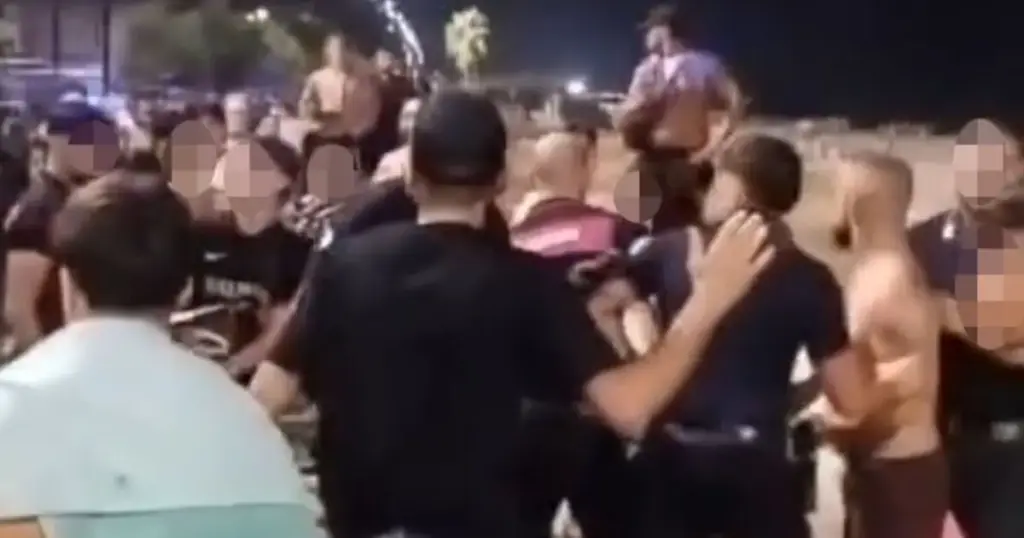
The brawl soon involved dozens of active participants, with punches, kicks, and slaps traded indiscriminately. In one widely circulated video clip that has since drawn outrage across Italian media, two women can be seen locked in a vicious struggle, grabbing each other by the hair while screaming obscenities, surrounded by a swirling mass of shouting onlookers.
03:30 AM: Escalation with Edged Weapons
The situation took a significantly darker turn when several individuals allegedly drew knives. The introduction of edged weapons transformed a chaotic fistfight into a life-threatening situation. As the flashpoints multiplied, a number of participants and unfortunate bystanders sustained injuries from both physical blows and knife wounds.
Realizing the extreme danger, bystanders—including families with small children who had been enjoying the late-night coastal atmosphere—began fleeing in terror. The mass exodus quickly overwhelmed the beach, pushing the violence outward.
03:45 AM: Spillover onto the Seafront and Police Intervention
Unable to contain the violence to the sandy expanse of the beach, the warring factions spilled over onto the nearby seafront promenade. This secondary theater of conflict triggered widespread panic among local businesses, late-night diners, and pedestrians.

Emergency calls flooded local dispatchers, prompting a rapid and heavy response from Italian law enforcement units. Police officers arrived to find a scene of utter confusion. Officers faced immense difficulties in safely separating the combatants, who continued to lash out despite the presence of law enforcement. Through coordinated tactical maneuvers, police managed to regain control of the area, disperse the remaining crowds, and secure the perimeter for emergency medical personnel.
04:30 AM and Beyond: Triage and Detentions
Ambulance crews established a triage area near the seafront, treating multiple individuals for lacerations, contusions, and shock. Concurrently, law enforcement officers detained five primary suspects believed to have played instrumental roles in instigating and perpetuating the violence. These individuals were immediately transported to a local police station for formal identification and processing.
Supporting Context & Metrics: The Shadow Over Ferragosto
To fully grasp the gravity of the Mondragone beach brawl, one must understand the cultural significance of the holiday during which it occurred, as well as the broader demographic and geographical context of the region.
The Significance of Ferragosto
Ferragosto, celebrated annually on August 15, is rooted in ancient Roman history (Feriae Augusti, instituted by Emperor Augustus in 18 BC). In modern Italy, it represents the absolute zenith of the summer holiday season. Millions of Italians leave urban centers for the country’s coasts, lakes, and mountains. Coastal towns swell to several times their normal populations, creating immense logistical, sanitary, and security challenges for municipal authorities.
Traditions associated with Ferragosto often include late-night beach gatherings, communal bonfires, music, and feasting under the stars. However, the massive influx of tourists, combined with alcohol consumption and unregulated nocturnal gatherings, frequently creates a tinderbox of social friction.
The Demographic Profile of the Detainees
The aftermath of the Fiumarella incident yielded swift identification of five key participants by local investigators, highlighting a cross-jurisdictional clash:
- Local Residents: A man and a woman hailing directly from Mondragone.
- External Participants: A man, a woman, and a juvenile (minor) traveling from the nearby, densely populated province of Naples.
The involvement of individuals from varying locales underscores a recurring issue along the Domitian coast: the convergence of diverse populations into unregulated nighttime spaces, frequently resulting in territorial or interpersonal clashes.
The Pre-existing Municipal Ban
Adding a layer of administrative failure to the incident, the chaos unfolded in direct defiance of local governance. Prior to the weekend, Mondragone Mayor Francesco Lavanga had issued a strict municipal ordinance explicitly banning unauthorized beach camping and late-night bonfires along the town’s coastline.
Despite this official decree, large crowds circumvented the regulations, gathering on the public beach in the dead of night. The failure to prevent these gatherings highlights the severe limitations local authorities face when attempting to enforce seasonal restrictions across expansive shorelines with finite police resources.
Official Statements and Political Fallout
The violent outbreak in Mondragone has sparked fierce national debate across Italy, drawing sharp rebukes from lawmakers and renewing calls for structural reforms in coastal security management.
Local Governance Under Scrutiny
While Mayor Lavanga’s administration had attempted to preemptively mitigate public safety risks through the implementation of the bonfire and camping ban, the sheer scale of the disregard for the ordinance has led critics to question the municipality’s enforcement capabilities. Local councils along the Domitian coast have long struggled to balance the economic benefits of mass tourism with the heavy infrastructural and security burdens it imposes.

Parliamentary Condemnation: Francesco Borrelli Speaks Out
The incident gained national political traction when regional and national figures weighed in on the breakdown of public order. Among the most vocal critics was Italian Member of Parliament Francesco Borrelli, who issued a scathing assessment of the security failures along the Domitian coastline.
In a strongly worded public statement, Borrelli emphasized that legislative bans are meaningless without active, robust enforcement:
"More stringent checks and a widespread security presence are needed along the Domitian coast: orders and bans cannot remain merely on paper.
Anyone who turns beaches and public places into scenes of violence must be identified and dealt with firmly."
Borrelli’s comments echo a growing sentiment among Italian politicians that southern coastal regions require permanent, high-visibility law enforcement task forces during peak holiday periods to deter opportunistic violence and protect law-abiding citizens and families.
Future Outlook: Reforming Italy’s Coastal Security
As the dust settles on the Fiumarella beach brawl, local authorities, national lawmakers, and tourism boards are forced to confront uncomfortable truths regarding the management of Italy’s public spaces during high-traffic holidays.
Immediate Legal Proceedings
The five individuals detained in the immediate aftermath of the Saturday morning riot face serious legal consequences. Formal reports have been filed against them on suspicion of multiple offenses, including:
- Participation in a violent affray (brawl)
- Insulting a public official
- Resisting a public official during the execution of their duties
Judicial authorities have indicated that further arrests could follow as forensic teams continue to analyze video footage captured by witnesses and local CCTV cameras. Investigators are working to identify other active participants who managed to flee the scene before police could establish a complete lockdown of the area.
Policy Implications and Structural Changes
The incident has catalyzed discussions regarding long-term structural changes for Italian beach management. Key recommendations emerging from regional security councils include:
- Enhanced Surveillance Infrastructure: Expanding the deployment of high-definition, night-vision CCTV cameras along public beaches and access points to deter illicit gatherings and accelerate the identification of lawbreakers.
- Joint Law Enforcement Patrols: Establishing coordinated patrols involving national police (Polizia di Stato), the paramilitary Carabinieri (who hold jurisdiction over many coastal zones), and municipal police forces (Polizia Locale) during peak holiday windows such as Ferragosto.
- Stricter Enforcement of Municipal Ordinances: Moving beyond paper bans by implementing physical barriers, increased lighting, and active curfew enforcement on public beaches to prevent unauthorized nocturnal occupations.
Preserving the Spirit of the Summer
Ultimately, the challenge facing Italian coastal communities is preserving the open, welcoming nature of their Mediterranean heritage without compromising public safety. Ferragosto remains a cornerstone of Italian cultural life, a time for families and friends to connect with nature and one another along the water’s edge.
However, as the events in Mondragone starkly demonstrate, without a proactive and uncompromising security apparatus, these historic celebrations risk being overshadowed by lawlessness. For the residents of Mondragone and the wider Domitian coast, the hope is that this violent awakening will serve as the catalyst for lasting, effective reform—ensuring that future summer celebrations are remembered for their joy rather than their terror.