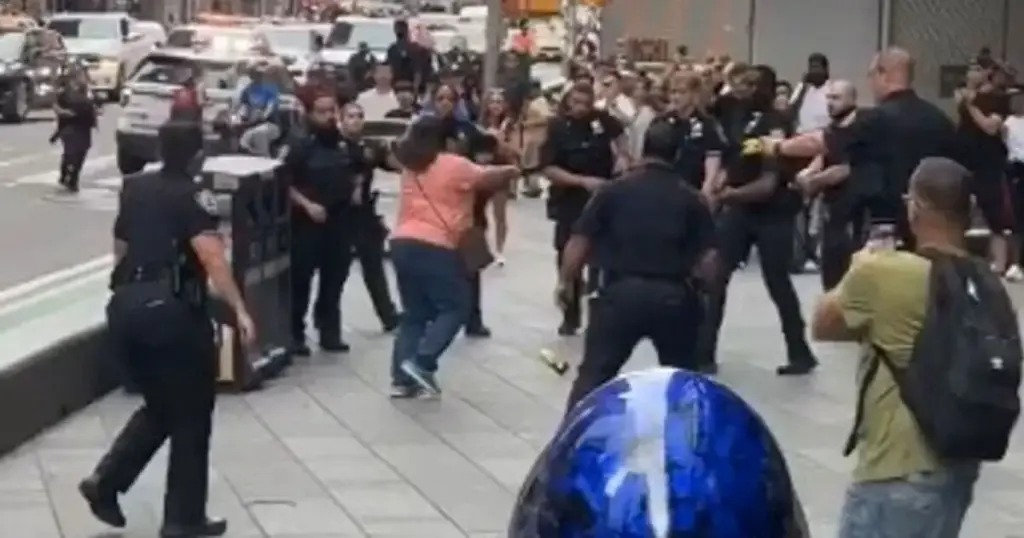
NEW YORK CITY — A routine late-afternoon rush in the heart of Manhattan devolved into absolute chaos on Monday, August 31, 2026, when a volatile knife attack in Times Square culminated in a high-stakes, officer-involved shooting.
The incident, which unfolded against the backdrop of one of the world’s most heavily populated and heavily touristed commercial intersections, left two innocent bystanders critically injured following a sudden stabbing rampage. The armed assailant, a woman brandishing dual blades, was shot by responding New York City Police Department (NYPD) officers after she allegedly refused repeated commands to drop her weapons.
As emergency vehicles flooded the gridlocked avenues, local authorities shuttered vital thoroughfares, throwing the bustling Midtown business and entertainment district into immediate lockdown. The event has reignited urgent conversations surrounding public safety, mental health intervention in urban centers, and the rapid response protocols required of law enforcement in high-density areas.
Executive Overview
The violent sequence of events began at approximately 4:26 p.m. local time, transforming a normal Monday afternoon into a scene of mass panic. According to preliminary reports from the NYPD and the New York City Fire Department (FDNY), the suspect—whose identity has not yet been publicly released—engaged in a sudden and erratic escalation of violence between Seventh Avenue and West 42nd and 43rd Streets.
Wielding two knives, the woman targeted and stabbed two individuals—one man and one woman—inflicting severe, life-threatening wounds before law enforcement intervened. Within moments of the initial emergency calls, officers confronted the armed suspect. Despite verbal warnings and commands to surrender the weapons, the suspect reportedly failed to comply, prompting officers to discharge their firearms to neutralize the immediate threat to the public.
Both innocent victims were rushed via emergency medical services to nearby trauma centers, where they remain in critical condition. The suspect was also transported for medical treatment, with her current medical status remaining unconfirmed as of late Monday evening. The immediate aftermath saw a massive deployment of police personnel, cordoned-off blocks, paralyzed traffic grids, and a wave of shock across social media as eyewitness footage circulated globally.
Detailed Chronology: A Timeline of Terror
To understand how a tranquil late-August afternoon turned catastrophic, investigators have pieced together a minute-by-minute account of the incident based on emergency dispatches, police logs, and bystander accounts.
4:26 p.m. — The First Emergency Dispatch
The FDNY receives an initial, frantic call reporting that a person has been stabbed at the bustling crossroads of Times Square. Emergency medical technicians (EMTs) stationed nearby immediately prepare for a priority response, anticipating the complications of navigating rush-hour pedestrian traffic.
4:27 p.m. — The Escalation and Police Intervention
Within sixty seconds of the first emergency call, the situation escalates from a medical emergency to an active-threat scenario. According to police sources and local reporting by ABC7, the female suspect is spotted brandishing two knives, reportedly threatening multiple pedestrians in what appears to be a chaotic attempted knifepoint robbery or unprovoked rampage.
As the suspect confronts civilians, two individuals—subsequently identified as an adult male and an adult female—are violently attacked and suffer multiple stab wounds. NYPD patrol units and foot-post officers stationed permanently in the Times Square detail rush toward the epicenter of the commotion.
The Confrontation and Shooting
Upon arriving at the scene, officers command the armed woman to drop the blades. Witnesses report that the suspect ignores police directives, maintaining an aggressive posture and refusing to disarm. Faced with an imminent, lethal threat to themselves and the surrounding crowd of tourists and commuters, responding officers discharge their weapons, striking the suspect and bringing the rampage to an abrupt halt.
Post-Incident Lock Down and Emergency Response
Within minutes, the intersection is swarmed by an overwhelming presence of emergency vehicles, including multiple NYPD counter-terrorism and patrol cruisers, FDNY engines, and advanced life support ambulances. The wounded victims are stabilized at the scene before being rushed under police escort to local hospitals. Detectives secure the perimeter, stretching yellow police tape across major avenues while transit hubs and pedestrian walkways are cleared to preserve forensic evidence.
Supporting Context & Metrics: Times Square Security and Urban Crime
Times Square, frequently styled as "The Crossroads of the World," is one of the most heavily monitored, policed, and visited public spaces on the planet. Understanding the context of this shooting requires a look at the unique logistical and security challenges posed by the district.
The Footprint of the Crossroads
Daily Foot Traffic: On any given pre-pandemic or post-pandemic weekday, Times Square accommodates upwards of 330,000 pedestrians, swelling to nearly 400,000 during peak tourism seasons.
Law Enforcement Presence: The NYPD maintains a dedicated Times Square Substation, paired with a constant deployment of joint counter-terrorism units, foot patrols, mounted police, and a vast network of closed-circuit surveillance cameras (CCTV).
Response Times: Due to the dense concentration of emergency services in Midtown Manhattan, average police and EMS response times in the Times Square zone are among the fastest in the United States, often measured in seconds rather than minutes.
The Broader Safety Landscape
While New York City has experienced a general downward trend in overall violent crime over recent years, high-profile incidents involving emotionally disturbed persons (EDPs) and knife violence in mass-transit hubs and public squares continue to present severe challenges for municipal leaders.
Security analysts note that policing a sprawling, open-air pedestrian plaza presents unique tactical nightmares. Unlike a secured building or a gated venue, Times Square is porous, accessible from dozens of side streets, and constantly moving. When a sudden, spontaneous act of violence occurs—such as an individual pulling dual knives out of clothing—officers have mere fractions of a second to evaluate the threat, calculate crossfire risks in a crowd of thousands, and utilize proportional force.
Official Statements and Initial Reactions
As the investigation enters its foundational stage, city officials, police leadership, and emergency management agencies have begun releasing preliminary statements regarding the incident.
NYPD Press Bureau Update
In a late-evening media briefing, NYPD representatives confirmed the basic timeline of the event, emphasizing that officers were forced into a split-second defensive posture.
"Preliminary findings indicate that officers responded to reports of a violent assault in progress involving an armed suspect," an NYPD spokesperson stated. "Upon arrival, officers attempted to de-escalate the situation and ordered the suspect to drop the weapons. When those verbal commands were ignored and the safety of the public remained in immediate peril, police action was taken. The investigation remains active and ongoing."
Impact on Public Transit and Local Businesses
The closure of Seventh Avenue between West 42nd and 43rd Streets caused massive ripple effects across Manhattan’s public transit network and vehicular grid. Bus routes operating through Midtown were heavily rerouted, and subway entrances leading directly into the Times Square-42nd Street station complex experienced temporary access restrictions to prevent overcrowding and secure the perimeter.
Local business owners and hospitality workers expressed shock at the sudden violence. Storefronts along the affected blocks temporarily pulled down security shutters as police established a sterile zone for ballistics and forensic teams.
Future Outlook: Investigations, Accountability, and Recovery
As New York City wakes up in the shadow of this violent disruption, several critical questions remain unanswered, setting the stage for intensive scrutiny in the days and weeks ahead.
1. The Investigation by the Attorney General’s Office and NYPD Force Investigation Division
In accordance with standard protocol for police-involved shootings in New York State, the Attorney General’s Office of Special Investigation (OSI), alongside the NYPD’s Force Investigation Division (FID), has launched a full-scale probe into the shooting. Investigators will review body-worn camera footage, civilian smartphone videos, ballistic evidence, and witness testimony to determine whether the use of lethal force adhered strictly to departmental guidelines and state law.
2. Identifying the Suspect and Motive
One of the most pressing priorities for detectives is establishing the identity of the female suspect and her underlying motive. Investigators are working to determine whether the attack was a random act of violence perpetrated by an emotionally disturbed individual, a targeted assault, or an attempted robbery gone disastrously wrong. Background checks, medical records, and interviews with acquaintances will form the core of this psychological and criminal profiling effort.
3. Medical Updates on the Victims
The city’s collective focus remains trained on the recovery of the two innocent victims. Hospital spokespeople have confirmed that both individuals underwent emergency surgical procedures for their stab wounds. Their prognosis remains guarded, with family notifications currently underway by police social services.
4. Public Safety Reassurances
City hall and police leadership are expected to address the incident in upcoming public briefings, aiming to reassure residents, international tourists, and commuters that Times Square remains secure. However, the event has already reignited fierce debates among policy experts regarding how best to protect open urban spaces from unpredictable acts of violence without turning the heart of the city into an armed fortress.
As this is a developing news story, updates will be provided as official reports are finalized by the New York City Police Department and medical authorities.