Executive Overview
The landscape of British sport is undergoing a seismic shift, and at the epicentre of this revolution is women’s cricket. Following a sun-drenched summer packed to the brim with elite-tier action—highlighted by the ICC Women’s T20 World Cup and the high-octane drama of The Hundred—the sport has captured the public imagination as never before. Amidst this flurry of boundaries, wickets, and record-breaking crowds stands Marie Kelly, the tenacious batter for the London Spirit.
While the London Spirit fell short of defending their 2024 title this season, Kelly and her squad closed out their final home campaign at the iconic Lord’s Cricket Ground with a resounding 32-run victory against the Birmingham Phoenix. In an exclusive post-match interview with Stylist, Kelly reflects on the triumphs and tribulations of life at the top tier of domestic franchise cricket. Beyond her exploits on the pitch, Kelly discusses why modern formats like The Hundred are breaking down traditional barriers to entry for new fans, and how a frustrating piece of ill-fitting kit sparked her entrepreneurial journey as the founder of the specialized sportswear brand, Versatail.
Detailed Chronology: From Elsworth to the Home of Cricket
The Early Days: A Tennis Court Discovery
Long before she was walking out to a roaring crowd of 12,000 fans at Lord’s, Kelly’s sporting journey began far from the professional pitches of international cricket. Raised alongside her twin sister, Sian, Kelly’s early athletic pursuits were centred on the tennis court.
At just five years old, the twins were already competing fiercely. During one fateful match, they played against the daughter of former international cricketer Trevor Penney. Recognizing an innate athletic coordination and competitive spark, Penney suggested the sisters try their hand at cricket, steering them toward the local Elsworth Cricket Club.
"Because tennis was so competitive from a young age, it was really hard to progress, whereas with cricket, it was easier to gain attention quickly," Kelly recalls.
What began as a casual weekend diversion quickly blossomed into a vocation. Kelly seamlessly navigated the Warwickshire cricket pathway, progressing steadily through junior and county age groups. By the time she reached university age, the landscape of women’s cricket was beginning its historic transition toward professionalization, opening doors that previous generations of female athletes could only dream of.
The London Spirit Experience: Raising the Standard
Joining the London Spirit represents the pinnacle of Kelly’s domestic career thus far. Operating within the high-performance ecosystem of The Hundred, Kelly notes that the franchise culture feels definitively "next level."
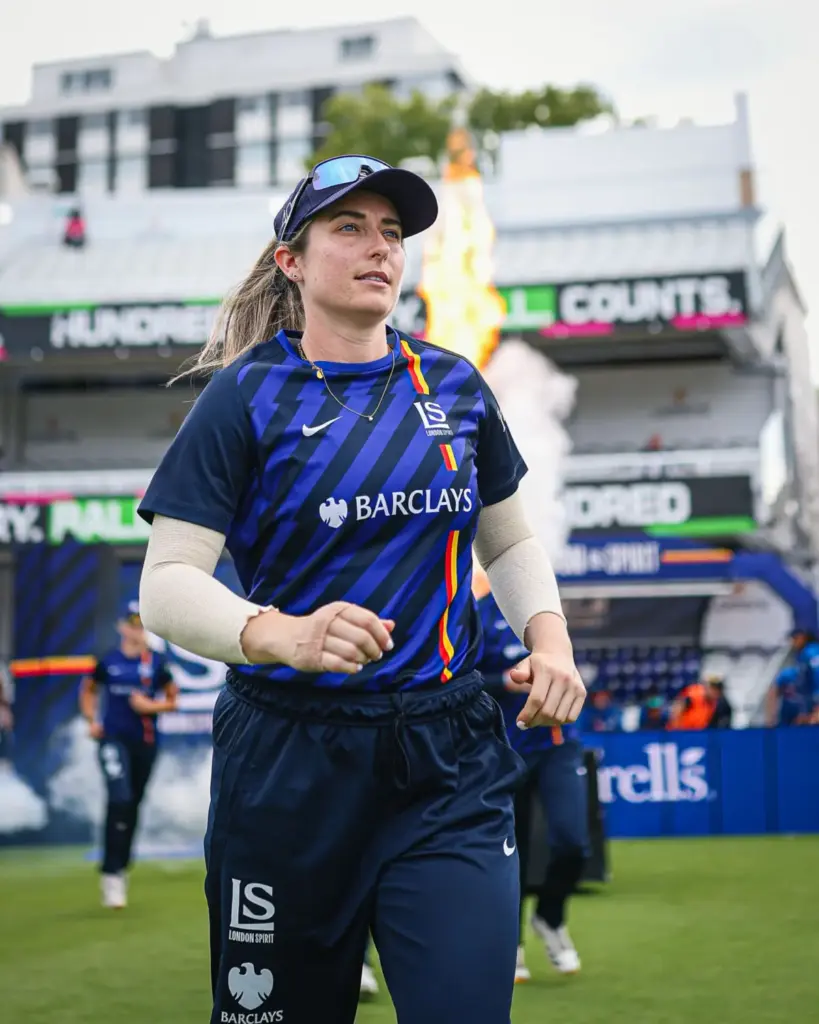
"It’s probably been the best franchise I’ve been part of," she says. "The staff members have been amazing. Everything felt elevated—big commercial sponsors like Barclays coming on board, and a brand-new kit designed by Nike that establishes a higher standard of professionalism."
Despite the team’s off-field infrastructure operating at world-class standards, translating that excellence onto the pitch proved remarkably difficult in a fiercely competitive tournament. After lifting the trophy in 2024, the Spirit faced a challenging title defense this season. However, rather than letting heads drop, Kelly emphasized that the squad’s final fixture at Lord’s against her former side, the Birmingham Phoenix, was about playing for pride and maintaining internal standards.
Securing a dominant 32-run victory provided a fitting emotional crescendo to their home campaign, sending the loyal Lord’s faithful home with a performance worthy of the venue’s storied history.
Supporting Context & Metrics: The Rise of The Hundred and Modern Fan Engagement
Simplifying the Noble Game
Cricket has long battled an enduring, albeit outdated, stereotype: that it is an impenetrable, overly complex, and slow-paced sport designed exclusively for purists. Complex laws surrounding LBWs, strategic declarations, and multi-format variations have historically alienated casual observers.
This is where innovations like The Hundred have fundamentally altered the paradigm. By condensing innings to 100 balls per side, stripping away traditional over structures, and pairing world-class athletic competition with live musical entertainment at half-time, the competition has rewritten the rulebook on spectator sports.
"There are a lot of different rules in cricket that we take for granted, but when you’re explaining it to people, it’s really hard to justify some of the rules," Kelly explains. "So The Hundred keeps it really relatable and simple. It’s a really easy way for kids to follow it as well."
Demographic Shifts in the Stands
One of the most encouraging metrics emerging from the recent summer of cricket is the changing demographic of stadium attendees. Historically, women’s domestic sports have fought an uphill battle to attract neutral or cross-demographic support. The Hundred, however, has successfully cultivated a diverse, family-oriented audience.
"It’s also nice to see such a good mix of boys and girls as well," Kelly notes. "It’s not just girls supporting girls’ cricket and boys supporting boys’ cricket. It genuinely is such a big mix."
With crowds reaching upwards of 12,000 spectators for women’s fixtures at Lord’s—a venue affectionately known as the Home of Cricket—the atmosphere during crunch moments has become electric. For Kelly, stepping onto the hallowed turf requires a deliberate moment of pause.
"A couple of times, I’ve come out on the pitch and I take a minute to look around to just take it all in," she admits.
Official Statements and Industry Insights: Addressing the Kit Conundrum
While the overarching narrative of women’s cricket is one of unprecedented growth, structural and operational oversights still persist at grassroots and elite levels alike. Conversations surrounding access to sport frequently focus on funding, facilities, and media broadcasting rights. However, athletes face secondary barriers once they are already active participants—chief among them being equipment and apparel designed without female physiologies in mind.
The Genesis of Versatail
During her time playing for Warwickshire, Kelly and her teammates encountered a persistent, highly frustrating logistical problem: the kit issued to them was simply a scaled-down version of the men’s apparel.
While receiving parity in terms of team garments was a step forward, practical application lagged far behind. The traditional cricket caps and shirts failed to accommodate common female hairstyles, particularly ponytails and buns.
"I’ve never really liked wearing cricket caps," Kelly shares. "When we played for Warwickshire, we managed to get the same kit as the men—albeit in men’s sizes—but we couldn’t wear them properly with our ponytails, so we all started cutting holes into them. That was where the idea started."
The issue came to a definitive head during a grueling winter training block in Perth, Australia. Recognizing that elite athletes should not have to modify their professional uniforms with scissors just to maintain comfort and focus on the pitch, Kelly decided to take matters into her own hands.
What began as a personal prototype designed to solve an immediate functional annoyance quickly gathered momentum. As fellow players across the domestic circuit experienced the exact same friction, they gravitated toward Kelly’s solution. This organic demand laid the foundation for Versatail, Kelly’s newly launched sportswear business aimed at engineering functional, female-first cricket apparel.
"It started off with something just for myself, and then more and more women started to resonate with it," Kelly explains. "So I thought, let’s make a business out of it. It’s not a massive deal, but it’s just a really simple thought: why can’t we have stuff that’s made for us? Why can’t we make it? Why don’t we just do it? Let’s get on with it."
Future Outlook: Dismantling Stereotypes and Expanding Horizons
As the dust settles on another landmark summer of cricket, athletes like Marie Kelly are looking forward to a future where the sport’s commercial viability and cultural footprint continue to expand. The challenge moving forward is not convincing those who attend matches of the sport’s merits—as Kelly points out, retention rates among first-time attendees are exceptionally high—but rather breaking through lingering cultural inertia.
"Once you’ve come once, you want to come again," Kelly asserts. "So I think it’s just getting people to the game in the first place. There’s a stereotype that cricket’s boring, but it’s so not—there’s so much to do, and I think The Hundred epitomises that. If you’re going to start somewhere, I think The Hundred is the perfect place to start."
The Road Ahead for Women’s Sport
The trajectory of women’s cricket over the past half-decade suggests that the sport is no longer merely experiencing a temporary boom, but rather undergoing a permanent structural re-alignment. With robust institutional backing from bodies like the England and Wales Cricket Board (ECB), lucrative commercial partnerships with global brands like Nike and Barclays, and innovative tournament formats capturing the attention of a younger, gender-diverse audience, the foundation has never been stronger.
For pioneers like Marie Kelly—who balance the intense physical and mental demands of professional batting with entrepreneurial ventures designed to improve the game for future generations—the future is bright. Whether she is driving the ball through the covers at Lord’s or designing the next generation of athletic wear in the boardroom, Kelly remains at the forefront of a sport finally playing by its own modern rules.