Executive Overview
The modern fitness landscape is undergoing a fascinating ideological shift. On one side, the commercial weight room remains a dominant cultural fixture—a temple of clanging iron, chalk dust, and heavy lifting. For many, however, this environment is intimidating. The prevailing atmosphere of heavy equipment, complex machinery, and aggressive posturing can create a high barrier to entry, leaving casual exercisers and beginners wondering if there is an alternative.
Enter bodyweight training—also known as calisthenics. Devoid of complex machinery or expensive gear, exercises like air squats, push-ups, and planks offer a streamlined path to fitness. They can be performed in a cramped hotel room, a quiet living room, or a local park, completely free of charge.
Yet, this convenience raises a fundamental question that has long divided fitness professionals: Can you genuinely build muscle and increase physical strength using only your body weight, or are dumbbells and barbells an absolute necessity?
According to leading kinesiologists, strength coaches, and physiological researchers, the answer is nuanced. While bodyweight workouts offer exceptional accessibility and are remarkably effective for beginners, rehabilitation, and long-term functional maintenance, they carry inherent biological limitations. To build significant muscle hypertrophy, a workout must generate sufficient mechanical tension and push muscles close to failure. While exercises like push-ups and pull-ups can initially deliver this stimulus, the human body adapts rapidly. Without external resistance, most individuals will eventually hit a growth plateau.
This deep-dive investigation explores the mechanics of bodyweight training, how muscle hypertrophy actually works, and the strategies required to maximize calisthenics—alongside the critical juncture where you must pick up a dumbbell to keep progressing.
Detailed Chronology of the Fitness Industry’s Shift Toward Functional and Accessible Movement
To understand the current popularity of bodyweight training, it helps to examine how the fitness industry evolved from exclusive, machine-heavy bodybuilding gyms to the decentralized, hybrid fitness models of today.
The Era of the Machine-Centric Gym (Late 20th Century)
For decades, physical conditioning was synonymous with heavy iron and sophisticated selectorized machines. The prevailing philosophy dictated that isolation was king. To grow a muscle, you sat in a specialized apparatus designed to target that singular muscle group through a fixed range of motion. Bodyweight training was largely relegated to military basic training, high school physical education classes, or the foundational warm-up routines of serious athletes.
The Functional Fitness Revolution (2000s–2010s)
As sports science advanced, researchers and elite coaches began pushing back against machine-based isolation. The rise of functional fitness—championed by movements like CrossFit, obstacle course racing, and boutique movement studios—reintroduced multi-joint, compound movements. Practitioners realized that real-world strength required moving the body through space, rather than simply moving a weighted lever while seated. During this period, calisthenics experienced a massive resurgence, transforming from a "poor man’s workout" into an art form characterized by advanced movements like muscle-ups, human flags, and planche push-ups.
The Pandemic and the Rise of At-Home Fitness (2020–Present)
Global lockdowns forced a sudden, dramatic reimagining of fitness culture. With commercial gyms shuttered, millions of people were forced to look inward—quite literally—for their daily exercise stimulus. Online coaching platforms, bodyweight apps, and minimal-equipment routines exploded in popularity.
Out of necessity, a vast demographic discovered that a living room floor was more than sufficient to break a heavy sweat. As gyms reopened, many exercisers retained a hybrid mindset, blending traditional weight room sessions with convenient, scalable bodyweight movements. Today, bodyweight training occupies a respected, sophisticated space in mainstream fitness, valued just as much for its scientific efficacy as its unmatched convenience.
Supporting Context & Metrics: The Physics and Physiology of Bodyweight Load
To evaluate whether bodyweight exercises can rival external weights, we must examine the physics of load distribution and muscle recruitment. Not all bodyweight exercises are created equal, and the human body does not experience every movement with the same intensity.
The Load Discrepancy: Biceps Curls vs. Push-Ups
Consider the mechanics of isolation versus compound movements using body weight alone. "You’re not going to get benefit out of doing bodyweight biceps curls," notes Meredith Witte, MS, CSCS, founder of functional strength training platform The Playground. Because the only mass you are moving up and down is your own forearm and hand, the mechanical stress placed on the biceps brachii is virtually negligible.
Contrast this with the push-up, a foundational upper-body movement. Research published in the Journal of Strength and Conditioning Research reveals that a standard push-up requires an individual to support up to 75% of their total body mass. For a 150-pound person, that equates to pressing roughly 112.5 pounds of resistance with every single repetition. This explains why push-ups can feel intensely challenging, even without stacking heavy weight plates onto your back.
The Lower-Body Challenge
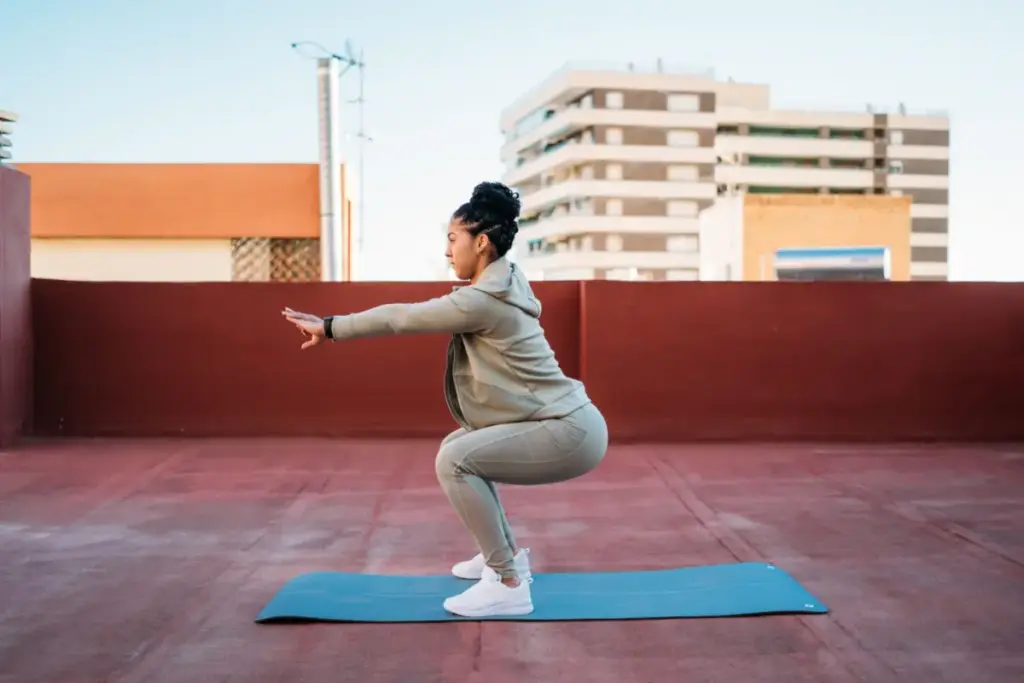
Lower-body movements—such as air squats and standard lunges—also recruit a large percentage of body mass. However, they face a unique physiological hurdle: the lower body houses some of the largest, most powerful muscle groups in the human body, including the quadriceps, gluteus maximus, and hamstrings.
These muscles are routinely subjected to heavy loads simply through walking, running, and climbing stairs. Consequently, standard bodyweight squats rarely provide enough mechanical tension to trigger micro-tears in trained muscle tissue for the average person.
"For the average person, bodyweight squats are not going to be enough," Witte explains. "Our legs are very strong, and so they’re going to feel challenged by body weight, but it’s still really not going to be enough to sufficiently build muscle, unless you truly have not worked out before, or you are an older adult who has not been working out."
Official Statements & Expert Insights: The Science of Muscle Hypertrophy
To understand how muscle growth occurs—and whether bodyweight training can check all the necessary boxes—we turn to leading voices in kinesiology and exercise science.
The Gold Standard: Getting Close to "Failure"
In exercise science, hypertrophy refers to the physiological enlargement of muscle fibers resulting from resistance training. According to Stuart Phillips, PhD, a distinguished kinesiology professor at McMaster University in Ontario, the primary driver of hypertrophy is not necessarily the amount of external weight used, but rather the degree of muscular tension generated as the muscle approaches fatigue.
Dr. Phillips points to research conducted by his team indicating that muscle growth can occur across a remarkably wide spectrum of repetition ranges—provided the set is taken close to the point of "failure." Muscular failure is defined as the exact moment when the mechanical load completely outmatches the muscle’s ability to complete another concentric repetition.
Whether you are lifting a heavy barbell for 6 repetitions or executing a high-volume bodyweight movement for 25 repetitions, the muscle responds similarly if it is forced to generate high tension as it nears exhaustion.
Witte describes the subjective sensation of this threshold metaphorically: "The sensation of muscular failure is like trudging through mud—your final reps should feel nearly impossible to complete."
Who Benefits Most from Calisthenics?
While advanced gymnasts can achieve staggering levels of muscle mass and relative strength primarily through complex bodyweight maneuvers (such as iron crosses and handstand push-ups), the everyday practitioner experiences the benefits of calisthenics differently.
"The biggest improvements in strength and muscle are going to happen in people who are pretty inactive to start with," Dr. Phillips notes.
For sedentary individuals, beginners, or those recovering from orthopedic surgery or injuries, simple bodyweight movements—such as glute bridges, wall push-ups, or basic air squats—provide more than enough stimulus to challenge the neuromuscular system. At this foundational stage, bodyweight exercises do double duty: they build baseline tissue tolerance while dramatically improving the brain-body connection.
"You can teach your brain to recruit the muscle fibers that you maybe aren’t utilizing," says Kristie Larson, CSCS, founder of Tension, a specialized strength training studio in Brooklyn, New York. This neural adaptation is often why beginners experience rapid strength gains within their first few weeks of training, even without touching a dumbbell.
The Principle of Progressive Overload
To sustain long-term strength and muscle development, fitness enthusiasts must adhere to the foundational principle of progressive overload. Traditionally, this is achieved by systematically adding weight to a barbell or dumbbell over time. However, resistance is not exclusively measured in pounds of iron.
Phillips emphasizes that anything capable of placing increasing systemic stress on the neuromuscular system can serve as an overload mechanism. In a bodyweight context, progression can take several imaginative and highly effective forms:
- Mechanical Advantage Shifts: Moving from a bilateral (two-leg) squat to a unilateral (single-leg or pistol) squat instantly doubles the load relative to the working limb.
- Tempo Manipulation: Slowing down the eccentric (lowering) phase of a push-up to a grueling 4-second count increases time-under-tension, driving deep muscle fatigue without adding external weight.
- Form Refinement: Eliminating momentum, tightening core bracing, and perfecting full ranges of motion ensures that target muscles are shouldering the workload rather than relying on surrounding stabilizer muscles or momentum.
- Volume Escalation: Gradually increasing the number of working sets and repetitions. However, experts caution that there is a threshold here. Once an exerciser can comfortably complete 30 or more repetitions of a movement without significant muscular failure, the physiological adaptation shifts. "At that point, that’s not really resistance training—it’s much closer to endurance training," Dr. Phillips warns.
Future Outlook: Finding the Optimal Balance in Modern Fitness
As the fitness industry matures past polarized debates—such as "free weights vs. machines" or "gyms vs. home workouts"—a more sophisticated consensus is emerging. The future of physical conditioning lies in hybrid training models that leverage the distinct advantages of both modalities.
The Ceiling of Bodyweight Training
For all its incredible benefits regarding accessibility, cost, and functional mobility, bodyweight training possesses an unavoidable ceiling.
"Bodyweight exercises just can’t provide enough stimulus for the average person for very long," Witte summarizes. "Pretty quickly, your body is simply going to need more to build muscle."
If an individual’s primary fitness goal is continual, long-term hypertrophy and maximal absolute strength (such as maximizing a deadlift or bench press), skipping external weights entirely will eventually lead to a hard developmental wall.
Maintenance vs. Progression
Conversely, not every fitness enthusiast is chasing bodybuilding stages or powerlifting records. For a massive segment of the population, the primary health objectives are maintaining metabolic health, preserving bone mineral density, supporting joint integrity, and securing long-term functional independence.
For these individuals, bodyweight exercises can serve as a lifelong, highly sustainable fitness strategy. "If someone wants to just maintain muscle, then bodyweight could be appropriate indefinitely," Larson points out.
While a dedicated calisthenics practitioner may never win a powerlifting competition, they will successfully harvest the profound longevity benefits of strength training—enhanced balance, robust bone density, improved metabolic function, and fluid mobility—entirely from the comfort of their own home.
Conclusion
Ultimately, the debate between bodyweight training and weighted resistance is a false dichotomy. The human musculoskeletal system does not care whether the resistance originating from the floor is a 300-pound barbell or the earth pulling against 100% of your body mass; it responds strictly to mechanical tension and metabolic stress.
By understanding the biological limits of calisthenics, embracing progressive overload through variations and tempo, and knowing when to introduce external loads, exercisers can craft a resilient, lifelong approach to physical strength that adapts to any environment, budget, or lifestyle.