Executive Overview
For decades, the cultural script dictating the management of female body hair has been remarkably rigid. Rooted in patriarchal ideals of youth, hyper-cleanliness, and artificial smoothness, the beauty standards of the late 20th and early 21st centuries demanded near-total eradication of natural hair. From razor-thin eyebrows to the omnipresence of Brazilian waxes, the message was clear: hairless equated to feminine, desirable, and civilized.
Today, however, that monolithic standard is fracturing. A growing cohort of women and non-binary individuals are choosing to reject the upkeep, expense, and physical discomfort of traditional hair removal routines. Far more than a simple aesthetic preference, this rejection has evolved into a profound political, social, and personal statement. By allowing their body hair to grow, these individuals are actively reshaping conversations surrounding gender expression, bodily autonomy, and queer identity.
This article explores the complex landscape of female body hair through the lived experiences of ten women who have consciously chosen to abandon the razor. By examining the historical pendulum of beauty trends, the persistence of sexist double standards, and the psychological liberation that comes with natural self-expression, we uncover a broader cultural shift—one where natural bodies are reclaiming their right to exist authentically in the public sphere.
Detailed Chronology: The Evolution of Body Hair Norms
To understand the current movement toward body hair acceptance, it is necessary to trace how society’s relationship with hair has evolved over the past several decades.
The Mid-to-Late 20th Century: The Rise of the Hairless Ideal
While the commercialization of women’s razors began in the early 1900s, it was not until the sexual revolution and the subsequent decades that smooth skin became a mandatory baseline for femininity. By the 1970s and 1980s, shaving underarms and legs had transformed from a trend into an entrenched social obligation.
The 1990s and 2000s: The Pinnacle of Extreme Hairlessness
If the late 20th century laid the groundwork, the 1990s and 2000s perfected the doctrine of total eradication. This era was characterized by an unprecedented level of maintenance. Eyebrows were aggressively plucked into pencil-thin lines, and the complete removal of pubic hair via Brazilian waxing transitioned from a specialized luxury service into a mainstream standard. Mainstream media, fashion magazines, and pop culture relentlessly reinforced the idea that any visible sign of female body hair was a faux pas, a sign of neglect, or inherently unfeminine.
The 2010s to Present: The Counter-Movement and Bodily Autonomy
In recent years, a cultural counter-weight has emerged. Fueled by intersectional feminism, body positivity movements, and digital platforms that allow marginalized narratives to bypass traditional media gatekeepers, the pendulum has begun to swing back. More women are opting for full brows, natural pubic hair, and uninhibited arm and leg hair. What was once viewed as a fringe political statement is increasingly being integrated into mainstream lifestyle choices, marked by a relaxed, individualized approach to grooming.
Supporting Context & Metrics: Navigating the Double Standard
Despite the winds of change, body hair remains a deeply charged cultural battleground. For many women, deciding how to wear their hair is inextricably linked to how they navigate gender, sexuality, and self-worth.
The Sexist Double Standard
Body hair continues to be heavily associated with masculinity. Women who naturally possess dense hair on their arms, faces, or legs are frequently subjected to coded criticisms labeling them as "unfeminine," "unattractive," or "sloppy." Conversely, men face virtually no social penalty for natural hair growth; in fact, heavy body hair in men is often culturally coded as a sign of rugged masculinity or maturity.
This double standard forces women into a narrow behavioral box where their bodies are constantly scrutinized and evaluated against an impossible, artificial baseline. Yet, a growing number of individuals are turning this paradigm on its head. Rather than viewing their body hair as a compromise of their femininity, they view it as an enhancement of it. They argue that true femininity does not require constant maintenance, pain, or chemical intervention.
The Intersection of Identity, Sexuality, and Aesthetics
For many queer and non-binary individuals, dropping the razor is a milestone in untangling oneself from heteronormative expectations. When people begin to critically examine cultural myths—such as the mandatory nature of heterosexual presentation—they often find that other societal pressures, including beauty standards, crumble under the same scrutiny.
Rejecting hair removal can thus serve as a tangible exercise in bodily sovereignty. It allows individuals to ask fundamental questions: Who am I doing this for? Does this practice bring me joy, or am I performing it to appease the gaze of others? For many, the answers lead directly to a permanent break from the grooming products that once consumed their time and finances.
Voices from the Movement: Ten Women on Rejecting Hair Removal
To capture the diverse motivations behind this shift, we spoke with ten women who have consciously chosen to leave their body hair untouched. Their stories reveal a spectrum of experiences—ranging from casual indifference to fierce political resistance.
1. The Power of Indifference and Comfort
For some, the decision begins simply with a realization that the effort required outweighs any perceived social reward.
"My hair is very light. Because of that, I always thought, ‘Oh wow, I actually don’t need to shave.’ So I let it keep growing, and when it finally became visible, I realized I simply didn’t care. I just felt very comfortable with it."
Another participant noted physical skin sensitivities as the primary catalyst:
"I don’t shave anywhere on my body. My skin doesn’t tolerate shaving well, and I think my body is supposed to look this way. In the summer, most people stare at my underarm hair, which I find bizarre. If you lift your arm and everyone is totally shocked… that’s just silly."
2. Redefining Femininity
Societal conditioning often tells women that body hair strips away their womanhood. Several participants found the exact opposite to be true:
"I love body hair and see no reason not to have any if you like it. I stopped shaving my underarms because I realized that hairless pits don’t automatically make me look feminine. I actually felt more feminine with body hair, so I decided to just let it grow. I feel super about it, and I’m all the happier when I see more and more women skipping underarm shaving. Yes, ladies!"
Another participant echoed this sentiment regarding her intimate grooming routine:
"With my bush, I feel mature and feminine."
3. Community and Shared Liberation
There is a distinct cultural bonding that occurs when women step outside conventional beauty standards. The visibility of uncompromised bodies creates unexpected moments of solidarity.
"I let my underarm hair grow simply for myself, and it was a totally empowering feeling. They feel very comfortable, and when I see other women with unshaved armpits—for instance, in the subway when they hold onto an overhead rail—it feels like we are part of a secret club or something. Back then, I was definitely shocked when I saw a woman with underarm hair. But it’s becoming more and more normal."
This sense of community often extends into social circles, particularly within progressive and queer spaces where natural appearances are met with acceptance rather than judgment.
"In my hometown, simply nobody shaved. It was completely normal—especially for the women at my art school—to just have underarm and arm hair. When I moved to a new city, it was different. Suddenly, it totally depended on the people you hung out with. I have many queer friends, and in that circle, body hair is nothing strange at all."
4. Overcoming Internalized Shame and Childhood Bullying
The journey toward self-acceptance is rarely linear, often requiring individuals to unlearn years of conditioned shame.
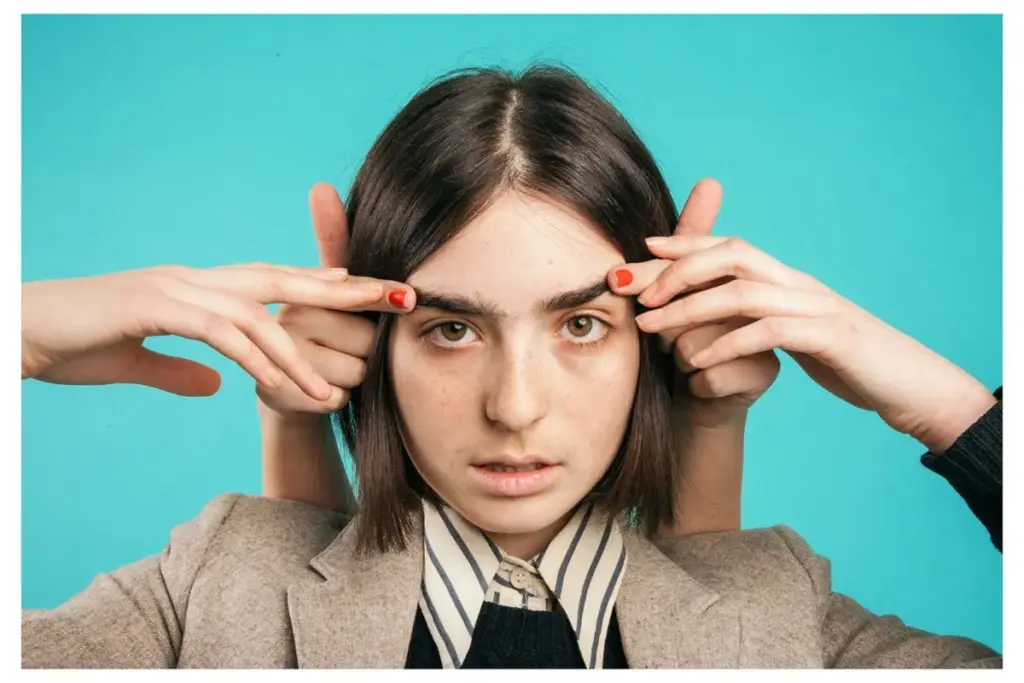
"My arms are quite hairy, and that used to make me very insecure when I was younger. I definitely have more body hair than many others. I also have fairly thick eyebrows. But for those, I get compliments—which is great!"
Another participant shared a similar history of childhood bullying regarding her facial features:
"As a child, many people made fun of my eyebrows. At one point, someone said I looked like a monkey—pretty mean. But I believe the trend is moving toward acceptance of body hair, and that more and more women are content to just keep it natural. What I like best about my eyebrows is how strong they look. They make me look strong, and I feel that way, too."
5. Dismantling Heteronormative Myths
For those navigating queer identities, shedding beauty routines is often tied to a broader deconstruction of societal conditioning.
"When I came out as a queer person and started exploring that identity a bit, I stopped shaving. At the same time, it was also tied to my very sensitive skin. I think, for the most part, it was about looking at gender anew and trying out all the facets of what a woman or femininity could look like… As a queer person, you feel that once you really examine cultural myths, you quickly realize they are all just made up. You are continuously fed the heteronormative narrative of how your life ‘should’ be—and once you question that and realize it’s all nonsense and doesn’t work for you, you start questioning the compulsion toward heterosexuality, too."
6. Relational Support and Autonomy
Partners can also play a supportive role in dismantling personal anxieties, reinforcing that bodily autonomy belongs solely to the individual.
"My partner encourages me to leave my body hair alone wherever I want. He wants me to do what makes me happy. It is your body—and therefore your business how you present yourself."
Future Outlook: Where Do We Go From Here?
The movement against compulsory hair removal is not necessarily a mandate that everyone must stop shaving; rather, it is a campaign for true choice. The ultimate goal of the body hair positivity movement is to dismantle the shame and social penalties associated with natural human biology.
As cultural norms continue to evolve, the conversation is shifting from shock value to normalization. When unshaded legs, growing underarm hair, and natural brows cease to be politicized statements and simply become accepted variations of human presentation, society will have achieved a true milestone in bodily autonomy.
Ultimately, whether an individual chooses an intensive grooming routine or decides to let every follicle grow unchecked, the power lies in the autonomy of the choice. The modern feminist landscape insists that a woman’s worth, cleanliness, and femininity are not measured by the smoothness of her skin, but by her freedom to inhabit her body entirely on her own terms.