Achtung: Minor spoilers for Priscilla lie directly ahead.
Executive Overview
When the world thinks of Elvis Presley’s aesthetic footprint, it immediately summons a vivid tapestry of the 1960s and 1970s counter-culture and pop-culture lexicon: the shimmering, jewel-encrusted jumpsuits, the gravity-defying pompadours, the peacocking swagger, and an unapologetic flair for the dramatic. Yet, in Sofia Coppola’s critically acclaimed biographical drama Priscilla, the wardrobe functions not as a celebration of rock-and-roll extravagance, but as a quiet, suffocating, and ultimately liberating psychological landscape.
Based on Priscilla Presley’s revealing 1985 memoir, Elvis and Me, the film stars Jacob Elordi as the undisputed King of Rock ’n’ Roll and Cailee Spaeny as his young bride. While Elvis’s wardrobe reflects his trajectory toward theatrical excess, Priscilla’s costumes tell a vastly different, more intimate story—one of a young woman being molded, silenced, and eventually reclaiming her own autonomy through fabric, silhouette, and style.
Led by longtime Coppola collaborator and costume designer Stacey Battat—whose previous works include The Bling Ring and The Beguiled—the wardrobe department embarked on an exhaustive archival journey. They did not merely replicate historical photographs; they translated the emotional subtext of an asymmetrical marriage into a visual language. From the pastel innocence of West Germany to the gilded cage of Graceland and the bohemian autonomy of 1970s Los Angeles, the costumes in Priscilla serve as silent witnesses to a complex power dynamic.
This comprehensive analysis explores the meticulous research, historical fidelity, high-fashion collaborations, and psychological narrative arc that defined one of the most compelling cinematic wardrobes of recent years.
Detailed Chronology: The Evolution of Priscilla’s Wardrobe
To understand the transformative power of the film’s costume design, one must trace Priscilla’s journey chronologically through the distinct stylistic eras mapped out by Battat and Coppola. The wardrobe shifts in lockstep with her geographical movements, her age, and, crucially, the level of control exerted over her by Elvis.
Phase I: The Innocent German Years (Late 1950s)
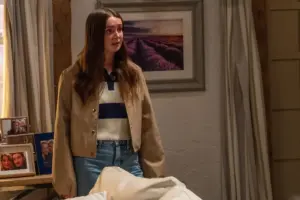
We are first introduced to Priscilla Beaulieu at just 14 years old. Living with her military family on a U.S. Army base in West Germany, her aesthetic is defined by adolescent innocence and mid-century normalcy. She navigates her daily life in pastel-hued cardigans, sweet A-line skirts, and delicate heart-shaped necklaces.
Battat and her team grounded these early scenes in historical authenticity. Pouring over vintage editions of Vogue and Harper’s Bazaar from the late 1950s and early 1960s, the design team meticulously researched the textiles and silhouettes of a teenage military dependent living abroad. One particularly striking visual reference pulled straight from reality is a photograph of Priscilla waving goodbye to Elvis as he departs Germany for the United States. In the film, Spaeny recreates this moment wearing an identical checkered dress paired with a transparent headscarf—a masterpiece of historical translation that anchors the character in genuine biographical history.
Phase II: The Graceland Transformation and Elvis’s Doll (Early 1960s)
When Priscilla relocates to Memphis, Tennessee, to live at Graceland, her youthful wardrobe is instantly dismantled. The checkered skirts and hair ribbons are cast aside, replaced by opera gloves and glamorous minidresses. However, this evolution is not organic; it is curated.
In a pivotal, deeply revealing shopping scene, Elvis dictates what Priscilla should wear, grooming her into the physical embodiment of his personal aesthetic ideals. Beyond clothing, this control extends to her physical self: Elvis demands that she dye her natural brown hair jet-black and heavily apply dark eyeliner. From this moment onward, Priscilla’s palette is strictly policed. She is funneled into a rotation of Elvis-approved pinks and blues, entirely purged of the brown tones and complex patterns that the singer personally detested.
Despite the external glamour of Graceland—where much of the narrative’s intimacy unfolds as Priscilla drifts through domestic spaces in pastel lingerie sets and delicate nightgowns—the clothing here feels less like a wardrobe and more like a uniform. She is living inside an aesthetic fantasy constructed by a man who views her as his living canvas.
Phase III: The 1967 Las Vegas Wedding
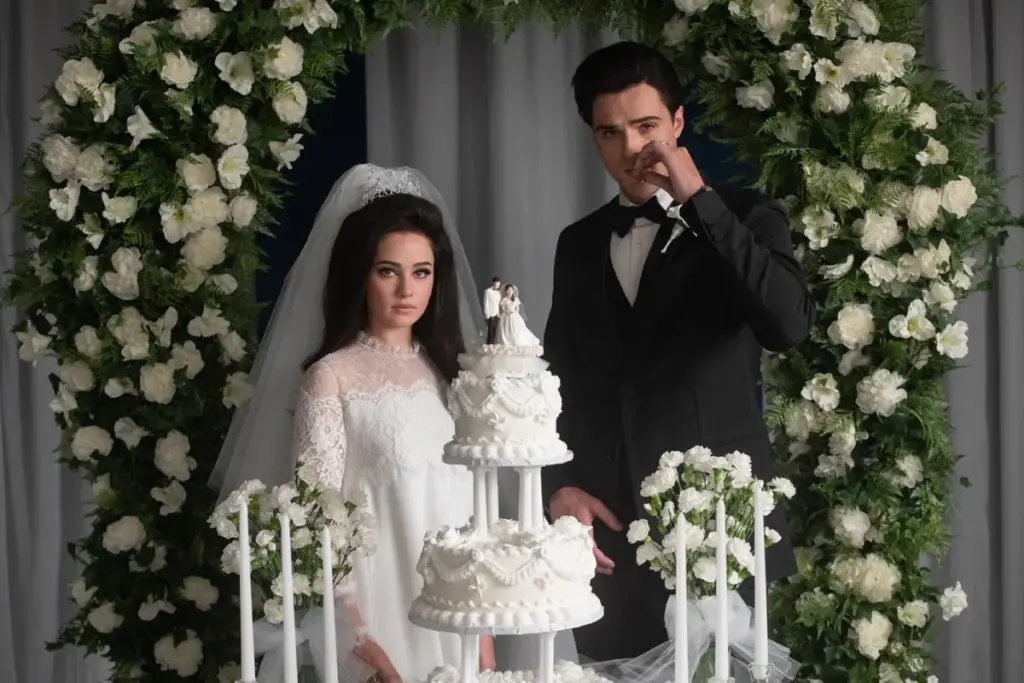
The crown jewel of the film’s sartorial milestones is, undoubtedly, the recreation of the couple’s iconic 1967 Las Vegas wedding. To achieve absolute authenticity, Battat collaborated directly with historic luxury fashion houses: Chanel designed Priscilla’s wedding gown, while Valentino crafted Elvis’s sharp suit.
The resulting bridal look is a loving homage to the original photographs of the ceremony. Priscilla wears a long-sleeved, lace-trimmed A-line gown, complemented by a dramatic tiara and a waist-length veil.
"The look contains direct allusions to the original dress," Battat explains. "However, a portion of it had to be structurally adjusted to accommodate Cailee’s height [1.56 meters / 5 feet 1 inch]."
This careful tailoring ensured that the dress did not overwhelm the petite actress, keeping the focus on Priscilla’s youthful vulnerability rather than the overwhelming spectacle of the media circus surrounding them. Similarly, the vibrant, bright pink dress Priscilla wears in the film immediately following the birth of their daughter, Lisa Marie, mirrors her real-life post-partum style, maintaining a strict adherence to the historical record while underscoring her hyper-visible status.
Phase IV: Divergence and Liberation (The 1970s)
The second half of Priscilla fractures the narrative space, separating the couple both emotionally and geographically. Elvis reaches the absolute zenith of his career in Las Vegas, while Priscilla carves out a solitary existence in Los Angeles. As the emotional chasm between them widens, their sartorial paths violently diverge.
Elvis abandons his earlier leather jackets and tailored suits in favor of flamboyant, hyper-theatrical jumpsuits—garments meticulously recreated by Battat in collaboration with BK Enterprises, the original maker of Elvis’s stage wear. Meanwhile, Priscilla falls under the spell of the relaxed, fluid trends of the 1970s: wide-leg trousers, organic patterns, and the triumphant return of her natural brown curls.
Supporting Context & Metrics: Behind the Design Process
To bring this atmospheric world to life, the production relied on a blend of exhaustive historical research, high-end fashion partnerships, and psychological subtext.
- Archival Precision: The costume department utilized primary sources, including vintage fashion magazines from the late 1950s through the 1970s, alongside personal family photographs provided by the real Priscilla Presley.
- Luxury Collaborations: The wedding sequence alone required cross-continental coordination with heritage fashion houses Chanel and Valentino, bridging modern cinematic craftsmanship with mid-century haute couture.
- Staged Divergence: According to Battat, the visual contrast in the film’s final act was intentional. Over 50 distinct costume changes chart Priscilla’s transition from a doll-like adolescent wearing prescribed pastels to an independent woman embracing earthy tones, denim, and unstyled hair.
- Proportional Scaling: Because the real Priscilla Presley and actress Cailee Spaeny possessed different statures, historic garments—particularly the 1967 wedding gown—required custom structural engineering to maintain the exact visual weight of the original without swallowing the actress’s frame.
Official Statements and Creative Insights
The philosophy underpinning the film’s costume design was born from a collaborative, intuitive spark between director Sofia Coppola and costume designer Stacey Battat. The entire visual journey of the film was catalyzed by a single, melancholy piece of historical documentation.
Reflecting on the genesis of the project, Battat recalls a specific photograph of Elvis and Priscilla taken in 1970:
"Sofia and I looked at this picture together, and we both agreed that Priscilla looked deeply uncomfortable in it," Battat shares. "I think that photo strongly mirrors how we see the two of them later in the film—long before the formal separation, you can see the emotional distance written entirely across their posture and their clothes."
This foundational image informed the film’s thesis on control versus expression. While Elvis descended further into self-parody and theatrical armor, Priscilla shed her manufactured artifice layer by layer.
"We looked at historical photos of Elvis and Priscilla and thought about the image they projected to the world," notes Battat. "I think he became increasingly theatrical and costume-like—wearing heavy makeup, copious jewelry, and massive sideburns. She, on the other hand, gradually removes her mask."
This shedding of the "mask" is perhaps the film’s most powerful visual thesis. When Priscilla finally walks out of Graceland, leaving behind the pink palettes, the heavy eyeliner, and the suffocating expectations of a global icon, her clothing is no longer a script written by someone else. It is an expression of self.
Future Outlook
Sofia Coppola’s Priscilla has fundamentally shifted how cinematic biographies approach the intersection of fashion and psychological realism. By subverting the traditional, high-energy rock biopic tropes popularized by films like Baz Luhrmann’s Elvis and focusing instead on the quiet, claustrophobic realities of domestic surveillance, the film elevates costume design from mere period-accurate window dressing to a primary narrative vehicle.
As audiences continue to analyze the cultural footprint of Priscilla, its impact on contemporary fashion—particularly the revival of 1960s mod aesthetics, soft pastel lingerie dressing, and the romanticization of retro domesticity—remains potent. Yet, the true legacy of Battat’s work on the film lies in its cautionary and empowering reminder: that what we wear can either be a cage built by others, or the first key to our liberation.
Priscilla is available to stream and watch in cinemas worldwide.