Executive Overview
The intersection of professional athletics and socio-political discourse reached a new flashpoint during a late-summer matchup between the WNBA’s Chicago Sky and the Indiana Fever at Wintrust Arena. Former NBA center Enes Kanter Freedom—who has remained out of the professional basketball league since the 2021–22 season—became the epicenter of a courtside confrontation that quickly transcended a routine sporting event. Wearing a t-shirt emblazoned with the phrase, "WOMAN noun. adult human female," Freedom ignited immediate backlash from players, fans, and league personnel.
The demonstration, which led to Freedom being escorted out of the arena by security, is far from an isolated incident. Instead, it forms part of a broader, increasingly contentious national debate surrounding athletic eligibility policies, gender identity, and the boundaries of freedom of expression within professional sports spaces. The altercation—highlighted by a heated confrontation with Chicago Sky guard Natasha Cloud—shines a light on the delicate ecosystem of the WNBA, a league that has historically positioned itself at the forefront of social justice advocacy, inclusivity, and LGBTQ+ representation.
This report provides a comprehensive examination of the events that transpired at Wintrust Arena, the background of the figures involved, the escalating cultural discourse surrounding transgender athletes in women’s sports, and the systemic implications this incident holds for the future of the WNBA and professional athletics at large.
Detailed Chronology: The Wintrust Arena Confrontation
The events of Sunday, August 23, unfolded against the backdrop of a high-stakes regular-season game between two of the WNBA’s most compelling franchises. However, the athletic competition was momentarily overshadowed by events happening just feet away from the hardwood.
The Courtside Demonstration
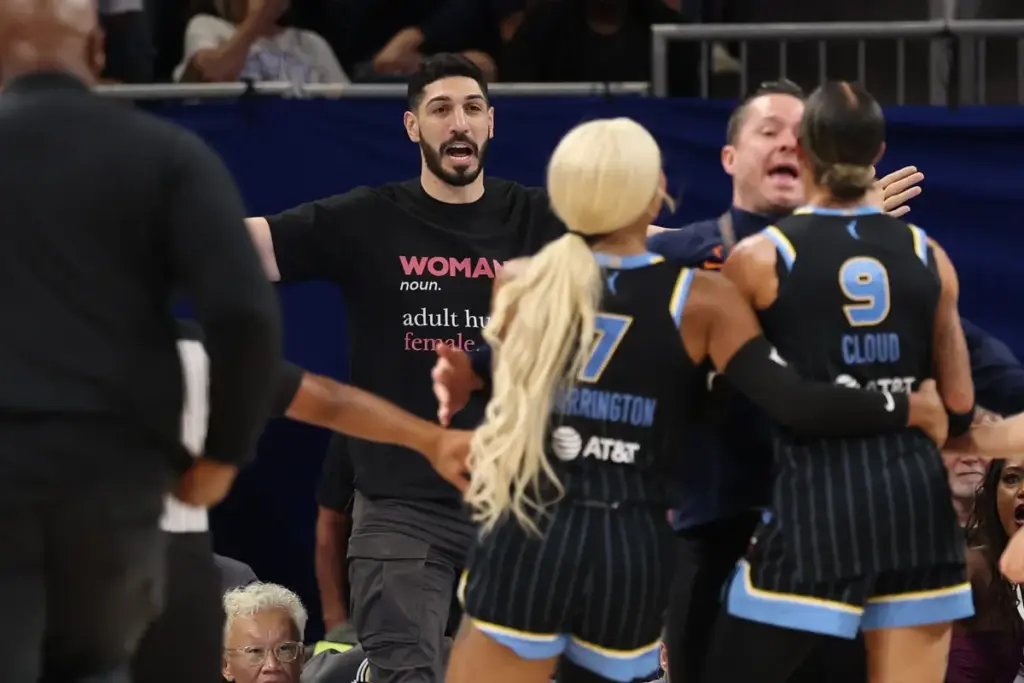
Enes Kanter Freedom, seated courtside, wore a black t-shirt prominently featuring the definition of the word "woman." The garment, widely recognized within contemporary political discourse as a pointed commentary targeting the transgender community and inclusive gender definitions, immediately drew the attention of players, coaches, and spectators.
While freedom of expression is heavily protected and debated in public spheres, arenas governed by private event policies and league codes of conduct maintain specific parameters regarding disruptive or targeted messaging.
The Third-Quarter Flashpoint
The tension culminated late in the third quarter during a scheduled timeout. Chicago Sky guard Natasha Cloud, visibly agitated by Freedom’s attire and presence, approached the courtside area.
According to broadcast footage and eyewitness accounts, Cloud directed verbal admonishments and pointed gestures at Freedom. The situation threatened to escalate physically as teammates, including DiJonai Carrington, actively held Cloud back to prevent a direct altercation.
Amid the escalating commotion, Freedom reportedly stretched his arms out and stepped closer to the playing boundary, further provoking reactions from the bench and nearby spectators. Arena security personnel swiftly intervened, establishing a buffer between the players and Freedom before escorting the former NBA player out of the venue.
Immediate Aftermath and Social Media Fallout
Following his ejection, Freedom took to social media platform X (formerly Twitter) to voice his perspective, writing: "I just got kicked out of a @WNBA game for supporting WOMEN! Let that sink in, AMERICA!"

Conversely, Natasha Cloud chose not to speak with the press immediately following the final buzzer, reportedly conferring instead with security officials to address player safety protocols and prevent future courtside disruptions. However, Cloud later took to Threads to issue a definitive statement of support for the transgender community:
"To every trans kid/person, You are apart of MY community & tribe. You belong. You’re loved. You’re seen. You’re perfect as you are. & you will always be protected by me."
Supporting Context & Metrics: Who Is Enes Kanter Freedom?
To fully understand the weight of the Wintrust Arena incident, one must examine the evolution of Enes Kanter Freedom from a traditional professional basketball player into a politically active media figure.
Professional Career and Legal Transformation
Born in Switzerland and raised in Turkey, Kanter was drafted into the NBA as the third overall pick in the 2011 draft. Over a decade-long career, he played for several notable franchises, including:
- Utah Jazz (2011–2015)
- Oklahoma City Thunder (2015–2017)
- New York Knicks (2017–2019)
- Portland Trail Blazers (2019–2021, 2022)
- Boston Celtics (2019–2021)
Throughout his career, Freedom gained renown not only for his rebounding prowess and offensive efficiency in the paint, but also for his vocal political stances—initially criticizing the Turkish government under President Recep Tayyip Erdoğan, which led to the revocation of his passport and an arrest warrant in his home country.
Following his acquisition of U.S. citizenship in November 2021, he legally changed his name to Enes Kanter Freedom. In the years following his departure from the NBA after the 2021–22 season, Freedom pivoted sharply toward domestic U.S. political commentary, frequently aligning himself with conservative media figures and organizations.
The 2027 WNBA "Eligibility" Campaign
Freedom’s appearance at the Wintrust Arena was not a random outing; it served as a physical extension of a campaign he launched earlier in August. On August 7, Freedom publicly declared himself "eligible" for the 2027 WNBA draft, framing the move as a satirical yet pointed critique of the league’s current inclusion policies regarding transgender athletes.
In statements accompanying his announcement, Freedom remarked:
"I am definitely not here to mock, make fun of, or disrespect any community or personal choices. I’m simply asking that the current rules be applied equally to everyone, the rules that represent the very values many WNBA players and coaches have publicly advocated for."
Critics, however, dismissed the stunt as a publicity maneuver designed to exploit ongoing culture-war narratives surrounding women’s sports categories.

Official Statements and Institutional Impact
The Wintrust Arena incident occurred within a broader climate of tension across the WNBA regarding player safety, fan behavior, and social commentary.
Broader WNBA Controversies
The league has faced multiple disruptions during the season. Just weeks prior to the Freedom incident, Indiana Fever guard Sophie Cunningham made headlines for comments expressing opposition to the inclusion of transgender athletes in women’s sports, referring to them as "biological men." (Cunningham later clarified in subsequent interviews that she "never once said" she "hated trans people.")
Furthermore, the league has grappled with bizarre and misogynistic disruptions from spectators. Notably, a recurring trend of individuals throwing sex toys onto the court—such as an incident during an August 21 matchup between the Los Angeles Sparks and the Atlanta Dream—has prompted heightened condemnation from players and executives alike.
These converging events have forced WNBA leadership to reevaluate security protocols, spectator vetting, and courtside seating rules to ensure that players are shielded from targeted harassment and inflammatory political demonstrations.
Future Outlook: Navigating the Intersection of Sports and Advocacy
The confrontation between Enes Kanter Freedom and Natasha Cloud highlights a fundamental tension in modern sports: the collision between athletic platforms and sociopolitical activism.
The WNBA has long distinguished itself as a league driven by social consciousness. From wearing warm-up shirts demanding justice for marginalized communities to engaging in high-profile political activism during electoral cycles, WNBA players have consistently leveraged their platforms to advocate for civil rights, gender equity, and LGBTQ+ inclusion. This foundational identity makes the league a primary battleground for ideological debates concerning gender identity and athletic governance.
Policy Implications and Arena Security
As sports leagues move forward, venue operators and league commissioners face difficult questions regarding where to draw the line between protected freedom of expression and prohibited disruptive behavior:
- Dress Codes for Courtside Patrons: While fans possess broad rights regarding apparel, leagues may increasingly enforce restrictive clauses in courtside ticket agreements to prevent targeted harassment of players.
- Player Protection Protocols: Incidents like the Cloud-Freedom confrontation demonstrate that players will not hesitate to police their own boundaries when institutional security fails to intercept provocative displays promptly. Enhanced physical barriers or accelerated security interventions are likely to become standard practice.
- League Eligibility Clarity: While governing bodies such as the NCAA, International Olympic Committee (IOC), and various professional leagues grapple with science-backed, inclusive, yet fair eligibility frameworks, high-profile stunts threaten to overshadow nuanced policy debates with polarized rhetoric.
Ultimately, the Wintrust Arena clash serves as a microcosm of a polarized society finding its way onto the basketball court. While Freedom maintains that his actions were intended to spark debate regarding fairness in women’s sports, players like Natasha Cloud have drawn a firm, protective line around the vulnerable communities targeted by such rhetoric. As the WNBA continues its meteoric rise in viewership, commercial value, and cultural influence, managing these complex cultural friction points will remain one of the league’s most critical administrative challenges.