Executive Overview
In an industry frequently accused of cautious self-preservation and calculated silence, actor Paul Walter Hauser once again demonstrated that he is willing to stand apart from the standard Hollywood playbook. On a Tuesday night in Los Angeles, amidst the flashing cameras, red-carpet glamour, and promotional obligations of a high-profile film premiere for Resident Evil, the Oscar-nominated and Emmy-winning actor utilized his public platform to draw stark attention to one of the darkest chapters of contemporary elite misconduct: the unredacted files associated with convicted sex offender Jeffrey Epstein.
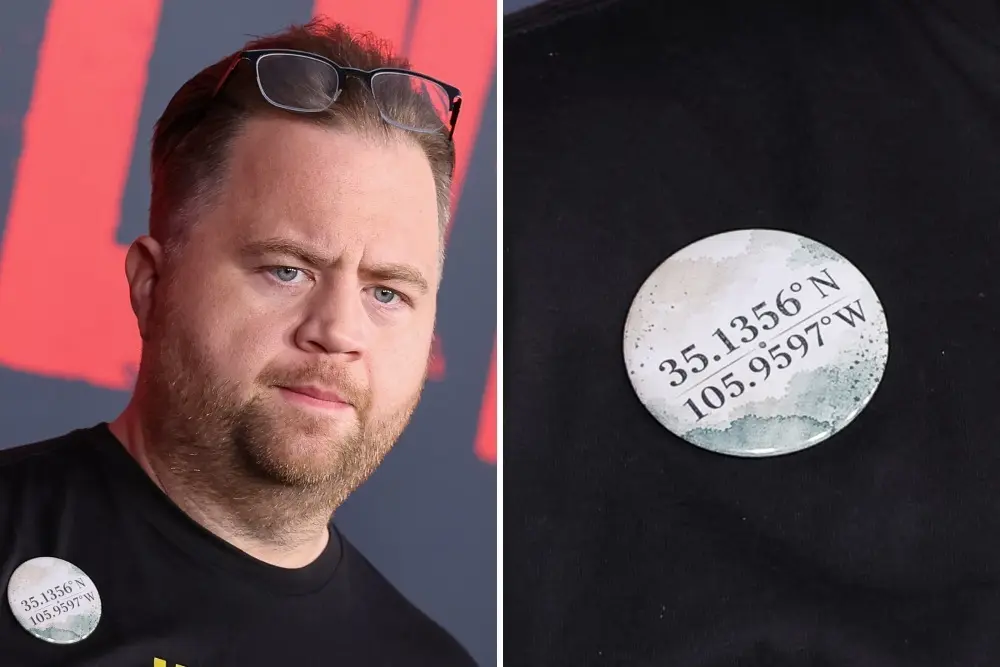
Rather than opting for conventional red-carpet attire designed simply to showcase luxury fashion houses, Hauser arrived in a minimalist black T-shirt adorned with pointed, controversial imagery and text. Affixed to his chest was a small, unassuming pin displaying precise geographic coordinates. To the casual observer, it might have appeared as a cryptic fashion choice or an abstract design. However, those numbers mapped directly to the sprawling, infamous Zorro Ranch in New Mexico—a property formerly owned by Jeffrey Epstein that has long been shrouded in allegations of systemic abuse, human trafficking, and profound institutional neglect.
Complementing the coordinates pin, the front of Hauser’s shirt bore a striking, yellow-lettered statement reading, "Kubrick Didn’t Kill Himself." While the latter served as a cheeky nod to internet lore surrounding the 1999 death of legendary filmmaker Stanley Kubrick, the underlying messaging of Hauser’s ensemble was deadly serious. The actor is deliberately using his visibility to challenge complacency within the entertainment community, demanding that his peers break their silence regarding the powerful figures allegedly implicated in the Epstein trafficking ring.
Hauser’s red-carpet statement is the latest development in a sustained, highly vocal crusade that began earlier this year on social media. By repeatedly calling out the selective activism of Hollywood elites—who frequently rally behind heavily publicized sociopolitical causes while remaining conspicuously quiet regarding the systemic exploitation of minors detailed in court documents—Hauser has positioned himself as an outlier in an industry that rarely welcomes internal dissent. As New Mexico state officials ramp up formal probes into the Zorro Ranch properties, Hauser’s ongoing activism serves as a high-profile reminder that public demand for accountability refuses to wane.
Detailed Chronology: From Social Media Outcry to Red-Carpet Activism
To fully understand the gravity of Paul Walter Hauser’s sartorial statement in Los Angeles, one must examine the timeline of his escalating critique against institutional silence in the entertainment industry.
The February Instagram Callout
The foundation for Hauser’s current advocacy was laid in February, when the actor took to Instagram to voice his profound frustration with what he perceived as selective outrage among his industry peers. Posting alongside an iconic image of Macaulay Culkin from the classic holiday film Home Alone, Hauser penned a searing open letter directed squarely at his "Hollywood Friends."
In the post, Hauser acknowledged that while Hollywood frequently mobilizes behind a myriad of worthy and critical global causes, a glaring blind spot persisted regarding the victims of Jeffrey Epstein. He pointedly noted that the unsealed Epstein court documents and investigative files had implicated figures across multiple sectors—including influential attorneys, high-ranking politicians, and prominent members of the entertainment media—in severe crimes against children and teenagers.
"Where are you now?" Hauser wrote, challenging the industry’s culture of performative activism and hashtag-driven solidarity. "Where are your voices and your hashtags now? Do you fear job loss? Death? Fear God. And protect children. And grow up. I don’t take my Emmy and Golden Globe with me when I die. The U-Haul truck will not follow the hearse in the funeral motorcade."
The post struck a nerve across digital platforms, dividing commentators between those who praised the actor for breaking ranks to advocate for vulnerable victims, and critics who questioned the efficacy—or tone—of leveraging high-profile cinematic references to address human trafficking. Despite the mixed discourse, Hauser remained resolute, refusing to walk back his comments or soften his critique.
The New Mexico Investigations (May)
As Hauser’s digital warnings circulated throughout the spring, structural developments outside of Hollywood began to catch up with the public discourse. In May, comprehensive reporting from outlets such as NPR revealed that state officials in New Mexico had officially launched fresh, targeted investigations into the allegations tied to Epstein’s Zorro Ranch.
For years, survivors and accusers have maintained that the sprawling New Mexico estate served as a primary locus for abuse, exploitation, and illicit activities facilitated by Epstein and his associates. The opening of new state-level probes provided renewed momentum to advocates who had long felt that institutional bodies were failing to pursue justice with the necessary aggression. This legal and investigative shift provided the contextual backdrop for Hauser’s subsequent public demonstrations, grounding his rhetoric in evolving real-world developments rather than transient internet speculation.
The Los Angeles Premiere Statement (Tuesday Night)
The culmination of Hauser’s months-long advocacy arrived on Tuesday night at the Los Angeles premiere of Resident Evil. Stepping onto the red carpet in his stark black T-shirt, Hauser ensured that his presence could not be dismissed as routine promotional pageantry.
When questioned about the pin affixed to his chest, Hauser did not shy away from detailing its significance. "The numbers on the pin were the coordinates of the Zorro Ranch in New Mexico," he explained to press members on the carpet. "It was at one point owned by Jeffrey Epstein. It’s shrouded in mystery, and then a church supposedly bought it, which is even more disconcerting, I think."

By highlighting the subsequent acquisition of the property by religious entities, Hauser pointed to a broader cultural unease regarding the sanitization or obfuscation of spaces historically linked to dark institutional crimes. He articulated a clear objective for his wardrobe choice: "I want to bring awareness to evil people who are surreptitious and need to have a little Google search done on them."
Supporting Context & Metrics: Unpacking the Symbolism and the Stakes
Paul Walter Hauser’s protest relies heavily on layered symbolism, touching upon the intersection of elite conspiracy culture, historic exploitation, and contemporary institutional accountability. Analyzing the individual components of his red-carpet statement reveals a deliberate strategy designed to maximize media attention.
The Zorro Ranch Coordinates
The geographic coordinates worn by Hauser point directly to Epstein’s 8,000-acre estate near Stanley, New Mexico. Purchased by Epstein in the early 1990s via a shell company, the ranch was designed as an isolated compound equipped with an airstrip, a massive main residence, and various outbuildings. Over the years, multiple civil lawsuits and criminal investigations have featured chilling testimonies from survivors alleging that minors were flown to the ranch and subjected to systematic abuse. Following Epstein’s 2019 death in a federal detention center, the property became the subject of complex legal maneuvers regarding victim compensation funds and asset liquidation, eventually changing hands through private real estate transactions.
The Kubrick Reference
Adding a layer of counterculture irony to his ensemble, Hauser’s shirt featured the prominent yellow text: "Kubrick Didn’t Kill Himself." When asked about the phrasing, Hauser readily admitted that he was having "fun referencing a little conspiracy theory."
Stanley Kubrick, widely regarded as one of the greatest and most meticulous directors in cinematic history (known for masterpieces such as 2001: A Space Odyssey, The Shining, and Eyes Wide Shut), died peacefully in his sleep from a heart attack on March 7, 1999, at his estate in Hertfordshire, England, at the age of 70. Despite official medical confirmation regarding the natural causes of his death, internet subcultures and alternative theorists have long speculated about the timing—occurring shortly after he completed the final cut of Eyes Wide Shut, a film that famously explores the secret rituals and masked parties of an ultra-wealthy, secretive elite.
By juxtaposing a lighthearted nod to a famous Hollywood conspiracy theory with the harrowing, well-documented realities of the Epstein files, Hauser created a jarring juxtaposition. It served to question how Hollywood processes institutional secrets, drawing a line between speculative internet lore and verifiable, systemic criminality.
Official Statements and Industry Reactions
The reception to Paul Walter Hauser’s outspoken activism has laid bare the complex relationship between Hollywood creatives and the socio-political issues that shadow the industry.
Hauser’s Defensive of Transparency
In his interactions with the media, Hauser has consistently emphasized that his primary motivation is the protection of children and the dismantling of a culture of fear that protects predatory behavior. Unlike many public figures who issue carefully scrubbed, public relations-approved statements written by crisis management teams, Hauser’s delivery remains raw, unfiltered, and deeply personal.
His insistence that material possessions—such as his Emmy and Golden Globe awards—hold no spiritual or moral value in the face of systemic child exploitation resonates with a populist sentiment that views Hollywood as fundamentally out of touch with foundational human ethics. By challenging his peers to risk their social standing and career trajectories for the sake of justice, Hauser is directly interrogating the industry’s unspoken code of silence.
Public and Media Response
Media analysts and entertainment commentators have noted that Hauser’s approach represents a rare breed of unfiltered celebrity activism. In an era where brand safety and corporate synergy govern almost every public appearance made by major studio actors, a star voluntarily wearing coordinates of an abuse site and challenging elite complicity on a red carpet is virtually unprecedented.
While mainstream studio representatives have largely avoided commenting on Hauser’s wardrobe choices—hoping to keep the focus strictly on the Resident Evil promotional cycle—social media platforms have seen a surge of engagement. Supporters have praised Hauser’s courage, arguing that his willingness to utilize red-carpet platforms for serious whistleblowing sets a necessary precedent. Conversely, critics occasionally point out the risk of conflating verifiable judicial documents with internet-adjacent conspiracy theories, noting that sensationalizing real-world tragedies can sometimes obscure the rigorous work required by legal investigators.
Future Outlook: The Ongoing Fallout for Hollywood and New Mexico
As the calendar moves forward, the ramifications of the Epstein files and the subsequent investigations into properties like the Zorro Ranch are far from resolved. Paul Walter Hauser’s public demonstrations ensure that the conversation remains firmly entrenched in the public consciousness, preventing the entertainment industry from sweeping the issue under the rug.
- State-Level Investigations in New Mexico: With local and state authorities actively probing the allegations tied to the Zorro Ranch, legal experts anticipate further revelations as testimonies are gathered, documents are scrutinized, and potential civil or criminal actions are weighed against associated entities.
- Shifting Celebrity Activism: Hauser’s vocal stance may pave the way for other artists to speak more freely about institutional corruption without fearing immediate industry blacklisting. As public tolerance for institutional opacity dwindles, performers who demand transparency may find a more receptive audience among fans and independent media.
- The Cultural Legacy of Accountability: Whether through social media critiques, red-carpet fashion statements, or direct engagement with investigative journalism, Paul Walter Hauser has firmly established himself as an actor willing to trade comfort for conscience. As the broader fallout from the Epstein files continues to unfold across legal, political, and cultural landscapes, Hauser’s unyielding message remains clear: the pursuit of truth and the protection of the vulnerable must always supersede the comfort of the status quo.