Executive Overview
The global feminist movement and the literary world are in mourning following the passing of Gloria Steinem, a preeminent trailblazer, investigative journalist, and the undisputed architect of contemporary second-wave feminism. Steinem passed away peacefully on September 2 at her home in New York City, surrounded by close loved ones, at the age of 92, according to an official statement released across her verified social media channels.
For over six decades, Steinem served as a cultural compass, shifting national discourse on gender equality, reproductive rights, civil rights, and systemic equity. From her groundbreaking 1963 undercover exposé on the exploitative working conditions at Hugh Hefner’s Playboy Club to co-founding the revolutionary Ms. magazine in 1972, she continuously subverted patriarchal systems using the written word as her primary tool. Her influence transcended political platforms and literary circles, permeating pop culture, fashion, academia, and global human rights initiatives.

In the wake of her passing, an unprecedented wave of grief and gratitude has poured forth from international leaders, activists, award-winning authors, and prominent cultural figures. Tributes from figures such as Barack and Michelle Obama, Hillary Clinton, Oprah Winfrey, Meghan Markle, and a diverse coalition of contemporary artists underscore a singular, resounding sentiment: modern society owes its architectural foundation of gender parity to Gloria Steinem’s unwavering resolve.
Detailed Chronology: A Life of Unrelenting Activism
The Early Years and Journalistic Beginnings
Born in Toledo, Ohio, in 1934, Steinem’s early life was marked by a nomadic childhood and an unconventional upbringing that instilled in her a deep sense of independence. After graduating from Smith College, she spent time in India on a Chester Bowles Student Fellowship, an experience that profoundly shaped her global perspective on systemic poverty and women’s rights. Returning to the United States in the late 1950s, she quickly established herself as a formidable freelance journalist in New York City.

The Playboy Club Exposé (1963)
Steinem’s breakthrough into investigative journalism came when she secured employment as a "Bunny" at the New York Playboy Club for Show magazine. Her subsequent two-part article, "A Bunny’s Tale," published in 1963, exposed the grueling labor conditions, low wages, mandatory medical checks, and pervasive sexual harassment faced by women working in the club. This early piece of immersion journalism not only cemented her reputation as a serious reporter but also laid the groundwork for her lifelong critique of the commercial exploitation of women’s bodies.
The Rise of Ms. Magazine and Second-Wave Feminism
Throughout the late 1960s and 1970s, Steinem transitioned from a keen observer of social movements to their central catalyst. In 1969, she published an article titled "After Black Power, Women’s Liberation" for New York magazine, which catapulted her to national prominence as a leading voice for women’s liberation.

Recognizing the desperate need for a media outlet created by and for women that spoke directly to their lived experiences—free from the traditional confines of homemaking and beauty tropes—Steinem co-founded Ms. magazine in 1972 alongside prominent feminist organizers like Dorothy Pitman Hughes and Letty Cottin Pogrebin. Ms. quickly became an indispensable cultural institution, fearlessly addressing taboo subjects such as domestic violence, abortion rights, workplace discrimination, and reproductive freedom.
Supporting Context & Metrics: Steinem’s Enduring Cultural Footprint
Steinem’s impact on American culture cannot be overstated. Her career offers a masterclass in how investigative reporting can directly inform legislative and social change.

- Media Evolution: Steinem’s journey bridged the gap between mid-century women’s periodicals and the radical feminist press. Reflecting on her time writing for Cosmopolitan under Helen Gurley Brown during a 1974 interview with The New York Times, Steinem noted:
"Cosmopolitan was a step forward from the formula of the traditional magazines that if you got divorced or had affairs before marriage, you would come to a bad end… If one magazine says women are sexual, it’s an improvement. In the land of the blind, the one-eyed is king."
- Awards and Accolades: In recognition of her lifetime dedication to social justice, President Barack Obama awarded Steinem the Presidential Medal of Freedom—the nation’s highest civilian honor—in 2013.
- Biographical Representation: Her sprawling, intersectional life story was adapted to the screen in the acclaimed 2020 cinematic biography The Glorias, showcasing how her coalition-building bridged generational and racial divides.
Official Statements and Tributes
The outpouring of grief following Steinem’s passing highlighted the profound, deeply personal connections she forged across generations of public figures and change-makers.

Global Leaders and Political Figures
- Barack and Michelle Obama: In a joint statement, the former president and first lady reflected on her monumental stature, writing: "Gloria really was larger than life. Today, generations of women are walking a little taller and aiming a little higher because of what she fought for and achieved."
- Joe and Jill Biden: Dr. Jill Biden shared via social media: "Joe and I are holding Gloria’s loved ones in our hearts today. Her voice changed our country, and her courage will continue to inspire us to keep fighting for the freedoms she spent her life defending."
- Hillary Clinton: Concluding a lengthy and reflective tribute, the former Secretary of State wrote: "Be like Gloria: Embody possibility, and extend it. In us, she will live on."
- Nancy Pelosi: Former Speaker of the House Nancy Pelosi emphasized the continuity of her mission, stating: "May it be a comfort to all of us who loved Gloria that her extraordinary legacy will live on in every generation that carries her fight forward."
- Stacey Abrams: The voting rights activist and former Georgia lawmaker noted: "Meeting heroes always risks disappointment, but knowing Gloria was an honor, where her humor and kindness were matched by a relentless belief that we could be better."
Cultural Icons and Entertainment Figures
- Oprah Winfrey: Acknowledging the profound debt owed to the pioneer, Winfrey wrote: "I was proud to bear witness to their sense of worthiness and independence—and recognized how Gloria’s work had helped forge the path to that moment. We as women owe her so much."
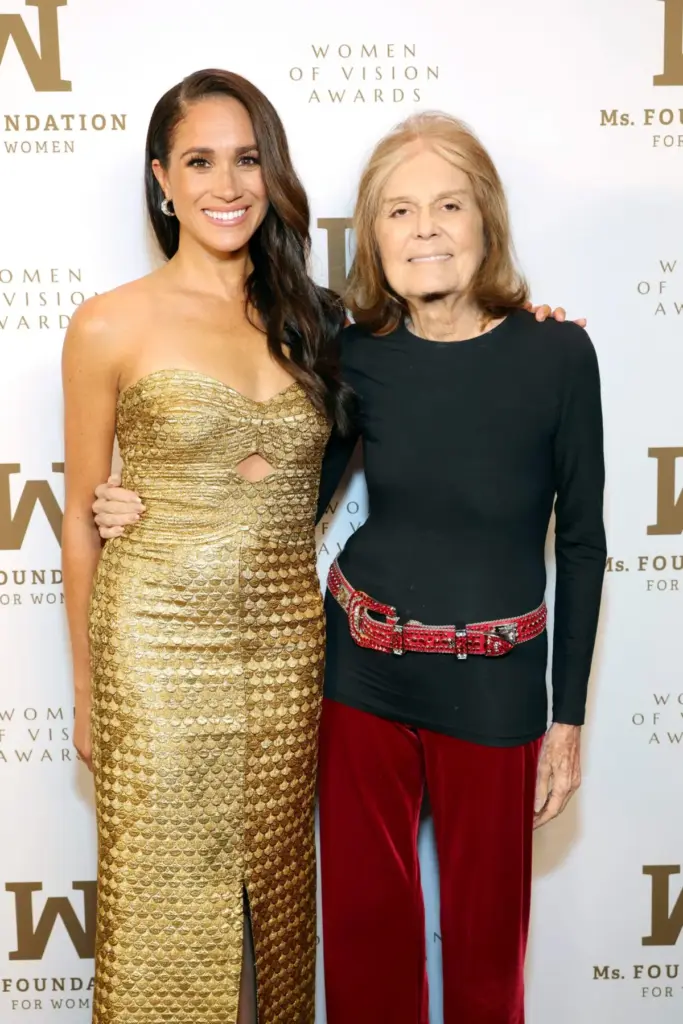
- Meghan Markle, The Duchess of Sussex: Sharing a moving reflection on her mentor and friend, Markle noted: "But privately, she was even better than you would imagine… Rest in peace, and rest in pride. Look at what you’ve done for all of us. Thank you."
- Julianne Moore: Having portrayed Steinem in The Glorias, the Academy Award-winning actor stated: "The time I spent studying Gloria Steinem in order to play her was one of the most edifying of my life."
- Lena Dunham: Sharing an intimate anecdote of Steinem’s generosity, Dunham recalled: "You weren’t just generous with your life force, your vision or your intellect: you were generous with your time, your laughter and even your jewelry," noting how Steinem once took a silver vulva ring off her own finger to gift it to her.
- Sandra Bullock: The celebrated actor shared on her Instagram Stories: "With her bare hands and force of will, she paved the roads that millions of us are able to walk on."
- Melinda French Gates: Philanthropist Melinda French Gates highlighted Steinem’s ability to empower others: "Her dedication helped illuminate a simple truth: When women can stand in their power, they invite everyone else to stand a little taller, too. What a light she was for me and so many others. What a debt we owe her."
- Brooke Shields: Summarizing the sentiment of many who found personal guidance in Steinem’s orbit, Shields wrote: "Role model, mentor, inspiration, fighter, friend. You made women feel seen and helped them understand their value. It was a huge blessing in my life to know you…"
Future Outlook: Carrying the Torch
As the world processes the loss of Gloria Steinem, the imperative shifts from mourning to preservation and action. Steinem never viewed feminism as a static achievement, but rather as an ongoing, living practice requiring constant vigilance, intersectional solidarity, and uncompromising courage.
In an era where reproductive rights, bodily autonomy, and democratic institutions face renewed global challenges, Steinem’s blueprint for grassroots activism remains more vital than ever. Her passing marks the end of an era for the foundational architects of second-wave feminism, yet her framework lives on through the millions of women, men, and non-binary individuals who refuse to quiet their voices in pursuit of equity.

Gloria Steinem’s final chapter has closed, but the road she paved stretches infinitely forward—illuminated by the enduring fires of a movement she spent her entire life fueling.