Executive Overview
The United Kingdom’s aviation network remains in a state of severe disarray following a catastrophic technical failure at National Air Traffic Services (NATS) that crippled flight operations nationwide. The system glitch, which struck on Tuesday and forced the cancellation of roughly 1,300 flights across the UK, has cascaded into a second day of widespread chaos, leaving tens of thousands of passengers stranded, terminals overcrowded, and airlines openly feuding with air traffic executives.
Major transport hubs—most notably London Heathrow, Gatwick, Stansted, and Manchester—have been pushed to their absolute limits. British Airways alone was forced to axe upwards of 190 flights from its Wednesday schedule following an initial 246 cancellations at Heathrow. Meanwhile, low-cost carriers like Ryanair and Wizz Air have reported tens of thousands of affected travelers. The crisis has exposed deep vulnerabilities in the UK’s airspace infrastructure, prompting furious calls for leadership resignations, emergency government interventions, and urgent parliamentary scrutiny.
As transport officials scramble to restore normal operations, the fallout has extended far beyond airport terminals. Rail disruptions, highway closures, and even elite sports logistics have been swept up in the vortex of the meltdown. This comprehensive report details the anatomy of the crisis, the immediate operational impacts, the war of words between airlines and regulators, and what this means for the future of British air travel.
Detailed Chronology of the Crisis
Tuesday: The Outage and Initial Meltdown
The crisis began unfolding midday on Tuesday when NATS—the primary provider of air traffic control services across 15 UK airports—encountered a critical system failure. Initially, departures at London Heathrow were abruptly paused around lunchtime as controllers lost digital visibility and routing capabilities. Although flights briefly resumed, the reprieve was short-lived.
By the afternoon, the tarmac gridlock reached breaking point. Because grounded aircraft could not clear the gates, Heathrow quickly ran out of physical space to accommodate incoming flights, forcing widespread ground stops. Flight monitoring platform Flightradar24 ultimately logged 1,300 flight cancellations to and from UK airports by the end of the day.
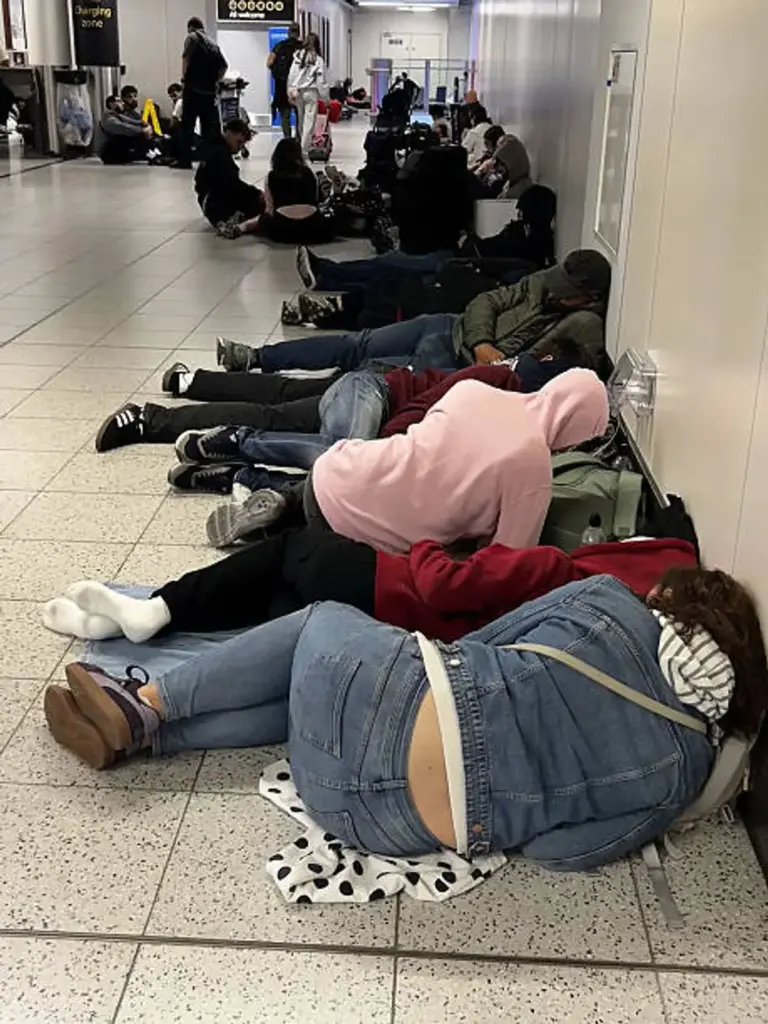
Passengers reported nightmarish scenes inside terminals. Josie Donoghue, trapped on a grounded flight to Ireland at Gatwick for three hours before disembarking, likened navigating the terminal to "trying to get out of Alcatraz." Thousands of travelers found themselves sleeping on terminal floors, queuing for hours at baggage claims, or confined to aircraft. On a British Airways flight bound for Baltimore, passengers endured a four-hour ground delay, during which flight attendants served pasta and chicken curry while travelers watched movies in the aisles.
Even high-profile travelers were caught in the crosshairs. Arsenal Football Club’s travel plans for an upcoming Champions League clash against Napoli were thrown into disarray, forcing the team to delay their departure from their training ground as the airspace gridlock choked off departures.

To alleviate the compounding backlog, aviation authorities were forced to take the rare step of lifting Heathrow’s strict night-time noise curfews, allowing displaced flights to land and depart during the early hours of Wednesday morning. Simultaneously, local emergencies compounded the transport misery; a police-led incident forced the complete closure of the M4 motorway in both directions between Junction 3 (Harrow) and Junction 4 (Heathrow) in the dead of night, leaving motorists trapped in stationary traffic queues beneath the flight path.
Wednesday: The Morning After and Ongoing Disruption
By Wednesday morning, the promised recovery proved agonizingly slow. NATS officially announced that the technical issue had been resolved by 7:30 PM on Tuesday, but the ripple effects transformed Wednesday into what travel journalist Simon Calder warned would be a "horrible" day for aviation.
As dawn broke over London Heathrow Terminal 5, an "uneasy feeling" pervaded the concourses. PA systems continuously broadcast new delay announcements, while baggage reclaim areas ground to a halt due to scrambled flight schedules and misplaced luggage. Queues at British Airways check-in desks stretched back deep into the terminal halls, with exhausted passengers resorting to sitting atop baggage trays and trolleys while awaiting word on rescheduled services.
Flight statistics compiled by Wednesday morning painted a bleak picture:
- Heathrow Airport: Recorded 246 cancellations by 6:00 AM, with at least 177 additional cancellations logged specifically for Wednesday.
- Gatwick Airport: Grappled with 33 initial cancellations, issuing warnings that operations would take considerable time to normalize.
- Regional Hubs: Manchester Airport reported nine cancellations, Bristol logged five, and Stansted recorded single-digit cancellations alongside broader knock-on delays.
Adding insult to injury, rail infrastructure also buckled under the strain. National Rail warned commuters of severe disruption between Purley and Gatwick Airport due to a broken-down train blocking lines, alongside lingering reductions on the Heathrow Express route following a recent major fire at Scrubs Lane in North Kensington.
Supporting Context & Metrics
The Scale of the Disruption
The sheer magnitude of the NATS failure places it among the most disruptive aviation incidents in recent British history, threatening to rival the infamous airspace shutdown of August 2023.
- 1,300: Total flights canceled across UK airports on Tuesday alone.
- 279+: Additional cancellations recorded across Heathrow and Gatwick by Wednesday morning.
- 65,000+: Ryanair passengers directly impacted by the disruption, alongside tens of thousands more managed by British Airways, EasyJet, and Wizz Air.
- 15: The number of primary UK airports directly reliant on NATS air traffic control architecture.
Parallels to the August 2023 Meltdown
The incident has triggered painful memories of the August 2023 NATS technical meltdown, which grounded over 2,000 flights and impacted more than 700,000 passengers. An independent inquiry by the Civil Aviation Authority (CAA) into that previous incident exposed critical institutional shortcomings, including a "significant lack of pre-planning," a paucity of multi-agency crisis rehearsals, and an over-reliance on remote working arrangements for maintenance engineers during public holidays.

Critics and airline executives have been quick to point out that despite sweeping post-2023 promises of modernization and fail-safe redundancy, the UK aviation network remains vulnerable to single-point technical failures.
Official Statements and Industry Reactions
NATS Defends its Record While Acknowledging Responsibility
Martin Rolfe, Chief Executive Officer of NATS, faced a grueling media rounds on Wednesday, defending the organisation while absorbing intense criticism. Speaking on BBC Radio 4’s Today programme, Mr Rolfe categorically ruled out malicious cyber activity as the root cause of the crash.
"We will be doing a very, very thorough and full investigation," Rolfe stated. "At this point, we have ruled out cyber. We don’t believe it was a cyber-attack."
Addressing the broader anger from passengers and carriers, Rolfe said: "I absolutely understand the frustration. There is nothing we hate more than delaying people and not allowing them to get to their destination. We never do this lightly… I don’t believe we’ve ever seen an incident happen more than once. So this will be something different, something that we’ve never seen in 50 years of operation."
When pressed on whether he would step down or accept personal accountability, Rolfe maintained: "I always accept full responsibility… what I absolutely take responsibility for is keeping people safe and delivering the best service we possibly can."
Airlines Launch Furious Attacks on NATS Leadership
While Rolfe preached patience, airline executives launched scathing verbal assaults on NATS management, demanding immediate accountability and systemic overhauls.
Neal McMahon, Chief Operating Officer of Ryanair, did not mince words during an appearance on Sky News. McMahon renewed Ryanair’s formal demand for Martin Rolfe’s immediate resignation, accusing the NATS chief of having "presided over a litany of IT failures in the UK" that are virtually unheard of elsewhere in European airspace.

"More than 200 Ryanair flights were cancelled all because NATS does not have a functioning backup system for when these types of events happen," McMahon charged, emphasizing that the failure mirrored the systemic weaknesses exposed in August 2023.
Budget carrier Wizz Air echoed these sentiments, releasing a blistering statement declaring that NATS is "simply not fit for purpose in its current form."
Government Intervention
Political pressure is mounting rapidly. Transport Secretary Heidi Alexander is scheduled to hold direct, high-level talks with NATS CEO Martin Rolfe later today. The timing is politically sensitive, as Alexander is simultaneously set to address Members of Parliament in the House of Commons for the second reading of the upcoming Civil Aviation Bill. Parliamentarians from across the political spectrum are expected to use the debate to demand answers regarding the resilience of critical national infrastructure and whether tougher regulatory penalties should be imposed on air traffic monopoly providers when systemic failures occur.
Future Outlook: The Long Road to Recovery
As the aviation industry looks toward the remainder of the week, the immediate priority remains operational stabilization. Both Heathrow and Gatwick airports have issued stern advisories urging passengers not to travel to terminals unless their specific flight status has been explicitly confirmed as operating by their airline.
Key Challenges Ahead
- Aircraft and Crew Dislocation: Because aircraft and flight crews were displaced to various airports across Europe and domestic hubs, airlines face a logistical marathon to reposition assets back to primary bases like Heathrow and Gatwick.
- Backlog Clearance: Clearing the backlog of tens of thousands of delayed and bumped passengers will take days, particularly given that late-summer flight schedules are already running near maximum capacity.
- Regulatory and Financial Fallout: Airlines will face substantial compensation payouts under UK passenger rights regulations. This is expected to trigger a wave of legal and financial wrangling between carriers and NATS over liability for the multi-million-pound losses incurred.
- Structural Reform: The impending discussions between Transport Secretary Heidi Alexander and NATS leadership will likely dictate whether the government mandates independent technological audits, accelerated infrastructure upgrades, or structural changes to the UK’s air traffic control governance.
For now, the overarching mood across British aviation remains one of exhaustion and heightened vigilance. Until NATS completes its forensic investigation into this unprecedented 50-year system anomaly, millions of travelers and commercial operators will be left wondering when—not if—the next digital fault line will test the limits of Britain’s skies.