By Rachel Vickers-Price | UK and World News Reporter
Published: September 9, 2026
Executive Overview
In a landmark moment for British television and global conservation, Sir David Attenborough has triumphed at the National Television Awards (NTAs), capturing the prestigious TV Presenter prize at the remarkable age of 100. Besting a formidable shortlist of entertainment heavyweights—including Alison Hammond, perennial favourites Ant and Dec, Claudia Winkleman, and Stacey Solomon—the internationally adored naturalist claimed the top honour in a category traditionally dominated by light-entertainment stars.
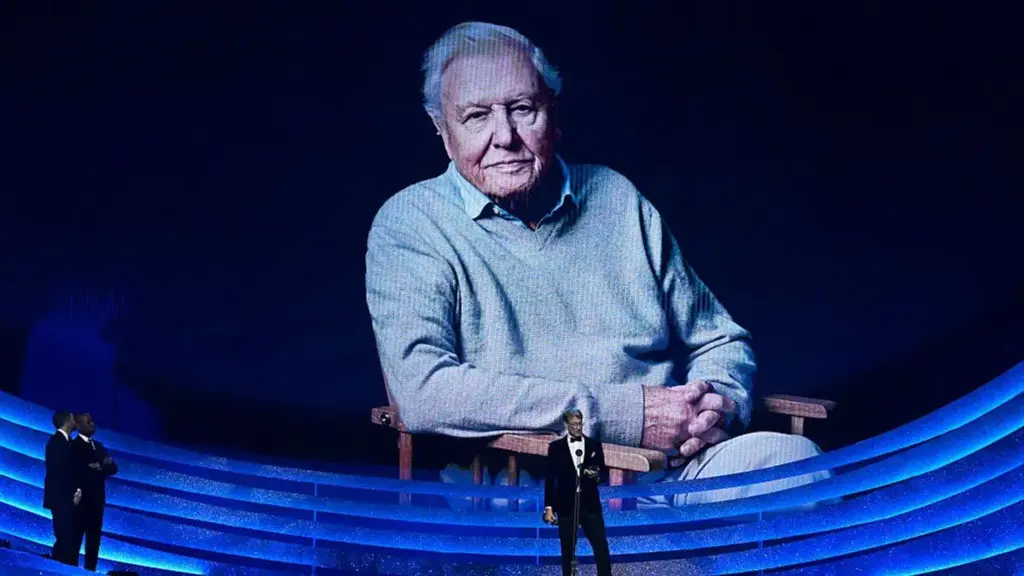
Though Sir David was absent from the live ceremony, his acceptance speech resonated deeply across the auditorium and through living rooms nationwide. Eschewing the conventional platitudes typical of award acceptance speeches, Attenborough leveraged his moment in the spotlight to issue an urgent, unvarnished plea regarding the "terrible plight of our wonderful planet."
This latest accolade underscores a career spanning seven decades, cementing his status not merely as a broadcaster, but as the defining voice of the natural world. Yet, as this comprehensive report will explore, the milestone arrives at a critical juncture where the lines between broadcast entertainment and environmental advocacy have never been more blurred.
Detailed Chronology: A Historic Night and a Legacy in Motion
The atmosphere at the National Television Awards was electric as the nominees for the TV Presenter category were announced. The lineup represented the pinnacle of contemporary British broadcasting: Alison Hammond’s infectious daytime warmth, the infallible entertainment empire of Ant and Dec, Claudia Winkleman’s masterclasses in reality television hosting, and Stacey Solomon’s deeply relatable domestic charm.
Yet, when the envelope was opened, it was the centenary broadcaster—whose career began when television was still in its infancy—who emerged victorious.
While Sir David did not attend the gala in person, an acceptance speech delivered on his behalf silenced the room. The address moved fluidly from an expression of profound gratitude to a stark reminder of humanity’s ecological obligations.
"I hope this award is a response to the part television has played in growing recognition, not only for the terrible plight our wonderful planet is in as a result of human activity," the speech conveyed, "but also of the fact we now have a pressing responsibility to do what we can to protect and conserve it."
This victory marks another high point in a stellar year for the naturalist. Earlier in the evening, Sir David had also been nominated in the Factual Entertainment category for his critically acclaimed nature documentary, Secret Garden. Although that specific accolade ultimately went to Channel 4’s cultural phenomenon Gogglebox, the dual recognition highlighted the sheer breadth of his ongoing creative output even at 100 years of age.
Supporting Context & Metrics: Seven Decades of Broadcasting Excellence
To understand the magnitude of Sir David’s NTA win, one must look back at a broadcasting career that fundamentally shaped how humanity perceives the Earth.
The Evolution of a Pioneer
Sir David’s journey as a presenter commenced in 1954 with the groundbreaking series Zoo Quest, a production that transported British viewers to exotic locations previously accessible only to elite explorers. Armed with a curiosity-driven narrative style, he pioneered a genre of television that bridged scientific discovery with popular entertainment.
Over the subsequent decades, his filmography grew into a masterclass of natural history programming:

- The Life Collection: Comprehensive taxonomic explorations spanning mammals, birds, plants, and reptiles.
- Natural World & Wildlife on One: Benchmark BBC series that brought intimate animal behaviours into millions of homes.
- The Planet Earth Franchise: Revolutionary landmark series that set new benchmarks in high-definition cinematography and global viewership.
- The Blue Planet & Frozen Planet: Deep dives into Earth’s most extreme and vulnerable ecosystems.
Industry Impact and Ratings
Statistically, Attenborough’s programmes have consistently shattered records. Planet Earth II (2016) and Blue Planet II (2017) drew peak UK audiences exceeding 14 million viewers per episode, frequently outperforming prime-time drama and reality television. More importantly, these series triggered real-world cultural shifts—most notably the "Blue Planet effect," a surge in public consciousness and legislative action regarding single-use plastics following the exposure of ocean pollution in 2017.
| Milestone / Metric | Detail | Significance |
|---|---|---|
| Broadcasting Debut | 1954 (Zoo Quest) | Established wildlife documentary as a mainstream television staple. |
| Peak Viewership | 14M+ per episode (Planet Earth II / Blue Planet II) | Proved that natural history could dominate prime-time ratings. |
| NTA Recognition | TV Presenter Award at Age 100 | Demonstrates enduring cultural relevance across generations. |
| Global Reach | Broadcast in over 100 countries | Unprecedented international educational impact. |
Official Statements and Industry Reactions
The reaction to Sir David’s NTA win was swift, cutting across political, scientific, and entertainment spheres. Broadcasters, environmentalists, and fellow nominees praised the decision as a triumph of substance over style.
In his read speech, Sir David emphasized that systemic environmental repair requires more than high-level policy; it demands grassroots commitment:
"We are increasingly aware that if we are to repair the planet we need major national and international initiatives which certainly require our support, but it is also possible to make small differences in our own spaces and neighbourhoods. If enough small differences are made they do add up to doing something significant, while also providing spaces that we do enjoy being in and nurturing."
Fellow nominees and industry figures took to social media and post-show interviews to express their admiration. Insiders noted that losing to Sir David was, in effect, a victory for the entire television industry, validating the public’s appetite for programming with a profound moral and educational purpose.
Attenborough’s address concluded with a philosophical, urgent reminder of our evolutionary tether to the natural world:
"Humanity has always needed the natural world for all the practicalities of life and for our mental wellbeing. Now the natural world needs us too. Surely we must not ignore that simple fact."
Future Outlook: The Enduring Legacy and the Road Ahead
As Sir David Attenborough enters his second century of life, his influence shows no signs of waning. The NTA win serves as a powerful cultural barometer: in an era saturated with fast-paced, algorithm-driven digital content, the public continues to gravitate toward authentic, authoritative storytelling rooted in ecological stewardship.
The Next Generation of Conservation Broadcasters
The challenge facing the television industry moving forward is twofold: maintaining the high production values pioneered by Attenborough’s units at the BBC Natural History Unit and other production houses, and finding ways to translate his unique blend of academic rigour and gentle persuasion to younger audiences.
Projects like Secret Garden demonstrate that innovation remains alive in his work, shifting focus to micro-ecosystems and accessible green spaces that viewers can cultivate in their own backyards. This aligns directly with his NTA message regarding the power of "small differences" made in local neighborhoods.
A Permanent Cultural Landmark
Sir David’s centennial award is more than a trophy on a mantelpiece; it is a public referendum on the value of environmental journalism. As global policymakers grapple with climate change, biodiversity loss, and resource depletion, the cultural space carved out by Attenborough remains an indispensable bridge between scientific reality and public action.
Ultimately, the 2026 National Television Awards will be remembered not for the glamour of the red carpet, but for the moment a 100-year-old broadcaster used the nation’s biggest entertainment stage to remind us that the earth’s survival is the ultimate drama—one in which every human being plays a starring role.