
Executive Overview
Few partnerships in contemporary cinema capture the public imagination quite like Penélope Cruz and Javier Bardem. Spanning more than three decades, their parallel journeys from the vibrant auteur-driven golden age of Spanish cinema to the upper echelons of Hollywood stardom represent an enduring masterclass in both artistic collaboration and personal discretion.
Long before they were Academy Award winners, international style icons, and parents to two children, Cruz and Bardem crossed paths in the sun-baked expanses of Spain’s Monegros desert on the set of Bigas Luna’s 1992 dark comedy, Jamón, Jamón. What began as a foundational professional encounter—one that vaulted a teenage Cruz into national prominence and solidified Bardem’s status as a formidable rising force—morphed over the ensuing decades into a profound creative synergy and, ultimately, one of Hollywood’s most stable and fiercely guarded marriages.
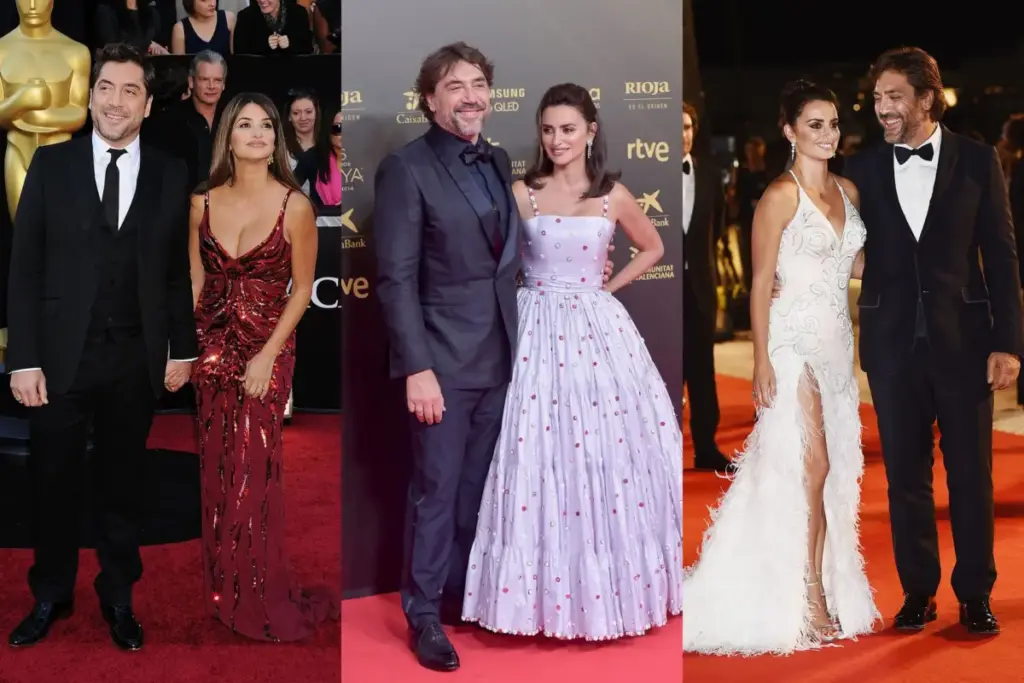
As the power couple prepares for their high-profile red-carpet reunion at the Venice Film Festival to premiere their latest psychological drama, Bunker, the industry finds itself once again captivated by their undeniable chemistry. Playing a married couple whose lives unravel following a morally dubious architectural commission, Cruz and Bardem continue to demonstrate that their off-screen bond only serves to heighten their on-screen electricity.
This retrospective examines their extraordinary trajectory: a three-decade masterclass in navigating fame, artistic risk, high-fashion red carpets, and a multi-generational cinematic legacy that continues to define modern European and American film.
Detailed Chronology: Three Decades of Collaboration and Commitment
1992–1999: The Genesis of a Lifelong Creative Partnership
The story of Penélope Cruz and Javier Bardem begins in the humid, raw environment of Bigas Luna’s Jamón, Jamón (1992). Cruz, making her feature-film debut at just 18 years old, portrayed Silvia, a young factory worker caught in a frantic, darkly comic love triangle against the stark backdrop of rural Spain. Bardem, already building a reputation for intense, physical character work, played Raúl, an aspiring bullfighter and underwear model. The film was a critical sensation in Spain, notorious for its provocative imagery and satirical bite, and it instantly catapulted both young actors into the national consciousness.
Though their characters shared intense screen time, a romance did not immediately ignite. Instead, the film established a professional foundation. Recognizing each other’s relentless work ethic and fierce commitment to their craft, directors quickly realized the value of pairing them together.
Throughout the mid-to-late 1990s, Spanish and European cinema capitalized on their dynamic. They reunited in Emilio Martínez Lázaro’s romantic comedy Love Can Seriously Damage Your Health (1996) before delivering a masterwork of psychological tension in Pedro Almodóvar’s critically acclaimed Live Flesh (1997). By the time the 20th century drew to a close, Cruz and Bardem were no longer just promising local talents; they were individual artistic forces on the precipice of global stardom.
2000–2010: Hollywood Stardom and the Turn to Romance
The turn of the millennium marked their respective breakthroughs into the English-language market. Bardem earned an Academy Award nomination for Best Actor for his haunting portrayal of Cuban poet Reinaldo Arenas in Julian Schnabel’s Before Night Falls (2000), while Cruz captured international headlines with high-profile American projects like Vanilla Sky (2001) and Blow (2001).

Despite their branching international careers, Spanish cinema kept pulling them back together. They appeared alongside one another in Agustín Díaz Yanes’s 2001 adventure-drama Don’t Tempt Me (Sin noticias de Dios). Yet, it was Woody Allen’s sun-drenched 2008 romantic comedy-drama Vicky Cristina Barcelona that served as the true catalyst for their personal evolution. Playing the volatile, brilliant, and fiercely passionate artist couple Juan Antonio and María Elena, Cruz and Bardem achieved a new tier of critical acclaim. For her breathtaking, volcanic performance, Cruz made history by becoming the first Spanish actress to win an Academy Award, taking home the Oscar for Best Supporting Actress.
Behind the scenes, the boundary between professional collaboration and personal affection finally dissolved. It was reportedly on the set of Vicky Cristina Barcelona that their long-standing friendship blossomed into a romance. Keeping true to their notoriously private natures, the couple kept their relationship out of the relentless Hollywood spotlight, quietly becoming engaged in 2009. In July 2010, they formalized their partnership in an intimate, low-profile ceremony at a friend’s home in the Bahamas, surrounded only by family members.
2011–Present: Family, Prestige Projects, and the Bunker Era
As a married couple, Cruz and Bardem entered a mature phase of their careers marked by selective, high-impact projects and a steadfast commitment to family life. They welcomed their first child, a son named Leo, in January 2011, followed by a daughter, Luna, in July 2013. Rather than letting family life slow their output, both actors continued to rack up prestigious credits—Bardem claiming an unforgettable Oscar for his chilling turn as villain Silva in the James Bond film Skyfall (2012), and Cruz earning subsequent Oscar nominations for her work in Nine (2009) and Pedro Almodóvar’s Parallel Mothers (2021).
In 2017, the couple took on one of their most physically and emotionally demanding joint projects to date: Fernando León de Aranoa’s biographical crime drama Loving Pablo. Portraying notorious Colombian drug lord Pablo Escobar and his real-life lover, journalist Virginia Vallejo, Cruz and Bardem delivered unflinching, gritty performances that showcased their ability to share the screen without eclipsing one another.
Now, nearly a decade after Loving Pablo, Cruz and Bardem are reuniting for Bunker. Directed with psychological acuity, the film casts them as Miguel and Sofia, a married couple whose comfortable existence is abruptly shattered when Miguel—a successful London architect—accepts a lucrative yet morally compromising commission to construct an elite survivalist bunker for an eccentric tech billionaire. The film explores themes of paranoia, ethical decay, and marital strain, offering a showcase for two actors whose shared history allows them to project profound intimacy and underlying tension with effortless authenticity.
Supporting Context & Metrics: The Box Office and Critical Footprint
To fully understand the cultural weight of Penélope Cruz and Javier Bardem, one must examine the staggering quantitative metrics behind their individual and collective filmographies.
- Academy Recognition: Together, the couple commands an elite pedigree. Javier Bardem has received four Academy Award nominations (winning Best Supporting Actor for No Country for Old Men in 2008), while Penélope Cruz has earned four nominations as well, securing the Best Supporting Actress statuette for Vicky Cristina Barcelona in 2009.
- Global Box Office Impact: Across more than 120 combined feature film credits, Cruz and Bardem’s cinematic footprint accounts for billions of dollars in worldwide box office receipts, ranging from massive blockbuster franchises (Pirates of the Caribbean, Dune, James Bond) to revered European art-house masterpieces.
- Festival Prestige: Both actors are mainstays at the world’s most prestigious film showcases—Cannes, Venice, Toronto, and Berlin. Notably, Bardem holds the distinction of winning the Best Actor award at the Cannes Film Festival (Biutiful, 2010), while Cruz has claimed the prestigious Volpi Cup for Best Actress at the Venice Film Festival (Parallel Mothers, 2021).
- The Rare On-Screen Couple Dynamic: It is exceedingly rare for A-list married actors to maintain long-term box office viability while repeatedly sharing the screen. Unlike partnerships that suffer from overexposure, Cruz and Bardem’s strategy of spacing out their joint appearances—averaging a collaboration roughly once every decade—ensures that each reunion feels like a monumental event for cinema enthusiasts.
Official Statements and Industry Perspective
While Cruz and Bardem guard their personal lives with legendary discretion, they have occasionally offered rare glimpses into the philosophy behind their enduring romance and professional partnership during major press circuits.
Reflecting on what it is like to share both a home and a film set, Javier Bardem noted in a previous interview regarding their collaborative style:

"There is a shared language that comes from having grown up in the same industry, in the same culture, and knowing each other since the very beginning of our journeys. When you look across the set and see someone who not only understands the vulnerability required for a role, but who has protected you through every phase of your life, the work becomes fearless."
Similarly, Penélope Cruz has frequently spoken about the necessity of leaving work at the studio door, emphasizing how their family life acts as an anchor against the turbulence of international celebrity:
"We are very lucky that we found each other early, before the noise of Hollywood could dictate who we were. When we finish a film like Loving Pablo or Bunker, the costume comes off, the character stays on the page, and we go home to our children. That is our real life; everything else is just a wonderful, creative adventure we get to share."
Industry analysts have continually praised the couple’s ability to navigate the treacherous waters of celebrity culture. Film historians point out that Cruz and Bardem represent a throwback to classical Hollywood partnerships—reminiscent of Humphrey Bogart and Lauren Bacall or Paul Newman and Joanne Woodward—where mutual respect for raw talent supersedes the superficial demands of tabloid culture.
Future Outlook: The Next Chapter
As the spotlight turns toward the Venice Film Festival red carpet for the premiere of Bunker, the cultural significance of Penélope Cruz and Javier Bardem feels stronger than ever. In an entertainment landscape increasingly driven by algorithm-tested IP and fleeting digital fame, their career longevity stands as a testament to the enduring power of craft, authenticity, and European cinematic tradition.
With Bunker projected to trigger major awards-season conversations, and with multiple independent and international projects already in development across their respective production slates, Cruz and Bardem show no signs of slowing down. Their trajectory suggests an inspiring roadmap for mature actors in the 21st century: one where artistic ambition, international acclaim, and a grounded family life are not mutually exclusive, but rather mutually reinforcing.
For audiences, every red-carpet appearance and every shared frame of film remains a masterclass in modern stardom—a rare chance to witness two generational talents who continue to write their own rules, both on the silver screen and in life.