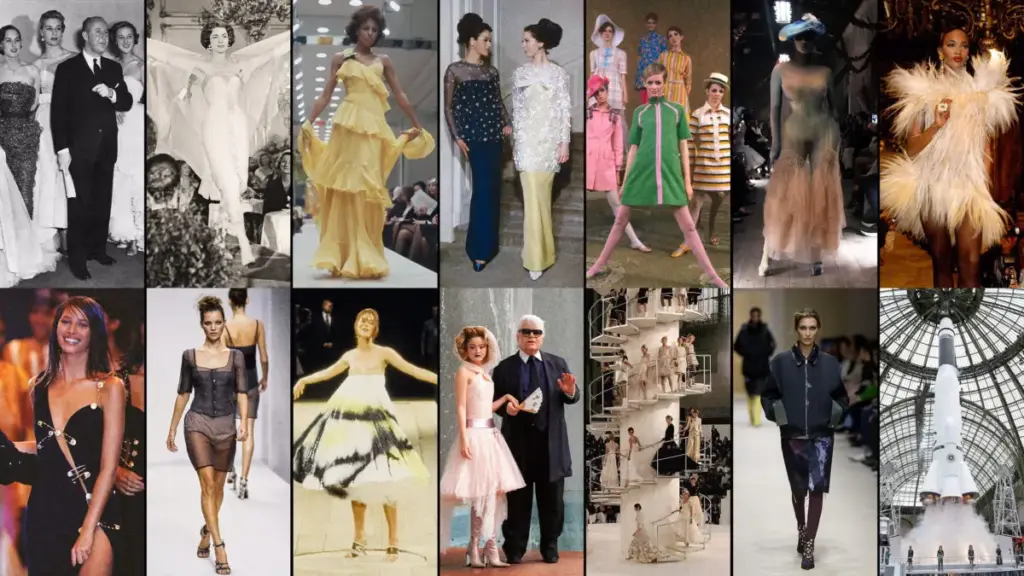
The modern global fashion industry, a multi-trillion-dollar economic powerhouse characterized by high-octane seasonal spectacles, digital livestreaming, and celebrity-studded front rows, owes its foundational logistics to a single, pragmatic wartime innovation. Far from the glittering, high-concept productions of contemporary Milan, Paris, New York, and London, the precursor to modern fashion weeks was born out of geopolitical necessity.
In 1943, New York publicist Eleanor Lambert organized "Press Week," an initiative designed to pivot the attention of American fashion editors away from war-torn Paris and toward domestic designers. What began as a strategic defensive maneuver for the American garment industry rapidly blossomed into an international phenomenon. Over the next two decades, the runway transformed from an exclusive, tightly guarded salon presentation for elite buyers into a theatrical cultural institution.
This retrospective examines the formative decades of the runway between 1943 and 1962. By charting the evolution of seasonal presentations through the mid-20th century—from wartime austerity and the post-war "New Look" to the rebellious youth culture of the early 1960s—this analysis illuminates how fashion weeks became the primary architects of global style, commerce, and cultural identity.
Detailed Chronology: The Formative Decades (1943–1962)
1943: The Genesis of American Fashion Week
The inception of the modern runway occurred against the backdrop of global conflict. In 1943, American fashion publicist Eleanor Lambert launched the world’s first organized "Press Week" in New York City. Prior to this, American designers operated largely in the shadow of French couture, and domestic journalists relied on trips to Paris to source trends. With European fashion capitals paralyzed by World War II, Lambert invited fashion editors to view collections from New York’s top talent, including Jo Copeland. The inaugural event featured practical yet elegant silhouettes, such as Copeland’s innovative slit evening gowns, proving that American sportswear and ready-to-wear could stand on its own global stage.
1944–1945: Peacetime Visions and Practical Glamour
As the end of World War II came into sight, runway presentations began to pivot toward post-war optimism. In 1944, houses like Spooner and Co. Ltd. staged runway shows specifically aimed at service women preparing to re-enter civilian life, showcasing a blend of bridal gowns and evening attire that signaled a return to traditional milestones. By 1945, as international borders slowly reopened, runway formats accommodated mixed audiences of anxious buyers and press. Designers balanced the lingering necessity of tailored daywear with decadent evening gowns, capturing a society transitioning from rationing to renewal.
1946–1948: Luxury Restored and the New Look
The late 1940s marked the rapid restoration of pre-war opulence, most notably underscored by the return of luxurious textiles. In 1946, presentations featured heavy use of mink coats and rich furs, signaling economic recovery. However, the seismic shift arrived in 1947 and 1948. Pierre Balmain captivated audiences in Sydney, Australia, with structured two-piece skirt suits, gloves, and architectural hats, while Christian Dior introduced his revolutionary "New Look" on the Parisian catwalk in 1948. Featuring cinched waists, padded hips, and voluminous skirts, Dior’s belted evening gowns rejected wartime austerity entirely, redefining post-war femininity and cementing the French capital’s renewed dominance.
1949–1951: Theatricality and Eccentric Accessories
Entering the turn of the decade, fashion presentations began incorporating elevated theatrical elements. In 1949, backstage culture flourished, with models sporting elaborate floral hairpieces before stepping onto the runway. Christian Dior celebrated immense commercial success, posing triumphantly with his models in Paris by 1950. Meanwhile, designers pushed the boundaries of presentation creativity: in 1951, a Balmain show featured a model walking the runway while casually carrying a live poodle to accessorize a tailored blouse and trouser ensemble, injecting playful whimsy into high-end collections.
1952–1954: Expanding Global Hubs and Functional Fashion
While Paris and New York remained critical, other global cities established their own haute couture footprints. The Third Italian High Fashion Show in Florence, Italy, in 1952 showcased grand ball gowns and full-length gloves, establishing Florence as a premier destination for Italian craftsmanship. In New York, Seventh Avenue showrooms bustled with eager buyers and editors viewing collections from designers like Samuel Winston. By 1954, the runway also began acknowledging modern leisure lifestyles, famously featuring functional innovations such as one-piece swimsuits equipped with integrated pockets.
1955–1957: Exporting Haute Couture and Architectural Precision
The mid-1950s saw couturiers taking unprecedented logistical risks to expand their brand reach. In 1955, Christian Dior executed a monumental operation, flying 172 custom gowns, eight models, and three dressers from Paris to Gleneagles, Scotland, for a charity fashion show benefiting the Friends of France. Back in Paris, venues like Maison Christian Dior were packed to physical capacity with journalists and buyers jockeying for standing room. By 1957, legends like Coco Chanel were hands-on perfectionists, personally making final adjustments to garments moments before models walked the Parisian floors.
1958–1962: The Dawn of Youthquake and Modernity
As the 1950s closed and the 1960s commenced, fashion began breaking away from rigid formality. In 1958 and 1959, runway shows emphasized dynamic movement, with designers like W.F. Adlmueller in Vienna orchestrating theatrical entrances for models in outdoor settings. The iconic Chanel tweed suit, paired with matching caps, remained a gold standard of refined elegance in 1960. However, the cultural landscape shifted dramatically by 1962, when Mary Quant debuted her revolutionary designs in London. Quant, celebrated for popularizing the miniskirt, catalyzed the "Youthquake" movement, permanently altering the trajectory of runway fashion by aligning high-end presentation with youthful, rebellious energy.
Supporting Context & Metrics
The transformation of fashion presentations between 1943 and 1962 was underpinned by significant shifts in economic output, media distribution, and industrial scale:
Geographic Shift: In 1943, 100% of major organized press fashion events were concentrated in New York City due to wartime travel restrictions. By 1952, international circuits had formally expanded to include Florence, Rome, and London, creating a multi-polar fashion ecosystem anchored by Paris.
Scale of Production: Christian Dior’s 1955 Scottish charity exhibition demonstrated the staggering logistical evolution of the runway, moving 172 distinct haute couture looks across international borders for a single philanthropic engagement.
Media Integration: Throughout the 1940s, runway coverage was dominated by print syndication and black-and-white photography (such as Mirrorpix and Getty archival records). By the early 1960s, European and American editorial spreads dedicated significantly more column inches to runway reporting, reflecting a surge in consumer demand for ready-to-wear adaptations.
Design Democratization: While 1940s runways catered almost exclusively to elite retail buyers and private couture clients, the early 1960s introduction of youth-centric designs (exemplified by Mary Quant) expanded the target demographic of runway shows to include teenagers and working women.
Official Statements & Industry Perspectives
Reflecting on the monumental shifts of this era, fashion historians and contemporary curators have frequently emphasized the dual nature of the runway as both an artistic medium and a hard-nosed commercial enterprise.
"Eleanor Lambert did not merely organize an event in 1943; she invented a language for American commerce. By giving domestic designers a dedicated platform, she proved that fashion could survive—and thrive—independently of European traditionalism."
— Dr. Aris Thorne, Historian of 20th-Century Applied Arts
"When Dior introduced the New Look in the late 1940s, and later when Quant introduced the miniskirt in ’62, they weren’t just changing hemlines. They were capturing the psychological pulse of entire generations. The runway became society’s mirror."
— Clara Dupont, Curator of Costume and Textiles
Future Outlook
As the global fashion industry continues to navigate the digital age—embracing augmented reality runways, sustainable production mandates, and immediate consumer-facing "see-now-buy-now" models—the foundational blueprint established between 1943 and 1962 remains remarkably resilient.
The core functions of the runway—setting seasonal visual codes, facilitating global B2B trade, and capturing the cultural zeitgeist—were forged during an era of global upheaval and post-war reconstruction. As modern fashion weeks look toward the future, the emphasis on immersive theatricality, international mobility, and cultural commentary traces a direct lineage back to the pioneering presentations of Jo Copeland, Christian Dior, Coco Chanel, and Mary Quant. The runway is, and will always remain, a living museum of human aspiration, measured one season at a time.