EXECUTIVE OVERVIEW
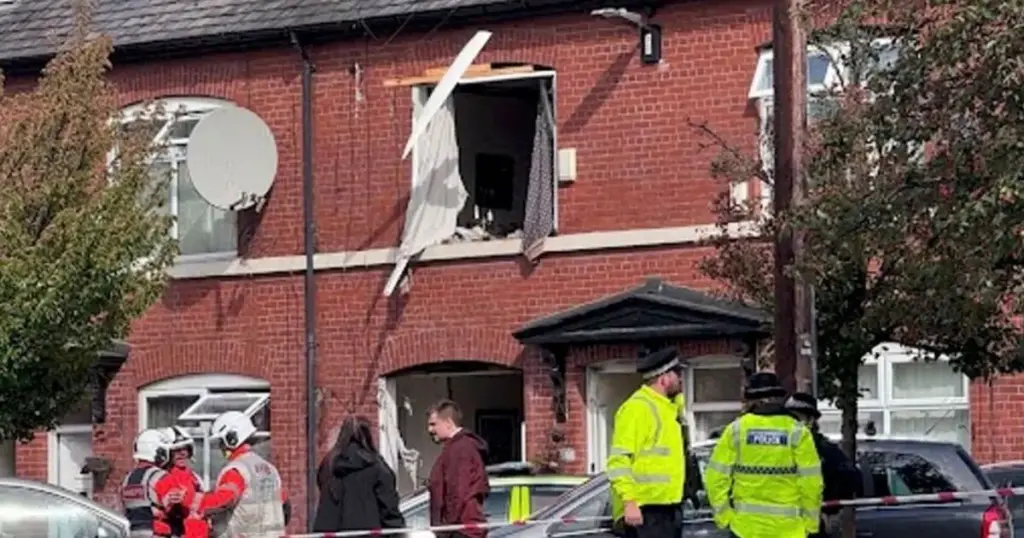
MANCHESTER, UK — Emergency services descended in force upon the Harpurhey district of north Manchester on the morning of Tuesday, September 8, 2026, following reports of a catastrophic suspected gas explosion at a residential property. The blast, which occurred on Ash Street near a busy local commercial hub, left a residential building extensively damaged, with initial photographs from the scene revealing windows completely blown out and structural integrity severely compromised.
First responders, including multiple units from the Greater Manchester Fire and Rescue Service (GMFRS), Greater Manchester Police (GMP), and the North West Ambulance Service (NWAS), rushed to the area shortly before midday. Local residents reported hearing a deafening blast that reverberated across the neighborhood, with several witnesses stating they felt the ground physically shake beneath their feet.
As emergency personnel secured a wide cordon around Ash Street, traffic was diverted, and local businesses near the row of shops experienced temporary disruptions. At this early stage, official casualty figures remain unconfirmed, and investigators from fire and utility agencies are working to determine the exact sequence of events that led to the incident. This developing report provides a comprehensive examination of the emergency response, witness accounts, structural safety concerns, and the broader context of urban infrastructure resilience in Greater Manchester.
Detailed Chronology of the Harpurhey Incident
The unfolding emergency began just before the noon hour on a quiet Tuesday in September, instantly transforming a routine morning in north Manchester into a scene of chaotic urgency.
11:30 AM – 11:45 AM: The Blast and Initial Impact
According to residents living adjacent to the affected property on Ash Street, the incident commenced with a sudden, thunderous detonation. The concussive force of the explosion was felt several streets away.
One local witness, speaking to regional reporters at the scene, described the moment of the blast: "It sounded like a bomb going off. There was a huge, echoing bang that rattled our windows, and for a split second, everything just stopped. Then people started rushing out onto the street to see what had happened."
Another resident reported a distinct tremor accompanying the sound: "I actually felt the ground shake under my feet. It wasn’t just a loud noise; it felt like a shockwave. When we ran out to look, you could immediately see the smoke and the sheer scale of the damage to the house."
11:51 AM – 12:00 PM: The Emergency Mobilization
Within minutes of the initial blast, the emergency services communication centers were inundated with calls from terrified residents. The scale of the reported destruction prompted an immediate, multi-agency response.
The North West Ambulance Service dispatched rapid-response vehicles and paramedic crews to triage any potential injuries, while Greater Manchester Police mobilized officers to secure the perimeter. Ash Street, known for its proximity to local convenience stores and foot traffic, was swiftly locked down to protect the public from potential secondary hazards, such as falling masonry or unstable gas lines.
Simultaneously, specialized crews from the Greater Manchester Fire and Rescue Service arrived with fire engines and technical rescue equipment. Firefighters immediately set about checking the property for active flames, securing gas and electrical mains in the vicinity, and assessing whether any individuals remained trapped inside the debris.
Post-12:00 PM: Securing the Scene and Investigation Phase
By early afternoon, the immediate neighborhood had transformed into a command-and-control hub for emergency responders. Structural engineers and forensic investigators were dispatched to evaluate the neighboring properties for collateral damage.
Photographs emerging from the cordoned-off zone illustrated the severity of the blast: the front and rear facades of the targeted house bore the hallmarks of high-pressure internal displacement, with window frames entirely splintered, glass hurled across the pavement, and internal structural elements exposed to the elements.
Supporting Context & Metrics: Urban Infrastructure and Safety in Manchester
Incidents of this magnitude immediately focus public and regulatory attention on the state of urban housing stock, aging gas infrastructure, and emergency response efficiencies in metropolitan areas like Greater Manchester.
The Geography of Harpurhey
Harpurhey is a densely populated residential and commercial district situated approximately two miles north of Manchester city centre. Characterized by a mix of traditional Victorian-era terraced housing, mid-20th-century developments, and modern regeneration projects, the area experiences high volumes of pedestrian and vehicular traffic, particularly along its primary commercial arteries and side streets like Ash Street.
The density of the housing stock presents unique challenges for emergency services during critical incidents. Close-quarter terraced properties mean that structural failures, fires, or explosions carry an inherent risk of secondary damage to adjoining homes, making rapid containment and evacuation paramount.

Gas Safety and Structural Failures in the UK
While the definitive cause of the Harpurhey explosion remains under active investigation, suspected domestic gas leaks or appliance malfunctions remain among the primary causes of structural blasts in residential settings across the United Kingdom.
According to data compiled by the Health and Safety Executive (HSE) and various fire authorities:
- Domestic Incidents: Hundreds of gas-related incidents—ranging from minor leaks to major structural explosions—are investigated across the UK annually.
- Aging Infrastructure: A significant portion of urban residential properties rely on decades-old gas distribution networks and internal pipework, requiring rigorous maintenance and periodic safety checks by certified professionals.
- Public Vigilance: Campaigns by national utility providers continuously urge residents to recognize the distinct smell of mercaptan (added to natural gas) and to immediately report suspected leaks to the national gas emergency service.
The swift deployment of specialized technical rescue units in Manchester highlights the preparedness protocols established to handle structural collapses, which require specialized shoring equipment, canine search units, and advanced thermal imaging technology to ensure no victims are overlooked amidst heavy rubble.
Official Statements and Inter-Agency Coordination
As operations on Ash Street continue, local authorities and emergency service leaders have urged the public to avoid the area to allow uninterrupted access for rescue vehicles and technical experts.
Greater Manchester Fire and Rescue Service (GMFRS)
A spokesperson for GMFRS emphasized the complexity of the ongoing operation:
"Our crews were mobilized immediately following reports of a structural explosion on Ash Street, Harpurhey. Upon arrival, firefighters encountered significant structural damage to a residential property. Our primary objectives remain life safety, securing the surrounding utilities, and working alongside our police and ambulance partners to stabilize the scene. We ask members of the public to stay away from the immediate area while our investigations and safety assessments are carried out."
Greater Manchester Police (GMP)
GMP released a brief operational update confirming road closures and localized diversions:
"Emergency services are currently responding to an incident on Ash Street in north Manchester. Road closures are in place around the junction near local shops, and motorists are advised to seek alternative routes. Further updates regarding the nature of the incident and any casualties will be provided as soon as verified information becomes available."
North West Ambulance Service (NWAS)
Paramedics on the scene confirmed that clinical personnel remain on standby to treat any casualties and support operational safety protocols. The NHS trusts operating in the region have been briefed to prepare for potential admissions, though specific patient conditions have not yet been publicly detailed pending next-of-kin notifications and formal medical assessments.
Future Outlook: Investigation, Demolition, and Community Recovery
In the wake of Tuesday’s dramatic events, the coming days and weeks will bring a meticulous multi-agency inquiry to determine the exact genesis of the blast.
The Forensic and Engineering Probe
Investigators from the Health and Safety Executive (HSE), local council building control surveyors, and fire service forensic teams will meticulously comb through the wreckage of the Harpurhey property. Their mandate will include:
- Gas Network Analysis: Pressure testing and metallurgical examination of local supply mains and internal domestic connections.
- Appliance Inspection: Forensic tracing of boilers, cookers, and heating systems to rule out or confirm mechanical failure or user error.
- Structural Integrity Audits: Comprehensive engineering assessments on the affected building and adjacent structures to determine whether partial demolition or extensive shoring is required to prevent further collapse.
Community Impact and Support
For the residents of Ash Street and the wider Harpurhey community, the incident represents a profound psychological shock. Local community organizations, working in tandem with Manchester City Council, are expected to establish temporary support hubs for displaced residents whose homes may be temporarily uninhabitable due to utility shut-offs or structural concerns.
Local traders whose businesses were temporarily cordoned off during the emergency response will also look toward the lifting of police perimeters to resume normal commercial operations.
As investigations proceed, further updates are expected from Greater Manchester Police and the Fire Service. Stakeholders across the region will be watching closely for the conclusions of the safety inquiry, which may carry implications for housing and gas safety standards across Manchester’s densely populated urban sectors.
This is a developing news story. Further updates will be provided as official information is released by emergency services and municipal authorities.