Executive Overview
Grammy Award-winning artist Macklemore has officially broken his silence following a fierce wave of public controversy, industry backlash, and online petitions sparked by his recent pro-Palestine remarks during a live performance. The Seattle-born rapper, long recognized for his outspoken political activism and social commentary, doubled down on his stance via social media, sharing a clip of the controversial stage speech alongside a defiant and concise caption: "Wanting all humans to be treated equal should never be controversial."
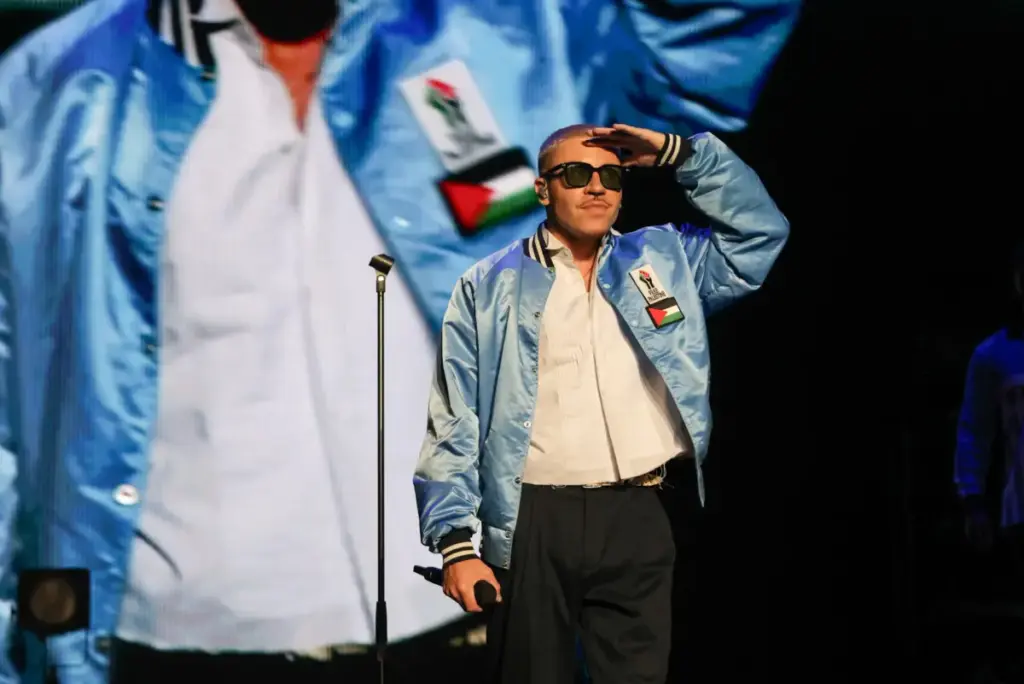
The controversy erupted on September 4, 2026, during a high-profile stadium concert in New Jersey, where Macklemore was performing as a supporting act for global pop superstar Ed Sheeran. Taking the stage in front of tens of thousands of fans, Macklemore delivered an impassioned address before launching into his politically charged track, “Hind’s Hall.” The speech—which included explicit calls to "Free Palestine," denunciations of Israeli government policies, and criticisms of U.S. domestic institutions such as Immigration and Customs Enforcement (ICE)—immediately polarized audiences, ignited international media attention, and triggered swift calls for his removal from the remainder of the tour.
Despite an online petition demanding that Sheeran’s management drop Macklemore from the lineup, the rapper’s recent statements indicate that he has no intention of retracting his words or softening his political messaging. This unfolding episode highlights the increasingly volatile intersection of mainstream entertainment, geopolitical activism, and the corporate music industry, where artists leveraging stadium platforms to address global humanitarian crises face unprecedented scrutiny and polarized public fallout.
Detailed Chronology of Events
The Stage at MetLife Stadium: September 4, 2026
The flashpoint occurred during the opening leg of a major stadium tour featuring Ed Sheeran. As a high-profile supporting act, Macklemore commanded a massive audience, utilizing the platform not merely for entertainment, but as a megaphone for his personal political convictions.
Stepping up to the microphone, the artist acknowledged the weight of his upcoming words, stating to the crowd: "I’ve been trying to figure out a way to say this all day."
He continued by framing his participation in the tour as an intentional opportunity to project a controversial message across massive American venues: "One of the reasons why I wanted to come on this tour was because I wanted to stand up here on stages in stadiums across America and say two words that are very near and dear to my heart: ‘Free Palestine.’"
Amplifying the Message: From Gaza to the West Bank
As the speech progressed, Macklemore raised the volume and intensity of his delivery, explicitly connecting his performance to the ongoing humanitarian crisis in the Middle East.
"I said, ‘Free Palestine!’ I want those words to be loud and clear so that people from Gaza, all the way to the occupied West Bank, know that we have not forgotten them," he told the arena.
The rapper then transitioned into introducing his song "Hind’s Hall," a track explicitly written in response to the student-led mobilization sweeping university campuses globally. He paid direct homage to the activism at Columbia University, praising students who put their academic and professional futures on the line.
"This next song was inspired by the bravery of Columbia University students who led an encampment movement that mobilized the entire world. Opened up hearts, myself included," Macklemore shared with the audience. "So thank you to those students that risked their diplomas, that risked their tuition, that risked their scholarships, that stood up and said, ‘No.’ CUAD students, Students For Justice In Palestine, and Jewish Voices For Peace. Thank you, guys."
Distinguishing Political Critique from Antisemitism
Anticipating potential backlash regarding his framing of the Israeli-Palestinian conflict, Macklemore explicitly addressed the Jewish community, drawing a firm line between political opposition to the state of Israel and prejudice against Jewish people.
"To all of my Jewish brothers and sisters," he stated. "Criticism of Israel, criticism of apartheid, being against genocide in no way is a criticism of you."
He reiterated that his overarching ethos remained rooted in universal human rights: "My message is for peace. Love. For all human beings to be treated with dignity, respect, and equality."
Broadening the Scope: Global Struggles and Domestic Policy
Macklemore did not limit his remarks to the Middle East. In the final moments of his address, he expanded his geopolitical critique to encompass multiple international crises, while also taking direct aim at United States domestic policy and federal law enforcement agencies.
"So I say free Palestine," he concluded. "I say free Lebanon; I say free Cuba; I say free Congo, free Sudan, free all people in America living in fear over this terrorist organization, ICE. None of us will be free until we are all free."
The Immediate Fallout and Digital Retaliation
The speech sent immediate shockwaves through social media networks and news outlets. Within hours, video clips of the performance were circulating widely, generating thousands of comments split sharply between praise for his courage and severe condemnation of his rhetoric.
Criticism quickly materialized in the form of organized digital resistance, most notably a petition demanding that Ed Sheeran and his tour promoters remove Macklemore from the remaining dates of the concert series. Critics argued that utilizing a shared pop tour—meant for general entertainment—to deliver divisive political speeches alienated concertgoers who paid to experience music, not partisan ideology.
Supporting Context & Metrics
The Genesis of "Hind’s Hall"
To fully understand the gravity of Macklemore’s recent stage remarks, one must examine the origins of the song that anchors his current political platform. "Hind’s Hall," released earlier in the year, derives its name from Hind Rajab, a six-year-old Palestinian girl killed in Gaza, and Hamilton Hall, a building temporarily occupied by student protesters at Columbia University.
The track serves as an aggressive indictment of U.S. foreign policy, military funding to Israel, and the systemic suppression of student protests on American campuses. Macklemore notoriously pledged to donate all proceeds from the streaming and sale of "Hind’s Hall" to the United Nations Relief and Works Agency for Palestine Refugees in the Near East (UNRWA). By integrating this track into his live setlists on a mainstream pop tour, the rapper intentionally forced a commercial audience to confront raw, frontline protest music.
The Rise of Celebrity Activism and Industry Polarization
Macklemore’s actions are part of a broader, systemic shift within the entertainment industry. Over the past decade, musicians, actors, and public figures have felt increasing pressure from fans and civil society to take public stances on global human rights issues, ranging from Black Lives Matter and climate change to the wars in Ukraine and Gaza.
However, this cultural demand for authenticity and political engagement has created an administrative nightmare for tour promoters, venue owners, and corporate sponsors. When an artist uses a shared stage—such as opening for an internationally beloved pop act like Ed Sheeran—their political statements inevitably implicate the headliner, the venue operators, and corporate partners who strive to maintain neutral, family-friendly commercial environments.
Public reaction metrics on platforms like X (formerly Twitter), Instagram, and TikTok following the New Jersey concert revealed a deep ideological schism:
- Pro-Artist Sentiment: Supporters praised Macklemore for risking commercial viability to advocate for the disenfranchised, viewing his refusal to remain silent as the true essence of punk and hip-hop ethos.
- Detractor Sentiment: Critics, including various advocacy groups and concert attendees, argued that political proselytizing during commercial entertainment events represents a breach of consumer trust, forcing audiences to ingest inflammatory geopolitical statements under the guise of an evening out.
Official Statements and Industry Responses
As of this reporting, neither Ed Sheeran nor his primary booking agencies have issued a formal, binding statement regarding whether Macklemore will be removed from the tour. Sheeran, known for maintaining a generally apolitical public persona during his performances, has traditionally steered clear of explosive geopolitical controversies, placing the immediate burden of the fallout squarely on his supporting act.
Macklemore’s official response came swiftly via his verified social media channels. By reposting the clip of his New Jersey speech and captioning it, "Wanting all humans to be treated equal should never be controversial," the rapper signaled that he views his critics as morally compromised rather than constructively engaged.
Prominent civil rights organizations, student groups, and political commentators have weighed in heavily:
- Students for Justice in Palestine (SJP) and allied chapters publicly thanked the rapper for utilizing his massive cultural reach to keep international focus on the humanitarian crisis in Gaza and the West Bank.
- Conversely, several cultural watchdog groups and pro-Israel organizations condemned the speech, arguing that the invocation of terms like "apartheid" and the comparison of U.S. immigration enforcement to "terrorist organizations" crosses the line from legitimate political discourse into inflammatory, divisive rhetoric.
Future Outlook
The controversy surrounding Macklemore’s pro-Palestine performance on the Ed Sheeran tour serves as a bellwether for the modern entertainment landscape. As geopolitical tensions continue to spill over into cultural spheres, the traditional boundaries separating artistic performance from political activism are rapidly dissolving.
Key questions moving forward include:
- Tour Continuity: Will public pressure and online petitions force tour organizers to drop Macklemore, or will promoters stand firm on principles of artistic freedom of expression?
- Precedent for Live Events: How will venues and event coordinators draft future contracts to manage political speech by supporting acts without infringing upon First Amendment protections?
- Artist Accountability: Will other mainstream musicians follow Macklemore’s lead in leveraging commercial stadium tours for radical political advocacy, or will the financial and reputational backlash deter peers from speaking out?
For now, Macklemore remains defiant. By doubling down on his message rather than issuing a conciliatory apology, the rapper has cemented his role not merely as a commercial recording artist, but as an unapologetic, polarizing political combatant within contemporary American culture. Whether this stance expands his counter-cultural credibility or permanently damages his mainstream marketability remains one of the most closely watched narratives in the modern music industry.