Executive Overview
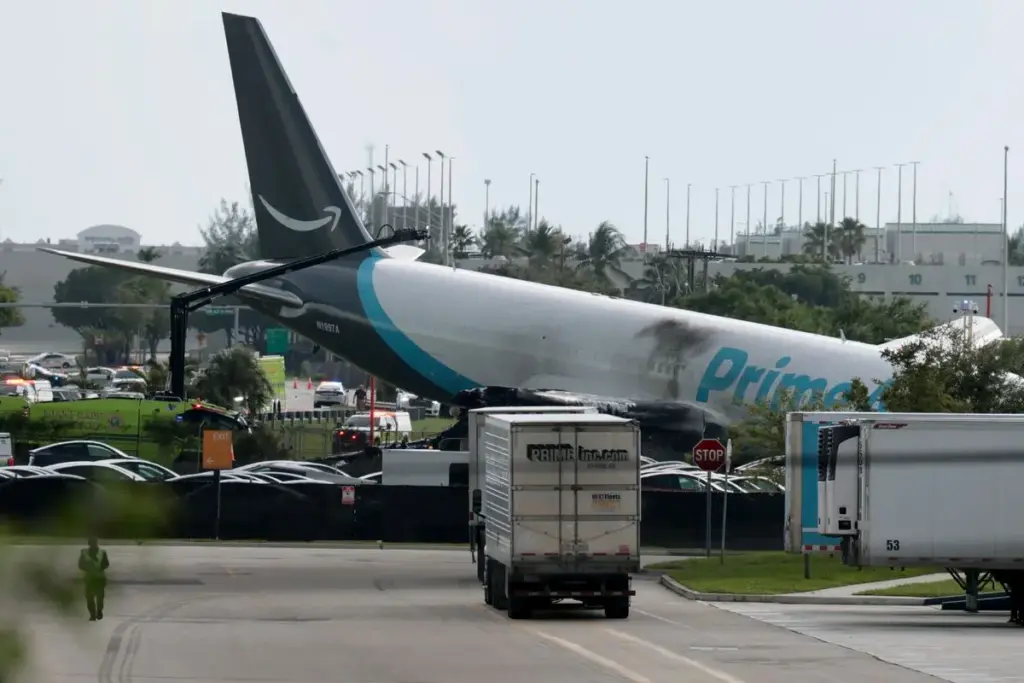
MIAMI, FLORIDA — In what has become one of the most devastating aviation accidents at a major U.S. transportation hub in recent years, at least five people have tragically lost their lives following a catastrophic runway overrun involving an Amazon Prime Air cargo plane. The incident unfolded on Sunday afternoon, September 6, 2026, when a Boeing 767 freighter operated by cargo carrier 21 Air veered violently off the tarmac at Miami International Airport (MIA).
The aircraft, which had just completed a scheduled flight from San Juan, Puerto Rico, breached the airport perimeter during the landing sequence, striking ground vehicles—including semi-trucks—before erupting into a massive, uncontrolled fireball. The sheer force of the impact and the subsequent inferno resulted in widespread devastation, claiming multiple lives instantly and leaving several others fighting for their lives in regional hospitals.
Emergency response units flooded the scene within minutes, deploying more than 60 specialized Miami-Dade Fire Rescue vehicles to combat the roaring flames and rescue trapped individuals from both the wreckage of the aircraft and crushed vehicles on the perimeter roadway. Hours after the initial impact, firefighters continued to wage a perilous battle against persistent fuel leaks and lingering hot spots, as thick plumes of black toxic smoke billowed over the South Florida skyline.
The disaster has thrown a harsh spotlight on airport perimeter safety, cargo aviation standards, and the operational oversight of aging converted freighters. As federal investigators descend upon Miami International Airport to piece together the sequence of events, aviation authorities, corporate giants, and the public alike are left demanding answers as to how a routine cargo flight culminated in catastrophic loss of life.
Detailed Chronology: Sunday, September 6, 2026
1:45 PM – Final Approach and Landing
The aircraft, a 32-year-old Boeing 767-200 converted freighter flying under the Amazon Prime Air banner, initiated its final descent into Miami International Airport. Having departed earlier in the day from Luis Muñoz Marín International Airport in San Juan, Puerto Rico, the flight had been routine up to this point. Weather conditions in Miami at the time were typical for early September—warm, with localized convective activity, though visibility and winds were initially thought to be within operational limits.

2:00 PM – The Catastrophic Overrun
As the aircraft touched down on the MIA runway, eyewitness accounts and early telemetry data indicate that the plane failed to decelerate effectively. Instead of stopping within the designated runway safety area, the heavy freighter continued hurtling forward at high speed, overrunning the end of the asphalt.
The Boeing 767 smashed through perimeter fencing and barriers before colliding directly with ground traffic on an adjacent roadway. The impact crushed multiple vehicles, trapping motorists underneath the wreckage, and instantly ruptured the plane’s fuel tanks. A massive, volatile explosion occurred almost immediately, engulfing the nose and midsection of the aircraft along with the struck vehicles in an intense wall of fire.
2:15 PM – Massive Emergency Response
Miami-Dade Fire Rescue received the first emergency calls reporting a major plane crash at approximately 2:03 PM. The response was immediate and overwhelming. Within minutes, more than 60 fire-rescue units, including hazardous materials teams, advanced life support ambulances, and heavy rescue trucks, converged on the disaster zone.
First responders were met with a chaotic and perilous scene: a massive fuselage resting on its belly, hissing with pressurized heat and pouring thick, toxic black smoke into the air, alongside mangled automobiles trapped near the aircraft’s tail assembly.
2:45 PM to 6:00 PM – Extraction and Fire Suppression
Firefighters deployed multiple high-capacity foam lines to suppress the roaring inferno, which threatened to consume the entirety of the cargo hold. Simultaneously, specialized extrication teams set to work freeing trapped victims.

Rescue personnel had to breach the crushed cabins of the ground vehicles to pull out survivors and victims. Inside the cockpit, the pilot and co-pilot were trapped amidst a compromised flight deck. Due to structural instability and the high volume of volatile jet fuel pooling around the landing gear and wings, extraction operations were agonizingly complex. Several hours into the operation, fire crews were still actively blanket-foaming the aircraft to mitigate an ongoing, dangerous fuel leak that threatened reignition.
Supporting Context & Metrics: The Aircraft, Airline, and Airport Impact
The Aircraft: History of the Boeing 767-200SF
The aircraft involved in the disaster was a veteran of the skies. Flight-tracking data and aviation registries reveal that the Boeing 767-200 was 32 years old. Originally manufactured in the early 1990s as a passenger airliner, the jet flew commercial routes for multiple legacy carriers before undergoing a comprehensive cargo conversion in 2015.
While converted freighters (often designated as SF or BDSF) are a standard and legally approved staple of modern logistics networks—enabling airlines to extend the economic life of aging airframes—the incident has reignited debates among safety experts regarding the structural fatigue, maintenance histories, and braking system tolerances of older aircraft subjected to the grueling demands of intensive cargo operations.
The Operator: 21 Air
The flight was operated on behalf of Amazon Prime Air by 21 Air, a North Carolina-based cargo airline operating under Federal Aviation Administration (FAA) Part 121 regulations. 21 Air provides ACMI (Aircraft, Crew, Maintenance, and Insurance) services and scheduled cargo operations across the Americas. The carrier’s safety record and maintenance protocols are now facing intense scrutiny from federal inspectors, who will examine whether mechanical failure, pilot fatigue, maintenance lapses, or environmental factors played a role in the runway overrun.
Casualties and Injuries
Local health authorities and Miami-Dade County officials confirmed the grim toll:

- Fatalities: At least five individuals have been confirmed dead, encompassing both vehicle occupants on the ground and personnel associated with the flight.
- Critical Injuries: Three individuals were rushed to local trauma centers in critical condition, suffering from severe burns, crush injuries, and smoke inhalation.
- Moderate/Minor Injuries: Two additional victims were hospitalized with non-life-threatening injuries.
- Trapped Victims: Ray Jadallah, Chief of Miami-Dade Fire Rescue, confirmed that several victims had been physically trapped inside crushed automobiles and the aircraft flight deck, requiring heavy hydraulic extrication tools.
Operational Disruption at Miami International Airport
As one of the busiest cargo and passenger aviation hubs in the United States, Miami International Airport experienced immediate and staggering operational paralysis following the crash.
- Flight Delays: Approximately 250 arriving and departing flights were severely delayed or diverted during the late afternoon and evening hours of Sunday, September 6.
- Runway Closures: Authorities immediately closed multiple runways to preserve the accident scene for investigators from the National Transportation Safety Board (NTSB) and the FAA, causing massive scheduling backlogs across domestic and international networks.
Official Statements and Corporate Response
The scale of the disaster prompted immediate responses from local government officials, emergency services, and corporate leadership at Amazon.
Amazon’s Official Statement
Kelly Nantel, a spokesperson for Amazon, released a statement addressing the tragedy:
"We are working closely with local authorities and officials to understand exactly what happened. Right now, our absolute priority is the safety, wellbeing, and care of everyone involved. We’re doing everything we can to support those affected and their families during this unimaginably difficult time."
Amazon Prime Air, which utilizes a dedicated fleet of leased cargo aircraft to manage its vast supply chain and rapid delivery network, has pledged full transparency and cooperation with federal regulatory bodies investigating the crash.

Local Authorities and Emergency Services
Speaking to reporters at a press briefing near the perimeter of the airport, Miami-Dade County officials praised the swift and courageous response of first responders.
"Our fire rescue and law enforcement personnel moved into an extremely dangerous, high-risk environment involving active fires and hazardous fuel leaks to save lives," stated a representative for the county. "Words cannot express our sorrow for the families of those who lost their lives today. Every resource of Miami-Dade County is being dedicated to supporting the investigation and caring for the injured."
Future Outlook: Investigations and Industry Repercussions
The Federal Investigation
The National Transportation Safety Board (NTSB), alongside the Federal Aviation Administration (FAA), has launched a comprehensive, multi-disciplinary investigation into the Miami disaster. An NTSB "skid team" and air crash investigators arrived on-site to secure critical evidence:
- Flight Data and Cockpit Voice Recorders ("Black Boxes"): Investigators recovered the flight data recorder (FDR) and cockpit voice recorder (CVR) from the tail section of the Boeing 767. These devices will provide second-by-second telemetry regarding braking pressures, thrust settings, control inputs, and crew communications leading up to the crash.
- Braking and Spoiler Systems: Engineers will inspect the aircraft’s hydraulic braking systems, anti-skid mechanisms, and wing spoilers to determine if mechanical failure prevented the plane from shedding speed on the wet or rubber-contaminated runway.
- Weather and Runway Conditions: Experts will analyze wind shear data, braking action reports from preceding flights, and the condition of the runway surface at the exact time of touchdown.
- Human Factors: Investigators will review the crew’s duty schedules, rest periods, training records, and medical histories to evaluate potential fatigue or cognitive overload.
Broader Implications for Cargo Aviation
The crash of an Amazon-branded freighter in a densely populated urban airport zone is expected to trigger wider systemic reviews across the e-commerce logistics sector. As consumer demand for rapid delivery drives freight airlines to fly higher frequencies with aging fleets, regulatory bodies may face renewed pressure to tighten oversight on converted passenger aircraft, enhance runway safety areas (RESAs) at major airports, and reevaluate perimeter security protocols to protect public roadways adjacent to active aviation facilities.
As the smoke clears over Miami International Airport, the profound human cost of Sunday’s tragedy remains the central focus, casting a long shadow over the future of modern supply chain logistics.