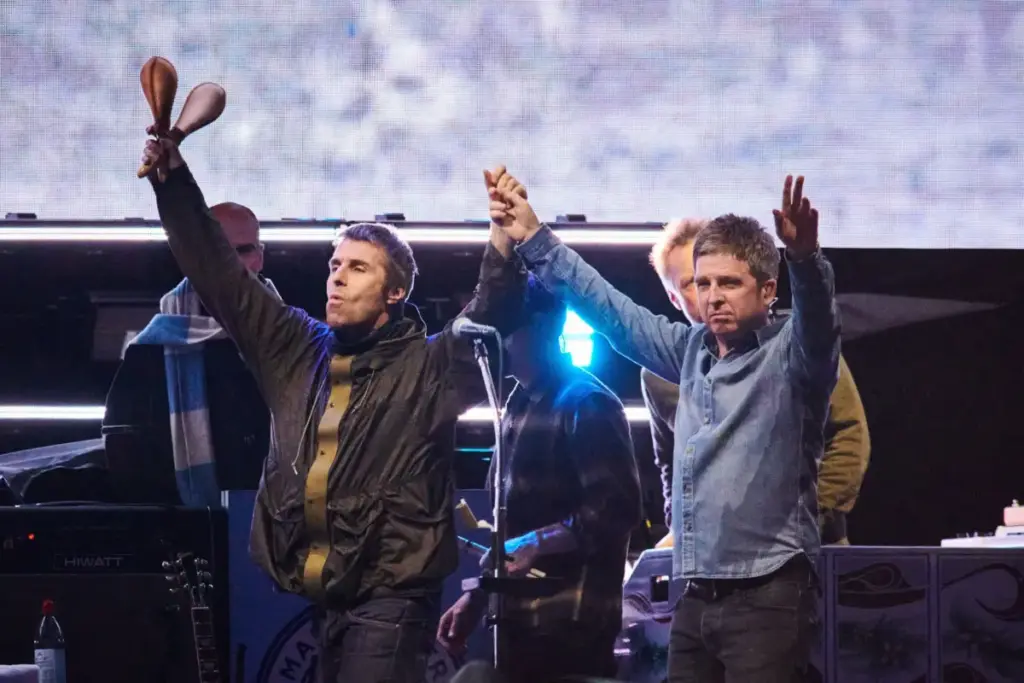
The 83rd Venice International Film Festival played host to one of the most unexpected and globally scrutinized cinematic premieres of the decade: Oasis: Don’t Look Back in Anger. Chronicling the explosive 2025 reunion of rock royalty Liam and Noel Gallagher after nearly 16 years of bitter estrangement, the documentary acts as a visual ledger of reconciliation, maturity, and working-class British grit.
However, true to the chaotic mythos of the band, the film’s September 5 premiere at the Palazzo del Casinò was not without its characteristic theatre. Despite arriving at the Lido together via water taxi and briefly posing for photographers alongside directors Will Lovelace and Dylan Southern, alongside Peaky Blinders creator and writer Steven Knight, the famously mercurial brothers were conspicuously absent from the official press conference.
While initial whispers suggested lingering tensions or a last-minute rift, insiders and creators were quick to dispel any rumors of discord. Knight insisted that the brothers were "beyond satisfied" and deeply emotional upon viewing the completed documentary for the first time. Far from being a manufactured PR stunt, Oasis: Don’t Look Back in Anger captures a raw, unfiltered dynamic—one that transitioned from silent tension in a rehearsal room to a triumphant global stadium tour. As the film prepares for its wider UK cinematic release on September 9, 2026, the global music industry watches with bated breath, tracking not only the legacy of Britpop’s most iconic siblings, but the genuine restoration of a fractured family.
DETAILED CHRONOLOGY: FROM THE LIDO WATER TAXI TO THE SILVER SCREEN
Arrival and Absence: The Venice Photocall Paradox
The morning of September 5, 2026, began with a frenzy of shutterbugs and screaming fans lining the Venice waterfront. Anticipation had reached a fever pitch over whether Liam and Noel Gallagher would make a joint public appearance to support the documentary charting their historic return to the stage.
The brothers delivered—at least partially. Stepping off a water taxi directly in front of the Palazzo del Casinò, Liam and Noel put on a united, albeit stoic, front. Flanked by directors Will Lovelace and Dylan Southern, as well as screenwriter Steven Knight, the pair paused for mandatory press photographs. They cut familiar figures: tailored, weathered, yet unmistakably bonded.
Yet, as journalists and media outlets filed into the official press conference auditorium, the Gallagher brothers were nowhere to be seen. When co-director Will Lovelace was initially queried about their absence, he deftly skirted the question, prompting chuckles from the press corps. Pressed directly for an explanation, Lovelace clarified: "They were here a second ago, having photographs taken — so they are here."
Ultimately, while the brothers opted out of fielding direct questions from the international press or speaking publicly ahead of the red carpet premiere later that evening, their physical presence on the Lido signaled a profound psychological shift. For two men who spent nearly two decades refusing to share a room—let alone a bill—standing shoulder-to-shoulder for cameras represented a major milestone.
The Invisible Crew: Capturing the 2025 Reunion
Central to the documentary’s narrative success is the discreet methodology employed by its filmmakers. Eschewing traditional, intrusive documentary techniques, Lovelace and Southern implemented an observational strategy designed to maintain absolute authenticity.
Speaking at the press conference, Dylan Southern detailed the lengths to which the production team went to preserve the sanctity of the brothers’ space:
"Our process was very deliberately designed not to influence what was happening. So when it came to rehearsals, our aim was to be completely invisible to the band. I don’t think for six weeks they saw us or a single member of our crew… So we put the cameras into the rehearsal space and let them explore what happened."
This fly-on-the-wall approach ensured that the camera acted as a passive recorder of human behavior rather than an active catalyst for drama. The filmmakers were acutely aware that any heavy-handed interference could derail the delicate process of reconciliation. Instead, they focused equally on the overwhelming emotional resonance of the fans, whose fervor during the Oasis Live ’25 tour served as an external gravitational pull drawing the brothers back together.
SUPPORTING CONTEXT & METRICS: UNPACKING THE OASIS MYTHOS
The Anatomy of a 16-Year Feud
To fully comprehend the weight of Oasis: Don’t Look Back in Anger, one must understand the volcanic history of the Gallagher brothers. Formed in Manchester in 1991, Oasis became the defining voice of the 1990s Britpop movement, anchoring global culture with anthems like "Wonderwall," "Champagne Supernova," and the documentary’s namesake track.
However, the combustible chemistry between older brother and chief songwriter Noel and younger frontman Liam proved unsustainable. Decades of public spats, physical altercations, and verbal sparring culminated backstage at the Rock en Seine festival in Paris on August 28, 2009. An argument involving a flying plum and a shattered guitar led Noel to quit the band on the spot, triggering a 15-year cold war characterized by solo projects (Noel Gallagher’s High Flying Birds, Beady Eye, and Liam’s subsequent solo career) and relentless social media barbs.
The announcement of the Live ’25 reunion tour sent shockwaves through the music industry, instantly selling out stadiums across the globe and generating historic economic metrics in ticket sales, merchandise, and tourism.
Fiction Versus Reality: Steven Knight’s Screenwriting Challenge
For screenwriter Steven Knight—internationally renowned for crafting meticulously scripted, hyper-controlled fictional universes like Peaky Blinders and A Thousand Blows—transitioning to a non-fiction music documentary was a radical departure.
Knight reflected on the psychological vulnerability required to document real human relationships rather than orchestrating fictional arcs:
"As opposed to writing fiction, where you’re in control of the structure, and in control of the three acts and the happy ending and all that, here you’re dependent on reality and real people and their relationships, and so we didn’t really know how this was going to go."
Knight’s perspective highlights the high-wire act of the film. The documentary captures the exact moment Liam walks into the rehearsal space for the first time in 16 years—a room thick with unspoken history. Eschewing cinematic melodrama, the scene plays out with authentic, working-class British understatement. There are no tearful embraces or Hollywood monologues. Instead, Liam inspects the drum kit, demands a change, counts down the tempo, and launches straight into the music.
OFFICIAL STATEMENTS: CREATORS ON THE BROTHERS’ EMOTIONAL REACTION
The emotional climax of the project occurred when Liam and Noel viewed the finished documentary for the very first time. According to the production team, the viewing experience proved profoundly moving for the notoriously tough musicians.
Steven Knight revealed that the brothers were left "very emotional" after watching their own redemption arc unfold on screen. Because the filmmakers refrained from showing them cuts during production, the final screening offered the Gallaghers an unfiltered perspective of their own healing process.
Will Lovelace addressed whether the filmmaking process actively influenced the brothers’ relationship, maintaining that the crew’s role was strictly archival:
"I’m not sure if the filmmaking affected their relationship, but we certainly captured their relationship coming back together. I think the whole world was interested in that 15 years apart, and will it work, and what’s it going to be like? And it was a sort of privilege to be able to see that relationship get closer together, both in rehearsals, but then also throughout the tour… you saw that reconciliation happening on stage in front of the world."
Echoing this sentiment, Dylan Southern emphasized that the driving force behind the reunion was never a commercial strategy or a cinematic endeavor, but the music itself and the sheer, overwhelming adoration of the fans:
"We didn’t want it to be the film that influenced the relationship, we wanted to document the very genuine thing that was happening and that was the love and excitement coming from the crowd, which was integral in them coming back together. The music brought them back together. They reunited on stage."
FUTURE OUTLOOK: BEYOND VENICE AND TOWARD 2027
As Oasis: Don’t Look Back in Anger prepares to hit UK cinemas on September 9, 2026, the cultural narrative surrounding Oasis has shifted decisively from nostalgia to active resurgence. The documentary serves not only as a historical artifact of the Live ’25 tour, but as a testament to forgiveness, familial endurance, and artistic redemption.
Crucially, the momentum shows zero signs of slowing down. Whispers and leaks emerging from industry insiders and former publicists indicate that new Oasis tour dates for 2027 are already being mapped out, with official ticket sales anticipated within a matter of weeks. Far from being a one-off nostalgic cash grab, the reunion of Liam and Noel Gallagher appears to have unlocked a permanent second act for one of Britain’s greatest rock bands.
In the end, Don’t Look Back in Anger captures the exact philosophy that saved Oasis from permanent dissolution. By stepping back, letting the cameras fade into the background, and allowing the music to heal old wounds, Lovelace, Southern, and Knight have delivered a cinematic triumph. Whether in the rehearsal rooms of London, the sun-drenched Lido of Venice, or packed stadiums worldwide, the Gallagher brothers have proven that sometimes, the past can be redeemed—one chord at a time.