Executive Overview
For decades, the September issue of Vogue was universally recognized as the undisputed Bible of the global fashion industry. More than just a magazine, it served as an annual cultural monument—a heavy, glossy prophecy that dictated the silhouettes, color palettes, and aesthetic obsessions of the upcoming year. Designers waited with bated breath, advertisers vied aggressively for prime real estate, and style enthusiasts treated its arrival as a major seasonal event.
However, the landscape of media and commerce has undergone a seismic shift. On this week’s installment of the Glossy Fashion Podcast, hosts Jill Manoff (Editor-in-Chief) and Danny Parisi (Senior Fashion Reporter) sat down to dissect the monumental September edition. This particular release holds immense historical and symbolic weight: it marks the very first September issue produced under the leadership of Chloe Malle, the newly appointed Head of Editorial Content who officially stepped into the role following the historic tenure of legendary editor Anna Wintour last September.
Malle’s debut stewardship arrives at a precarious crossroads for the traditional print medium. As real-time digital publishing, social media algorithms, and influencer-led micro-trends dominate the speed of style dissemination, print magazines can no longer function as immediate reporters of the "new." Instead, the medium has been forced into an existential pivot, transitioning from a fast-paced trendsetter to a timeless, slower-paced collector’s item.
During their incisive discussion, Manoff and Parisi unpacked the profound identity crisis currently facing legacy fashion publications. They explored how Malle—herself a digital-first editorial mind—navigated this transition, analyzing everything from unexpected wellness features and nepotism-driven cover stories to the death of eclectic, stylist-driven editorial curation. This report takes a deep, investigative dive into the themes raised on the podcast, examining the structural evolution of Vogue, the commercial pressures of modern luxury publishing, and what Malle’s inaugural September issue reveals about the future of fashion media.
Detailed Chronology: The Passing of the Torch and the Malle Era
To understand the weight of the current September issue, one must first contextualize the immense transition that occurred at One World Trade Center over the past year. For generations, Anna Wintour was synonymous with Vogue. Her ironclad vision shaped not only the magazine’s pages but the entire trajectory of the modern luxury fashion economy, launching designers, anointing supermodels, and dictating cultural taste levels.
When Chloe Malle assumed the role of Head of Editorial Content last September, the industry watched with intense scrutiny. Malle—an industry insider by birth as the daughter of celebrated actress Candice Bergen and legendary French filmmaker Louis Malle—was known for bringing a distinctly modern, digital-native sensibility to Vogue‘s online platforms. Her promotion signaled Condé Nast’s desperate need to bridge the gap between legacy prestige and the lightning-fast demands of internet culture.
The Anatomy of a Transition
As the dust settled on her first year in charge, the September issue became the ultimate test of Malle’s editorial thesis. Traditionally, the September issue serves as a statement of intent for any incoming leadership figure. Yet, as Manoff and Parisi pointed out on the Glossy podcast, the resulting product reflects the dizzying contradictions of modern print media.
On one hand, the publication remains tethered to traditional luxury advertising models, filled with glossy campaigns from brands that dominate current retail sales. On the other hand, the actual editorial text often feels startlingly detached from the fast-moving pulse of contemporary fashion commerce.
"It’s interesting that Chloe Malle is coming from a digital background," Manoff remarked during the podcast episode. Reflecting on her long history as a loyal Vogue subscriber, Manoff expressed bewilderment at the eclectic, sometimes jarring tonal shifts within the issue’s pages. "I used to read things that were buzzy and new. This issue had stories about improving your mood with Botox or one about the dangers of clenching your jaw. I was just like, ‘What am I reading here?’"
This tonal departure underscores a fundamental challenge: when real-time news, runway recaps, and trend forecasting are consumed instantly via smartphones and TikTok algorithms, what is the monthly print magazine actually for?
Supporting Context & Metrics: The Death of Timeliness and the Rise of the Coffee Table Book
To fully grasp why Vogue’s editorial content feels increasingly disconnected from the immediate business of fashion, industry analysts point to structural shifts in consumer behavior over the past fifteen years.
Print as a Collector’s Item
In the pre-digital era, consumers bought magazines to find out what was happening now. Today, consumers buy magazines to anchor a lifestyle aesthetic on their living room furniture.
"A lot of it doesn’t feel very timely," Danny Parisi noted during the podcast conversation. "Part of that is that people are more likely to buy print magazines today as a collector’s item, as a coffee table book. That’s why you see so many of those commemorative issues of random magazines in the grocery store aisle. They’re not meant to give you timely information, which has all moved online."
This shift has forced print publications into a strange paradox:
- The Digital Realm: Owns speed, data-driven traffic, real-time trend analysis, e-commerce integration, and interactive community engagement.
- The Print Realm: Owns tactile luxury, high-end photography, permanence, and aspirational escapism.
Because print cannot compete with the internet’s velocity, it must pivot toward timelessness. However, "timelessness" in a hyper-capitalist luxury ecosystem often manifests as a strange hybrid of service journalism (such as wellness, beauty routines, and psychological self-care) and high-concept art direction that exists outside the practical realities of how people actually dress.
The Nepo-Baby Discourse and Legacy Themes
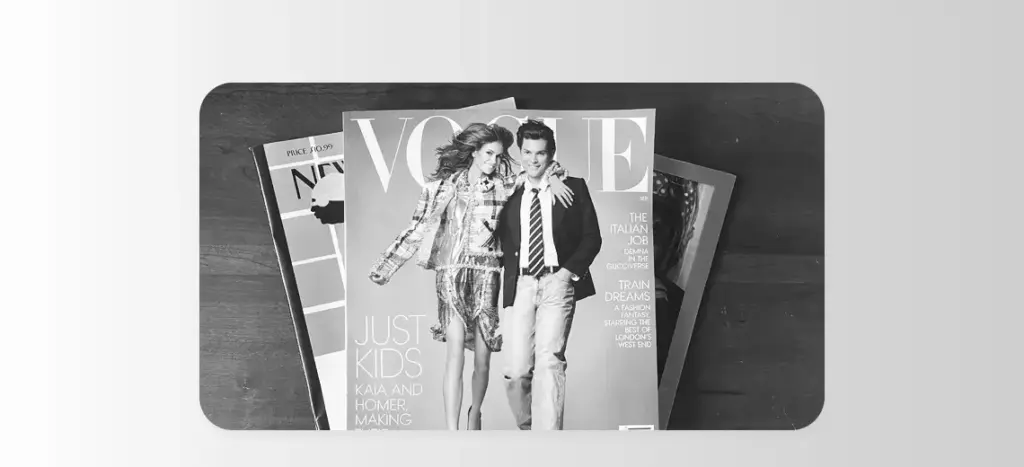
The thematic core of Malle’s debut September issue leaned heavily into self-referential cultural commentary, most notably through its cover story featuring Kaia Gerber and Homer Gere. Both subjects are prominent examples of "nepo babies"—the children of famous parents—a cultural phenomenon that has dominated public discourse across social media platforms for years.
Interestingly, this theme of lineage extended beyond the cover stars and into the heart of the fashion industry itself. The issue thoughtfully tied the proliferation of celebrity offspring in media to the broader corporate and creative shifts occurring across legacy fashion houses, where a new generation of young, established designers has rapidly taken over creative directorships.
Yet, while the thematic cohesion of legacy and lineage is undeniably clever, it highlights an insular industry gazing inward. For a general public navigating economic shifts, the concentration of fame and aesthetic power within elite bloodlines can sometimes feel alienating—further emphasizing the gap between print media’s ivory tower and the democratic chaos of digital style communities.
Official Statements & Industry Insights
The conversation between Manoff and Parisi also illuminated a critical evolution in how fashion is visually constructed within magazine spreads: the decline of the traditional, stylist-driven narrative in favor of corporate, single-brand monoliths.
The Disappearance of the Eclectic Stylist
For decades, the magic of a Vogue editorial spread lay in the visionary hand of the stylist. Legendary stylists like Grace Coddington, Tonne Goodman, and Camilla Nickerson didn’t just dress models in clothes straight off a single runway; they curated dreamscapes. They mixed archival couture with thrift-store vintage, paired high-end designer gowns with beat-up baseball caps, and created unexpected, highly personal styling tricks that inspired readers to experiment with their own wardrobes.
According to the Glossy hosts, that era of editorial styling has quietly faded into memory.
"We’ve definitely moved away from the stylist-driven looks, which haven’t been the norm for a while," Manoff observed. "I like when you see ‘stylist-owned ball cap’ or ‘vintage jeans’ in the credits. It’s unfortunate that that’s gone, because that is very inspiring to me."
The implications of this shift extend directly into consumer psychology and retail sales:
- Single-Brand Monopolies: Modern editorial spreads increasingly favor head-to-toe looks pulled directly from a single luxury house. If a model wears Prada, every single element—from the coat down to the socks and shoes—is Prada.
- The Death of Inspiration: As Manoff pointed out, this rigid adherence to brand uniformity strips away the creative problem-solving of personal style. "When you see a head-to-toe look that’s all one brand, you’re not getting ideas on how to style it. Nobody dresses that way."
- Commercial Pressures: The move toward single-brand dominance is largely driven by commercial realities. Advertisers demand complete visual control and direct translation from print page to retail checkout, leaving little room for the messy, rebellious art of independent styling.
Future Outlook: Where Do Legacy Magazines Go From Here?
As Chloe Malle navigates her second year at the helm of Vogue’s editorial content, the broader luxury media landscape faces an existential reckoning. The challenges highlighted by the Glossy Fashion Podcast are not unique to Condé Nast; they represent systemic hurdles for all traditional print media properties attempting to survive in an AI-driven, digital-first economy.
1. Redefining the Value Proposition of Print
To remain relevant, print must fully embrace its identity as a curated art object rather than an informational newspaper. This means elevating photography, investing in long-form, deeply reported cultural journalism that cannot be summarized in a TikTok video, and abandoning the frantic race to cover fleeting micro-trends.
2. Bridging the Digital-Print Divide
Malle’s digital background positions her uniquely to solve this puzzle. The future success of legacy titles will depend on creating a seamless, symbiotic loop between fast digital content and slow, contemplative print editions. Digital platforms can act as real-time laboratories—testing what audiences care about, tracking aesthetic movements, and building community—while the print magazine can serve as the ultimate, museum-quality archive of those cultural moments.
3. Reclaiming Creative Risk-Taking
Finally, the fashion industry must reckon with the homogenization of style. If print magazines continue to default to safe, single-brand advertorial looks and insular celebrity casting, they risk losing the very thing that made them cultural institutions in the first place: imagination. Bringing back the irreverence, unexpected pairings, and visionary curation of independent stylists could be the key to re-engaging a disenchanted audience.
As Vogue continues to chart its course under new leadership, the September issue remains a fascinating barometer of an industry caught between the ghost of its glamorous past and the unpredictable demands of its digital future.