Executive Overview
In the realm of physical conditioning, human biomechanics dictate that nearly all real-world movement occurs unilaterally. Whether walking up a flight of stairs, sprinting down a basketball court, or stepping across a rain-slicked pavement, everyday locomotion requires force production through a single leg at a time. Despite this fundamental truth of human kinematics, traditional weight training regimens have long remained dominated by bilateral movements. Standard back squats and leg presses—while effective for sheer mass accumulation—leave critical gaps in athletic development, stabilization, and functional strength.
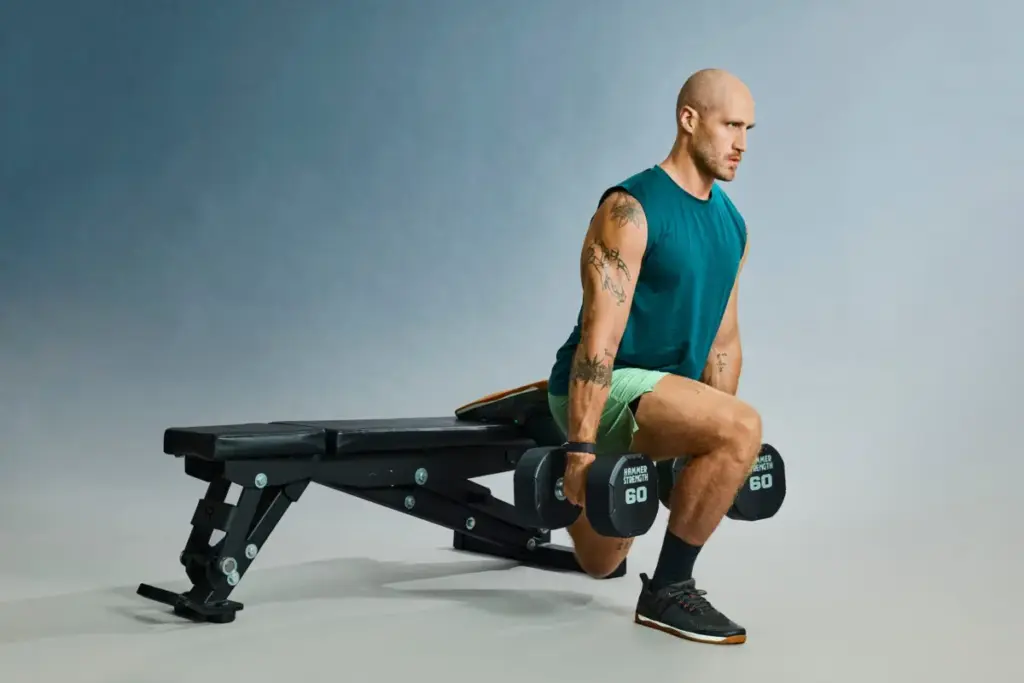
Enter the Bulgarian split squat, scientifically known as the rear foot-elevated split squat. This powerhouse movement has earned its reputation as the gold standard for unilateral lower-body training. However, its immense benefits come with a steeper technical learning curve. According to Men’s Health fitness director Ebenezer Samuel, C.S.C.S., executing the lift with precision is the defining factor between accelerated muscle hypertrophy and chronic joint discomfort.

By dissecting the mechanics, common setup errors, and advanced programming strategies, this guide provides an exhaustive blueprint for mastering the Bulgarian split squat to unlock superior leg strength, correct structural imbalances, and elevate overall athletic performance.
Detailed Chronology & Mechanics of the Lift
To understand why the Bulgarian split squat reigns supreme among strength coaches and kinesiologists, one must examine its evolutionary integration into modern fitness programs. Popularized by strength coach Charlie Francis during his work with elite sprinters, the movement was originally designed to build unilateral leg power without placing excessive axial compressive loads on the spine.

Over the decades, the exercise transitioned from specialized track-and-field conditioning to a staple of commercial and home gyms alike. Yet, its execution has frequently been compromised by poor coaching cues and a misunderstanding of foundational geometry.
Phase 1: The Precision Setup
The single biggest pitfall athletes encounter with the Bulgarian split squat occurs before a single repetition is performed: the setup.

- The Foot Placement Trap: If an exerciser stands too close to the elevated bench, the working knee drifts excessively forward, creating dangerous shear forces across the patellar tendon and increasing the risk of acute knee pain. Conversely, positioning the front foot too far forward turns the movement into a long stride, eliminating the optimal stretch on the back leg’s hip flexors and quads.
- The Ground-Up Protocol: Samuel emphasizes establishing positioning directly from the floor. Trainees should sit or kneel on the floor directly in front of the bench, extend their front leg outward, and stand up directly from that exact spot. This geometric baseline ensures the correct shin angle and trunk lean for the duration of the set.
Phase 2: The Controlled Eccentric Phase
Unlike explosive Olympic lifts, the Bulgarian split squat is an exercise defined by uncompromising control. The lowering phase (eccentric movement) demands absolute engagement of the stabilizing musculature.
- The Back Knee Rule: A prevalent amateur mistake is letting the rear knee drop completely to the floor. Doing so turns the movement into a heavily loaded, passive "couch stretch" rather than an active muscle-building exercise.
- The Hover Technique: Trainees must force themselves to stop approximately one inch above the floor, pausing for a micro-second in the bottom position. This pause eliminates momentum and the "stretch-shortening cycle bounce," demanding that the quads and glutes generate pure, unassisted concentric force to return to the starting position.
Phase 3: Glute Activation and Tracking
The biomechanical demands on the hip complex during a split stance are substantial. Without conscious neural drive, the gluteus medius and maximus can disengage, causing the front knee to collapse inward (valgus collapse)—a mechanical fault that compromises force output and strains connective tissue. Maintaining continuous glute tension ensures proper tracking of the knee over the toes while maximizing power output out of the deepest point of the squat.

Supporting Context & Metrics: Benefits and Requirements
Comprehensive Muscle Recruitment
The Bulgarian split squat is a true compound exercise that simultaneously challenges multiple muscle groups across the lower kinetic chain:
- Quadriceps: The rectus femoris, vastus lateralis, vastus medialis, and vastus intermedius work overtime during the knee-extension phase.
- Hamstrings & Glutes: The rear-foot elevation places the hip extensors in a lengthened state, requiring high levels of active tension from the gluteus maximus and hamstrings to drive the body upward.
- Core & Stabilizers: Because the base of support is narrow and destabilized, deep core stabilizers (transverse abdominis, obliques) and ankle stabilizers must fire continuously to maintain upright posture.
Equipment Requirements
Mastering the move requires minimal, highly accessible equipment:

- Elevated Platform: A stable weight bench, plyometric box, or at-home furniture such as a sturdy ottoman or couch.
- External Resistance (Optional): While bodyweight variations offer immense value for mobility and endurance, optimal hypertrophy and strength gains require added load. Common loading methods include:
- Dumbbells and Kettlebells: Held in a suitcase position at the sides, racked at the shoulders, or held goblet-style.
- Barbells: Placed across the upper traps for advanced lifters with exceptional balance.
Official Guidelines: Programming and Expert Insights
Programming the Bulgarian split squat depends entirely on an individual’s training age, balance proficiency, and primary fitness goals.
Bodyweight as a Finisher
For beginners or those refining their form, unloaded bodyweight split squats serve as an exceptional quad and glute finisher. Because there is no external axial load, trainees can safely push volume higher.

- Target Volume: 3 sets of 15 to 20 repetitions per leg.
- Placement: End of the lower-body workout to induce metabolic fatigue and flush blood into the musculature.
Loaded Strength Work
Once form is cemented, external resistance should be introduced. Because the lift demands high neural output and stabilization, it should be placed early in the training session when the nervous system is fresh.
- Target Volume: 3 sets of 8 to 10 repetitions per leg.
- Placement: Sandwiched between heavy bilateral compound movements (such as back squats or conventional deadlifts) and isolated machine work (like leg extensions).
Advanced Variations for Continued Growth
For experienced lifters who have mastered the standard movement, incorporating advanced variations can break through plateaus and stimulate new pathways for muscle growth:

- Pulse Pause Bulgarian Split Squat: Adding an intentional multi-pulse at the bottom of each repetition extends Time Under Tension (TUT), incinerating muscle fibers and challenging core stability.
- Pass-Through Clean Bulgarian Split Squat: Incorporates a dynamic weight transfer element, bridging the gap between strength training and raw athletic agility.
- Dead Stop Bulgarian Split Squat: Utilizing safety pins in a rack allows the lifter to come to a complete, dead stop at the bottom of the movement, eliminating all elastic energy storage and forcing pure concentric power generation.
- Mixed-Load Bulgarian Split Squat: Holding different loads in each hand (e.g., a heavy dumbbell in one hand and a light one in the other, or a rack hold on one side and a suitcase hold on the other) creates an asymmetrical challenge that forces the obliques and lateral core to resist lateral flexion.
Future Outlook
As the fitness landscape continues to pivot away from purely aesthetic, machine-based training toward functional, athletic longevity, unilateral exercises like the Bulgarian split squat will only grow in prominence. Kinesiologists and physical therapists increasingly view single-leg proficiency not merely as an advanced training option, but as a mandatory baseline for injury prevention, knee health, and long-term joint integrity.
By prioritizing strict execution over ego-lifting, trainees can transform the Bulgarian split squat from a dreaded gym punishment into an indispensable cornerstone of lifelong physical resilience.