Executive Overview
From her formative years as the undisputed breakout star of a wildly successful girl group to her reign as a mononymous global solo icon, Beyoncé Knowles-Carter has cultivated a visual lexicon that few living artists can rival. Her career is not merely defined by chart-topping singles and groundbreaking sonic eras; it is equally punctuated by sartorial milestones that have repeatedly halted the global fashion cycle. Whether she is stepping onto a red carpet in avant-garde haute couture, signaling an album era through meticulously curated stage wardrobes, or transforming traditional Americana into high-fashion statements, Beyoncé remains an immovable pillar of contemporary style.
In celebration of her birthday, this retrospective examines the trajectory of Beyoncé’s style history. We trace her path from the coordinated, mother-made Destiny’s Child ensembles of the late 1990s and early 2000s to the monumental, paradigm-shifting maternity reveals and museum-grade archival revivals of her solo career. Her wardrobe is a living archive—one that encapsulates the intersection of pop culture, Black excellence, and luxury fashion. By continuously collaborating with legendary design houses and visionary emerging talents alike, Beyoncé has transformed her image into a canvas for storytelling, proving that fashion, in her hands, is an active instrument of cultural power.
Detailed Chronology: From Y2K Trendsetter to Western Vanguard
The Dawn of an Icon: Y2K Roots and Destiny’s Child Coordinated Glory
Long before she was commanding the front rows of Paris Fashion Week or commissioning custom Schiaparelli, Beyoncé’s relationship with fashion was rooted in familial collaboration and the vibrant, experimental aesthetic of the late 1990s and early 2000s. During her tenure with Destiny’s Child, the group became famous for their synchronized stage outfits—often handcrafted by Tina Knowles—that defined millennium-era pop aesthetics.
Who could forget the playful, subversive Boy Scout uniforms the trio wore to the 2001 Kids’ Choice Awards, or the liquid-like, slinky green and gold gowns they donned for the Grammy Awards that same year? These early looks laid the foundation for a career that understood the power of visual unity and theatricality.
Simultaneously, Beyoncé’s solo off-duty style during this era captured the unfiltered essence of Y2K street style. Archive photographs of the young star sporting knee-length jean shorts, graphic baby tees, and the rhinestone-embellished slip dress she wore to the 2000 MTV Movie Awards highlight an era of youthful exuberance that continues to inspire modern vintage revivals today.
The Solo Ascent: Red Carpet Dominance and Cultural Earthquakes
As Beyoncé transitioned into her solo career with Dangerously in Love and B’Day, her fashion choices matured into sleek, high-octane glamour. However, it was her monumental live performances and red-carpet appearances that truly cemented her status as a global fashion deity.
Some moments were so seismic that they temporarily disrupted the internet and stopped the cultural clock. At the 2011 MTV Video Music Awards, Beyoncé paused her performance of "Love on Top" to drop her microphone, unbutton a purple sequined Dolce & Gabbana tuxedo jacket, and proudly reveal her baby bump—an image that instantly became one of the most iconic pregnancy announcements in pop culture history.
Four years later, at the 2015 Met Gala, she delivered another masterclass in red-carpet drama, arriving near the end of the evening in a sheer, bedazzled Givenchy Haute Couture "naked dress" covered in strategically placed multicolored crystals. Yet, for every widely celebrated red-carpet triumph, there are countless under-the-radar stylistic choices that deserve equal acclaim—from her fearless exploration of micro-trends to her early adoption of avant-century silhouettes.
The Era of Visual Albums and World Tour Extravaganzas
By the time Beyoncé released her self-titled visual album in 2013 and subsequently redefined pop culture with Lemonade in 2016, her approach to fashion had evolved from wearing designer clothes to co-authoring entire aesthetic movements. Fashion became inseparable from her music.
This philosophy reached a fever pitch during her legendary Renaissance World Tour. The stadium tour served as a living museum of contemporary design, featuring an jaw-dropping roster of custom stage costumes crafted by fashion’s most revered houses and daring visionaries alike. From bespoke Mugler chrome catsuits complete with antennae headpieces to sculptural Loewe crystal-encrusted bodysuits and futuristic Courrèges ensembles, the Renaissance tour established Beyoncé as an undisputed patron of the modern avant-garde.
Cowboy Carter and the Western High-Fashion Renaissance
Most recently, Beyoncé’s creative compass has pivoted toward the rich, historical tapestry of Americana and Western wear, ushered in by her critically acclaimed country album, Cowboy Carter. This sonic shift sparked an immediate wardrobe transformation, turning rodeo aesthetic and traditional Western motifs into high-fashion gold.
During the Fall 2024 season of New York Fashion Week, the singer caused an unprecedented frenzy when she made a surprise appearance at the Luar show. Decked out in a distinctly "Beyoncéfied" interpretation of Western wear—complete with a statement cowboy hat and an exquisite leather-and-metal ensemble courtesy of Gaurav Gupta—she single-handedly dominated the fashion week news cycle.
Her transatlantic style streak continued earlier this year when she and JAY-Z attended Pharrell Williams’s star-studded Louis Vuitton menswear show in Paris. True to form, Beyoncé leaned entirely into the western-luxe theme, pairing impeccably tailored French luxury pieces with classic American cowboy detailing.
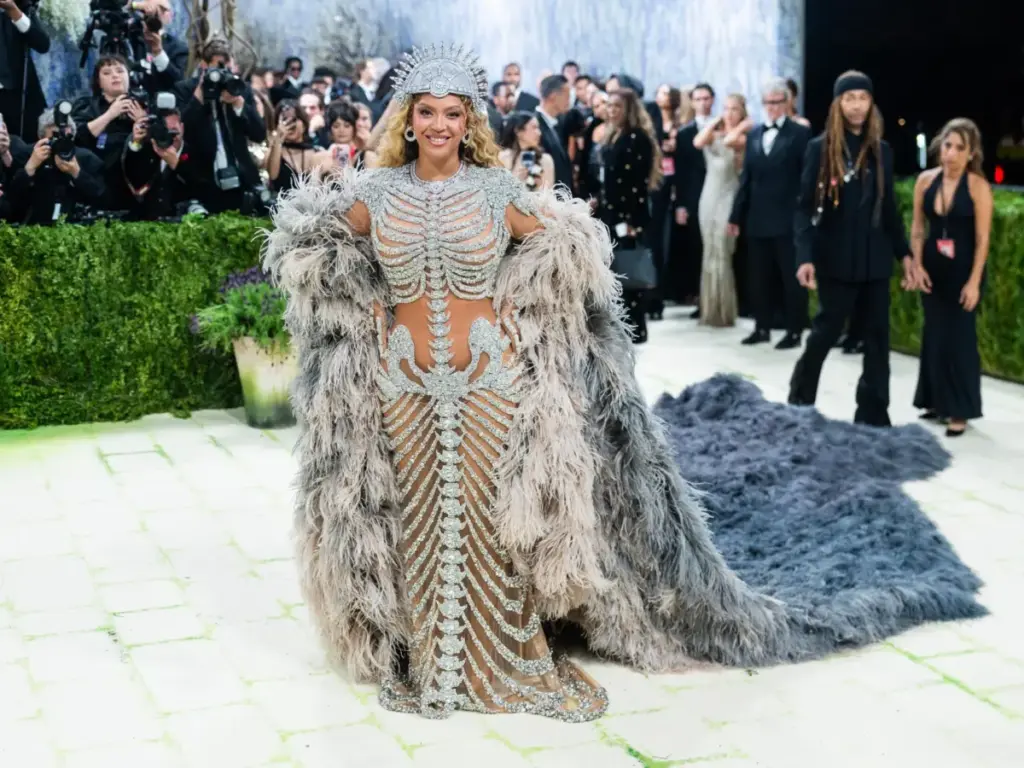
Yet, true to her polymorphic style identity, she never stays tethered to a single aesthetic for long. Whether diving deep into the Versace archives for the iHeartRadio Music Awards, enouncing structural elegance via Schiaparelli for a tailored cowgirl-chic Grammy look, or stepping onto the steps of the Metropolitan Museum of Art in theatrical, sculptural couture by Robert Wun and Olivier Rousteing, Beyoncé proves that versatility is the ultimate luxury.
Supporting Context & Metrics: The Economics and Cultural Impact of the "Beyoncé Effect"
The Quantifiable Value of a Single Appearance
In the modern luxury landscape, Beyoncé’s endorsement carries economic weight that traditional advertising budgets cannot buy. Industry analysts often refer to the "Beyoncé Effect," a phenomenon where a single public sighting or stage appearance results in immediate, exponential spikes in brand search volume, social media engagement, and direct-to-consumer sales.
When Beyoncé steps out in a custom piece from an independent designer—such as her surprise Luar appearance in Gaurav Gupta—the digital footprint of that brand expands overnight. According to fashion metrics platforms, emerging labels blessed with a "Beyoncé moment" frequently experience triple-digit percentage increases in web traffic and wholesale inquiries within 48 hours of publication.
Archival Revival and Museum-Grade Preservation
Beyoncé’s fashion choices increasingly blur the line between pop-culture styling and archival curation. By consistently pulling rare, historic garments from fashion houses like Versace, Givenchy, and Mugler, she treats high fashion not merely as seasonal apparel, but as a living museum. This practice elevates the cultural conversation surrounding fashion preservation, introducing seminal runway collections of the 1990s and 2000s to younger, digitally native generations who view her styling choices as definitive educational touchstones.
Sustainability and the Circular Fashion Economy
While world tours and red-carpet wardrobes are traditionally associated with hyper-consumption, Beyoncé’s stylists—notably longtime collaborators Marni Senofonte and KJ Moody—frequently incorporate vintage and repurposed deadstock materials into her visual storytelling. Her ability to merge archival pieces with cutting-edge custom creations champions a sophisticated form of sustainable luxury, proving that historical garments can be revitalized for modern, high-impact performance art.
Official Statements & Industry Perspectives
The cultural resonance of Beyoncé’s wardrobe has not gone unnoticed by the architects of the fashion industry itself. Over the years, legendary designers, creative directors, and cultural critics have repeatedly voiced their admiration for her collaborative spirit and exacting eye.
"Working with Beyoncé is unlike any other experience in fashion. She doesn’t just wear the clothes; she understands the narrative architecture behind every single stitch. She brings an intellectual rigor and an unmatched performance energy to the fitting room."
— Anonymous Haute Couture Creative Director
In recent interviews discussing the curation of the Renaissance and Cowboy Carter wardrobes, stylists and collaborators have emphasized Beyoncé’s hands-on approach to creative direction. Rather than acting as a passive mannequin for luxury brands, she functions as an active co-creator, ensuring that every garment aligns with the overarching socio-cultural themes of her music.
Fashion historians have similarly praised her ability to spotlight Black designers and historical Black western aesthetics through her recent stylistic pivot. By elevating western wear through a Black diasporic lens, Beyoncé has challenged traditional, Eurocentric narratives of luxury and Americana, forcing the global fashion industry to expand its definitions of elegance and heritage.
Future Outlook: What’s Next for Pop’s Ultimate Style Icon?
As Beyoncé continues to chart new territories in both music and design, her influence on the global fashion ecosystem shows no signs of decelerating. The meticulous world-building that characterized Renaissance and Cowboy Carter has established a new benchmark for how modern artists utilize wardrobe as a narrative device.
Looking forward, industry insiders anticipate that Beyoncé’s footprint in the fashion world will only deepen. Whether through potential direct-to-consumer lifestyle brand expansions, increased patronage of marginalized and independent design talents, or further exploration of museum-level artistic exhibitions, her trajectory suggests that she is transitioning from a muse of high fashion to an institutional force within it.
As we look back at her storied career—from the Y2K slip dresses of her teenage years to the sculptural, boundary-pushing couture of the present day—one truth remains immutable: Beyoncé does not merely follow fashion trends. She defines them, deconstructs them, and rebuilds them in her own awe-inspiring image.