The Venice International Film Festival—the oldest film festival in the world and one of the prestigious "Big Three" alongside Cannes and Berlin—has long served as a high-stakes runway for cinematic royalty. Set against the romantic, decaying backdrop of the Lido di Venezia, the festival blends old-world European glamour with the razor-sharp machinery of modern Hollywood publicity. While the Golden Lion remains the ultimate cinematic prize, the red carpet has evolved into a cultural phenomenon in its own right, where sartorial choices are dissected, celebrated, and written into fashion history.
Over the decades, the Venice red carpet has transitioned from classic, understated Hollywood elegance to a calculated theater of avant-garde statements, archival flexes, and boundary-pushing maternity looks. Curated insights from top fashion editors, directors, and stylists reveal that the festival’s most memorable style moments share a common thread: intention. Whether it is Zendaya commanding attention in sculpted wet-look leather or Jane Birkin redefining effortless French cool in Converse high-tops, these defining snapshots capture the ever-shifting zeitgeist of style. This retrospective explores the definitive fashion milestones of the Venice Film Festival, examining how stars, stylists, and heritage fashion houses have utilized the Lido as a canvas for high-fashion storytelling.
Detailed Chronology: Defining Sartorial Eras at Venice
The Mid-Century Blueprint: Effortless Mid-Century Icons (1960s–1990s)
Long before social media algorithms and live-streamed fashion breakdowns dictated the red carpet, Venice possessed an effortless, unforced charm.
Jane Fonda (1966): An enduring symbol of 1960s youth culture, Fonda appeared in Venice wearing a dandelion-hued sheath dress defined by delicate cap-sleeves and punctuated by a striking red necklace. According to fashion critics, the look remains a masterclass in understated elegance—proving that minimalist silhouettes paired with singular, bold accessories can transcend decades.
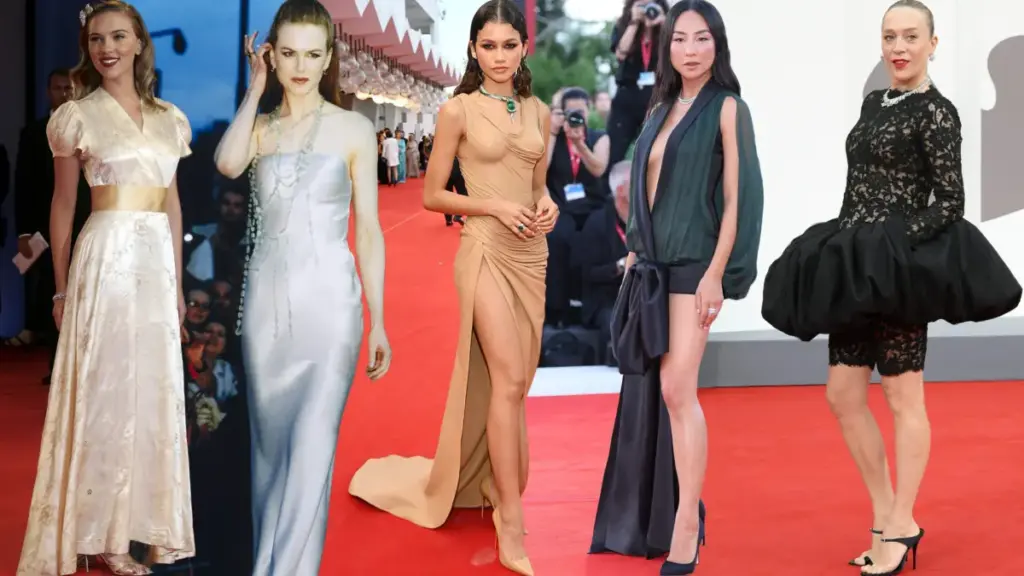
Nicole Kidman in John Galliano (1999): As the 20th century drew to a close, Kidman delivered a masterclass in modern ethereal dressing. Clad in a liquid-silver silk slip dress designed by John Galliano, the look was elevated by a cascading beaded body necklace. Industry experts note how this look felt light-years ahead of its time, balancing a subtle whisper of a statement with an undeniable radiance that allowed the actor to effortlessly command the room.
The Turn of the Century and the Rise of Risk-Taking (2000s)
The early aughts ushered in a wave of experimental tailoring, vintage revivals, and bold paradigm shifts regarding who and what the red carpet was designed for.
Kate Hudson in Chanel (2003): Navigating a high-profile public pregnancy on a major international red carpet was once a logistical and aesthetic tightrope. However, Kate Hudson shattered conventional maternity norms at the 2003 festival. Wearing a lilac-gray two-piece set from Chanel’s Spring/Summer 2003 couture collection—complete with a halter-neck top, a low-rise skirt, shimmering embellishments, feather trim, and sheer overlays—Hudson delivered a bold, rule-breaking masterclass that paved the way for modern celebrity maternity style.
Kirsten Dunst (2005): Proving that true style possesses prophetic foresight, Dunst stepped onto the Venice carpet in a 1920s-style sheath silhouette adorned with retro lace trim, an intricate Art Deco belt, and pointed toe pumps. Though executed in 2005, the ensemble mirrors the hyper-curated, vintage-inflected aesthetics that dominate modern red carpets today.
Scarlett Johansson in Vintage (2006): Long before archival pulls and vintage sourcing became the ultimate currency for red carpet stylists, Johansson championed sustainability and fashion history. Wearing a cream silk vintage gown featuring Japanese-inspired wrap detailing and a wide obi-style sash, she set an early blueprint for honoring heritage fashion house archives on the global stage.
Anne Hathaway in Atelier Versace (2008): To celebrate the premiere of Rachel Getting Married, Hathaway opted for an Atelier Versace gown that played brilliantly with optical illusions. Featuring a gray chiffon base saturated with complex undertones of pigeon purple and seafoam green ruffles, the dress shifted hues dynamically under the Venetian flashbulbs.
Jane Birkin (2009): Redefining festival arrival style entirely, the late singer and actor arrived in Venice radiating effortless Parisian cool. Channeling an aesthetic reminiscent of vintage Armani advertising campaigns, Birkin paired an oversized white linen button-down with wide-leg trousers cinched by a belt, casually rolling the cuffs to reveal a pair of classic Converse high-tops.
Modern Avant-Garde and Architectural Mastery (2010s–Present)
As the media landscape modernized, the Venice red carpet evolved into an arena for high-concept conceptual fashion, structural tailoring, and powerhouse collaborations between actors and master stylists.
Tilda Swinton in Haider Ackermann (2015): A perennial muse of the avant-garde, Swinton floated down the carpet for A Bigger Splash in a minimalist, ethereal creation by Haider Ackermann. Long before "butter yellow" dominated contemporary runways as a micro-trend, Swinton effortlessly weaponized the pale, luminous hue with understated grace.
Elizabeth Debicki in Schiaparelli Haute Couture (2019): Merging quiet luxury with monumental theatricality, Debicki wore a midnight-black Schiaparelli gown defined by a slouchy, strapless neckline flap, a dramatic train, and a metallic-sheen fabric. Fashion historians note that this particular look served as a sartorial audition for her critically acclaimed portrayal of Princess Diana in The Crown—a masterclass in poise and aristocratic melancholy.
Zendaya in Balmain (2021): Co-created with legendary image architect Law Roach, Zendaya’s appearance at the premiere of Dune remains a watershed moment in contemporary fashion history. Encased in a custom, sculpted leather Balmain gown featuring a daring thigh-high slit, the look was meticulously coordinated down to the last detail. From her wet-look braided hair to a statement-making Bulgari Serpenti diamond necklace and perfectly color-matched leather Christian Louboutin pumps, the ensemble left nothing to chance.
Dakota Johnson in Gucci (2021): Solidifying her signature red-carpet uniform under Alessandro Michele’s Gucci era, Johnson opted for a crystal-encrusted, sheer mesh column dress adorned with dramatic crystal fringe and strong shoulders. The "naked dressing" triumph demonstrated a rare balance of sensual exposure and architectural armor.
Amal Clooney in Versace (2024): Bringing classic Hollywood glamour to the canals, Clooney turned heads in a custom butter-yellow Versace gown. The design utilized sweeping chiffon trains, intricate lace paneling, and voluminous ruffles to create a silhouette that felt simultaneously romantic and commanding.
Chloë Sevigny in Simone Rocha and Saint Laurent (2025): Indie cinema’s reigning style icon continued her streak of boundary-pushing brilliance. Whether pairing a delicate ballet-pink Simone Rocha dress layered with cascading bows or a darkly whimsical Saint Laurent ensemble featuring a lacy catsuit tucked beneath a dramatic peplum skirt, Sevigny proved why her stylized whimsy remains unmatched.
Greta Lee in Dior (2025): Cementing her status as a modern fashion heavyweight, Lee’s architectural Dior gown captured the imaginations of critics worldwide, standing out as a masterclass in modern proportion, minimalism, and structural sophistication.
Supporting Context & Metrics: The Economics and Cultural Impact of Venice Fashion
While the art house films screened in the Sala Grande remain the primary focus of the festival, the economic and cultural impact of the red carpet has grown exponentially over the past two decades. According to digital engagement metrics compiled across global luxury conglomerates, high-profile fashion moments at the Venice Film Festival generate upwards of $150 million in Media Impact Value (MIV) annually for participating design houses.
Unlike the Met Gala—which operates under strict, theme-driven constraints—or the Academy Awards—which often favor safe, traditional tailoring—the Venice Film Festival occupies a unique sweet spot. Its late-summer timing places it at the exact intersection of the luxury resort and early autumn fashion cycles, making it the premier launchpad for global campaigns.
Furthermore, the rise of specialized image architects (such as Law Roach, Ryan Hastings, and Dani Michelle) has transformed the Lido into an extension of Paris Fashion Week. Archival searches for "vintage silk gowns" and "sculpted leather dresses" routinely spike by over 300% within forty-eight hours of major Venice red carpet premieres, proving that the festival’s historical retrospectives directly influence consumer behavior and retail trends for the upcoming seasons.
Official Statements and Editor Perspectives
The enduring magic of the Venice red carpet is perhaps best understood through the eyes of the industry professionals who chronicle it. Speaking on the collaborative nature of modern styling, executive digital director Lynette Nylander notes regarding Zendaya’s 2021 Balmain appearance:
"Zendaya and her stylist Law Roach leave nothing on the table when it comes to the red carpet… Everything was intentional, from the wet-look hair to the Bulgari Serpenti necklace to the shoes matched perfectly to the dress."
Echoing this sentiment of calculated whimsy, fashion commerce editor Michella Ore highlights Chloë Sevigny’s unique ability to bridge the gap between high conceptual art and wearable reality:
"Chloë Sevigny has mastered the art of making high fashion feel accessible. I think the key is that while she respects the clothes, she’s not afraid to be playful… wearing a lacy catsuit underneath a peplum skirt—by Saint Laurent, of course—with a freaky pump and generously sized jewels is just the sort of stylized whimsy she’s lauded for."
Designers and editors alike frequently emphasize how Venice allows for a more introspective, romantic brand of storytelling compared to other bustling festival circuits. Senior designer Sarah Olivieri, reflecting on Nicole Kidman’s iconic 1999 Galliano slip dress, observes:
"I’ll never get over how dreamily the silver silk of the dress hugs her—and the addition of the cascading beaded body necklace! Everything about this look feels so elevated and ahead of its time."
Future Outlook: The Evolution of Festival Style in the Digital Age
As the Venice International Film Festival looks toward upcoming iterations, the dynamics of red-carpet fashion are undergoing a profound digital transformation. With sustainability, transparency, and archival preservation becoming central tenets of modern luxury consumption, the practices pioneered by stars like Scarlett Johansson and Chloë Sevigny—favoring vintage sourcing, independent avant-garde designers, and reworn archival pieces—are projected to become the industry standard.
Moreover, the integration of real-time digital voting, augmented-reality fashion experiences, and direct-to-consumer digital shopping integrations means that future red-carpet moments will no longer be passive visual spectacles. Instead, they will function as interactive touchpoints where cinematic art and high fashion merge more seamlessly than ever before.
Ultimately, whether through Kate Hudson challenging archaic maternity expectations in 2003 or Zendaya defining a post-pandemic glamour renaissance in 2021, the Venice Film Festival red carpet will continue to serve as fashion’s most romantic cinematic stage—where past, present, and future collide beneath the Italian sun.