Executive Overview
Commuters traveling along one of the United Kingdom’s busiest orbital routes experienced severe travel disruptions on the morning of Wednesday, September 2, 2026. A multi-vehicle collision on the M25 clockwise carriageway—occurring between Junction 12 (Thorpe) and Junction 13 (Staines-upon-Thames)—forced emergency services and National Highways personnel to implement emergency lane closures.
The incident, which compounded morning peak-hour traffic volumes, involved multiple vehicles and resulted in a hazardous roadway spillage that required specialized treatment before the tarmac could be deemed safe for general transit.
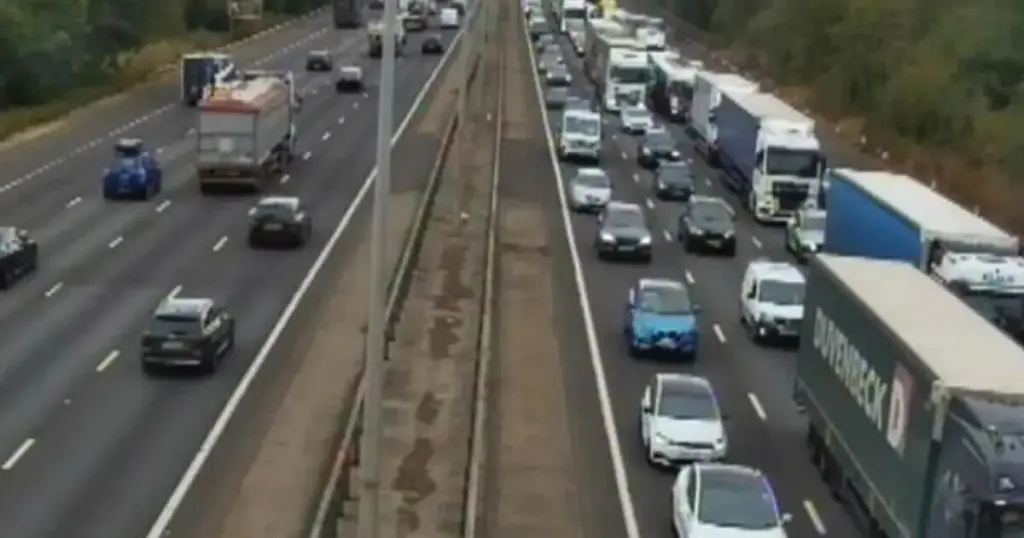
At the height of the incident, three out of the five available clockwise lanes were shut down, reducing throughput to a mere two lanes. This restriction triggered catastrophic knock-on effects across the motorway network, producing stationary queues stretching up to six miles.
Motorists faced peak journey delays of approximately 60 minutes as emergency crews worked diligently to clear wreckage, relocate vehicles to the hard shoulder, and neutralize the roadway hazards. Although all lanes have since been officially reopened, residual delays of around 30 minutes persisted as the network slowly absorbed the backlog. This incident serves as yet another stark reminder of the extreme fragility of the UK’s strategic road network, where a single localized collision can instantaneously paralyze tens of thousands of motorists and ripple across interconnected regional arteries.
Detailed Chronology of Events
The unfolding crisis on Wednesday morning followed a precise, rapidly escalating timeline managed by National Highways, regional traffic officers, and emergency responders.
10:30 AM – The Initial Alert and Network Response
The disruption began shortly before mid-morning when reports reached National Highways’ regional control centers regarding a multi-vehicle collision on the M25 clockwise stretch between Junction 12 and Junction 13. Immediate safety protocols were triggered. To protect motorists, recovery crews, and emergency personnel working at the scene, traffic management systems instantly initiated automated warning matrix signs across the approach corridors.
10:31 AM to 10:33 AM – Escalation and Lane Closures
As first responders arrived, the true scale of the incident became apparent. In addition to the physical debris and disabled vehicles obstructing the tarmac, a significant spillage had occurred, presenting an immediate skidding and environmental hazard. Consequently, traffic officers closed lanes one, two, and three of the five-lane motorway.
With only lanes four and five remaining open to accommodate the dense flow of commuter and freight traffic, capacity dropped precipitously. Telemetry and roadside sensors quickly captured the burgeoning tailbacks, confirming that motorists trapped behind the incident were enduring comprehensive delays scaling up to 60 minutes.
11:24 AM – Peak Congestion and Tailback Metrics
By late morning, the geographical footprint of the congestion had expanded dramatically. National Highways updates confirmed that the tailbacks had reached a staggering length of six miles, ensnaring thousands of private vehicles, commercial hauliers, and public transport services in a standstill. Motorists attempting to bypass the area via local diversion routes through Thorpe and Staines-upon-Thames also reported heavy localized congestion as displaced traffic sought alternative pathways.
11:34 AM – Clearance, Remediation, and Reopening
Swift action by recovery specialists and environmental cleanup teams mitigated the worst-case scenarios. All vehicles involved in the collision were successfully winched and towed onto the hard shoulder, clearing the main running lanes of physical obstructions. Simultaneously, specialized grit and chemical treatment agents were applied to the carriageway to neutralize the spillage.
National Highways formally announced the complete lifting of all lane closures via their regional communications channels. While residual delays of approximately 30 minutes lingered immediately following the full reopening, authorities confirmed that traffic flow was steadily returning to normal operational parameters.
Supporting Context & Metrics
To fully understand the magnitude of the delays experienced on the morning of September 2, 2026, it is essential to examine the operational ecosystem of the M25 motorway, its traffic densities, and the specific metrics recorded during the incident.

Infrastructure and Traffic Volume Dynamics
The M25 motorway, often described as London’s orbital motorway, is one of the busiest and most economically vital stretches of highway in Europe. Handling hundreds of thousands of vehicle movements daily—ranging from international freight bound for Channel ports to regional commuters traveling between Surrey, Berkshire, and Greater London—the corridor operates near maximum capacity during peak windows.
The specific section between Junction 12 (the intersection with the M3, near Thorpe) and Junction 13 (Staines-upon-Thames / A30) features a five-lane configuration in each direction under normal operating conditions. This configuration is designed to absorb high volumes of converging traffic from the south-west corridors into the western sectors of London’s orbital path.
Key Incident Metrics
- Location: M25 Clockwise, between Junction 12 (Thorpe) and Junction 13 (Staines-upon-Thames).
- Lanes Affected: Lanes 1, 2, and 3 closed out of a total 5-lane configuration.
- Maximum Delays: Up to 60 minutes recorded at the peak of the incident around 10:00 AM to 10:33 AM.
- Geographic Extent: Congestion and stationary traffic tailbacks stretched approximately 6 miles back along the clockwise approach.
- Resolution Window: Full clearance and reopening achieved within roughly one hour of intensive multi-agency intervention, with residual delays tapering down to 30 minutes shortly after 11:34 AM.
Official Statements and Multi-Agency Response
The rapid containment and successful resolution of the incident were credited to the coordinated efforts of National Highways’ South-East division, regional traffic officers, and recovery operators.
In an official status update broadcast via social media channels at 11:34 AM, National Highways: South-East provided a comprehensive technical breakdown of the operations:
"Update 2: M25 clockwise J12 to J13 near Staines. All involved vehicles have been moved to the hard shoulder to await recovery. Spillage has been successfully treated. All lanes now open. Delays of 30 minutes, though these should ease. Have a safe journey onwards."
Prior to the full reopening, operational briefings emphasized the compounding nature of the hazard. Road safety engineers underscored that roadway spillages—frequently involving automotive fluids, oil, or lost cargo—pose an insidious danger that requires rigorous chemical treatment rather than simple physical sweeping. Leaving an untreated film on a high-speed tarmac surface can easily trigger secondary collisions, explaining why authorities maintained strict lane closures despite mounting public pressure from gridlocked motorists.
Emergency planning experts noted that the decision to prioritize safety and thorough remediation over hasty reopening prevented what could have been a far more dangerous secondary incident on the busy commuter route.
Future Outlook: Mitigating Orbital Vulnerabilities
Incidents of this nature lay bare the inherent vulnerabilities of high-capacity smart motorways and arterial ring roads. As traffic volumes continue their post-pandemic rebound toward historic highs, transport planners face mounting pressure to enhance the resilience of the UK strategic road network.
Technological Interventions and Rapid Response
National Highways has increasingly relied on advanced intelligent transport systems (ITS) to detect incidents within seconds rather than minutes. Automated camera analytics, radar-based stopped-vehicle detection (SVD), and dynamic variable speed limits play a pivotal role in warning oncoming motorists and closing lanes before high-speed rear-end collisions can occur.
Moving forward, transport authorities are expected to accelerate the deployment of predictive traffic management algorithms and pre-positioned heavy recovery assets at critical junctions like the M25/M3 interchange. By reducing the response time required to clear heavy commercial vehicles and hazardous spillages, the network can minimize the cascading delays that cost the national economy millions of pounds in lost productivity each year.
Advice for Motorists
Transport agencies continue to remind drivers utilizing major routes like the M25 to adhere strictly to variable speed limits, maintain safe following distances, and check vehicle roadworthiness prior to undertaking long journeys. In the event of a breakdown or collision on a busy motorway, motorists are urged to move their vehicles to the hard shoulder or an emergency refuge area whenever possible, exit the vehicle from the passenger side behind safety barriers, and contact emergency services immediately.
As normal traffic flows resumed on the afternoon of September 2, 2026, the temporary chaos between Junctions 12 and 13 faded into the background—serving, for now, as a fleeting yet potent reminder of the delicate balance governing Britain’s busiest highway.