The Costumes of Priscilla: How Fashion Tells the Quiet Story of Identity, Control, and Liberation
When history remembers Elvis Presley, it often recalls the high-octane iconography of the 1960s and 70s: the rhinestones, the cascading capes, the flared jumpsuits, and the unmistakable swagger of a cultural titan who forever altered the landscape of global fashion. Yet, in Sofia Coppola’s masterfully restrained biographical drama Priscilla, the legendary King of Rock ’n’ Roll shares the spotlight with a wardrobe that tells an entirely different story. Based on Priscilla Presley’s 1985 memoir Elvis and Me, the film—starring Jacob Elordi as Elvis and Cailee Spaeny as Priscilla—shifts the sartorial focus away from stadium-sized spectacle and toward an intimate, delicate excavation of a young woman quietly constructing her own identity under the suffocating weight of global fame.
Executive Overview
For costume designer Stacey Battat, whose previous collaborations with Coppola include The Bling Ring and The Beguiled, the monumental task of outfitting Priscilla was not merely an exercise in historical recreation. It was an exploration of emotional geography. Battat approached the film’s wardrobe as a silent narrator tracking the seismic shifts in a marriage defined by profound imbalance, isolation, and eventual liberation.
From the innocent pastel cardigans of a teenage girl living on a US Army base in West Germany to the haute-couture wedding creations of Las Vegas, and finally to the bohemian, liberated silhouettes of 1970s Los Angeles, the clothes in Priscilla do more than decorate the screen. They act as armor, as cages, and ultimately, as the tools of an emotional escape. This comprehensive examination delves into the meticulous research, the high-fashion collaborations, and the psychological symbolism that defined one of the most visually compelling cinematic wardrobe transformations of recent years.
Detailed Chronology: A Sartorial Evolution
The visual narrative of Priscilla is meticulously mapped across distinct geographical and chronological phases, each bringing a fundamental shift in how the title character presents herself to the world—and to the man who sought to curate every aspect of her existence.
Act I: The Innocence of West Germany (Late 1950s)
The film introduces us to Priscilla Beaulieu at the tender age of fourteen. Residing with her family on a United States Army base in Germany, her world is one of innocent suburbia and youthful yearning.
To capture this era, Battat and her dedicated design team immersed themselves in historical archives, leafing through vintage editions of Vogue and Harper’s Bazaar dating back to the late 1950s and early 1960s. The objective was to ground the character in authentic textures and silhouettes. Priscilla’s early wardrobe consists of sweet A-line skirts, pastel-toned cardigans, delicate Peter Pan collars, and a signature heart necklace.
One of the most striking nods to historical accuracy in this section involves a meticulously recreated moment from real life: an archival photograph of Priscilla waving goodbye to Elvis as he departs Germany to return to the United States. In the film, Spaeny wears a near-exact replica of that outfit—a charming plaid dress paired with a transparent headscarf tied neatly beneath her chin. It is a snapshot of youthful vulnerability before the storm of worldwide celebrity irrevocably alters her reality.
Act II: The Gilded Cage of Memphis (1960s)
Upon relocating to Graceland in Memphis, Tennessee, Priscilla’s wardrobe undergoes an abrupt and dramatic metamorphosis. The innocent plaid skirts and hair ribbons of her adolescence are summarily discarded, replaced by the sophisticated demands of her new life: opera gloves, voluminous bouffant hairstyles, and glamorous minidresses.
This transformation, however, was not self-directed. As depicted in the film—and detailed in her memoir—Elvis quickly took total control of Priscilla’s aesthetic presentation. During intimate shopping trips in Memphis, the music icon actively dictated what she should and should not wear. Furthermore, he demanded that she dye her natural brown hair jet-black and apply heavy, dramatic winged eyeliner to match his own stylized image.
From this juncture onward, Priscilla is restricted to a curated palette of pinks and blues—hues favored by Elvis—while enduring his strict aversion to brown tones and busy patterns. Despite the luxurious surroundings of Graceland, her clothes here function as a uniform assigned by a director who viewed his young partner as a living canvas. Much of the domestic narrative during this period unfolds behind closed doors, where Priscilla drifts through the sprawling mansion in soft, pastel lingerie sets and delicate nightgowns, trapped in a gilded cage of domesticity.
The Iconic 1967 Las Vegas Wedding
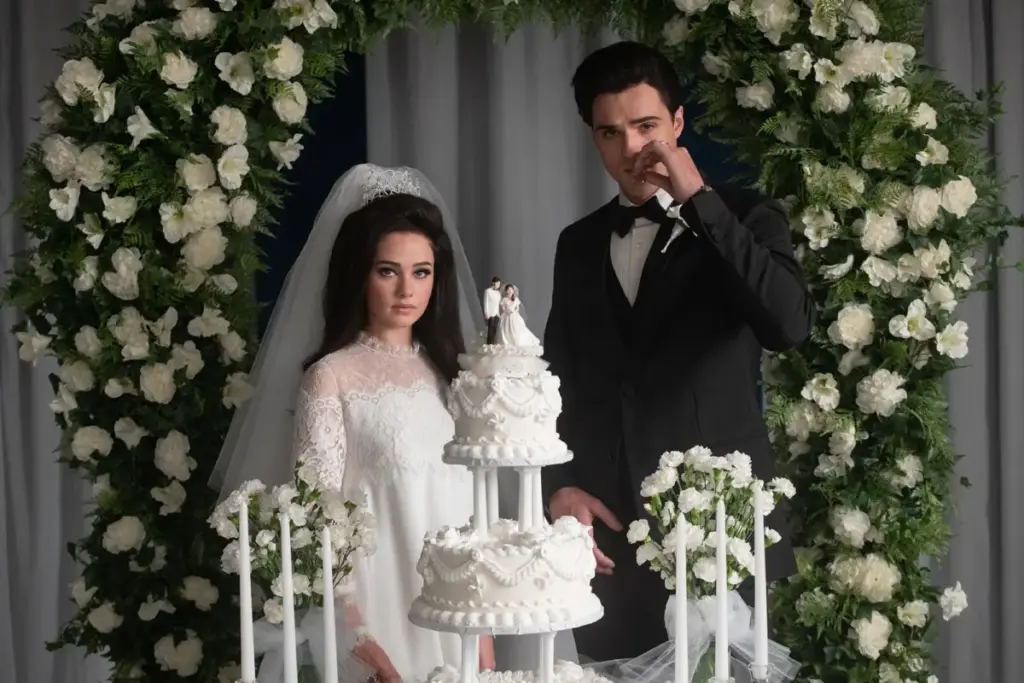
No exploration of the couple’s visual history would be complete without examining their landmark 1967 wedding in Las Vegas. For this pivotal cinematic sequence, Battat collaborated with two legendary fashion houses: Chanel, which designed Priscilla’s iconic bridal gown, and Valentino, which tailored Elvis’s sharp wedding suit.
The cinematic recreation of the wedding dress draws direct inspiration from the original historical photographs. Priscilla wears a floor-length, long-sleeved A-line gown heavily detailed with delicate lace, completed by a sparkling tiara and a dramatic, waist-length veil.
Adapting the garment for the screen required careful craftsmanship. Because lead actress Cailee Spaeny stands at 1.56 meters (approximately 5 feet 1 inch) tall, Battat and her team had to recalibrate the proportions of the original dress to fit Spaeny’s frame while preserving the distinct architectural lines that made the 1967 original legendary. Shortly after the ceremony, the film captures another historically grounded fashion moment: the vibrant, bright pink dress Priscilla wears upon returning home after the birth of their daughter, Lisa Marie.
Act III: The 1970s, Separation, and Liberation
The second half of Priscilla charts the agonizing, quiet unravelling of the marriage. Elvis reaches the theatrical peak of his career, performing glittering residencies in Las Vegas, while Priscilla finds herself increasingly isolated in Los Angeles.
As the emotional distance between them widens, their sartorial paths diverge sharply. Elvis sheds his earlier rock-and-roll leather jackets and sharp blazers in favor of hyper-theatrical, rhinestone-encrusted, colorful jumpsuits—garments that required Battat to partner with BK Enterprises, the original creators behind many of the King’s iconic stage wear.
Priscilla, meanwhile, finds solace in the relaxed, liberating fashion trends of the 1970s. She embraces wide-leg trousers, earthy patterns, and—most symbolically—her natural brown hair worn in soft, untamed curls. The armor imposed upon her a decade prior is finally shed.
Supporting Context & Metrics: The Visual Language of Decay
To fully appreciate the narrative weight of Priscilla, one must examine the psychological framework that guided the costume department. Fashion in cinema is rarely decorative; when executed by a visionary like Sofia Coppola, it serves as an emotional barometer.
The 1970 Photograph That Started It All
According to Stacey Battat, the entire conceptual framework for the film’s wardrobe was unlocked by a single, telling archival photograph taken of Elvis and Priscilla in 1970.
"Sofia and I looked at this picture together and we both felt that Priscilla looked as though she felt deeply uncomfortable in it," Battat recalls. "I think that photo strongly reflects how we later see the two of them in the film."
In that single image, the physical and emotional distance between the couple is palpable. Elvis remains encapsulated in his heavy, theatrical persona, weighed down by greasepaint, massive sideburns, and heavy jewelry. Priscilla, however, appears physically and emotionally detached from the spectacle. That photograph served as the North Star for the second half of the movie, illustrating a fundamental truth: while Elvis grew increasingly trapped inside his own myth-making machinery, Priscilla was actively stripping away her artifice to find her true self.
Official Statements & Design Insights
The creative synergy between director Sofia Coppola and costume designer Stacey Battat is well-documented, built on a foundation of mutual trust and rigorous archival research. In interviews surrounding the film’s release, Battat emphasized the collaborative nature of translating private trauma and public performance into tangible fabrics.
- On the evolution of personal presentation: "We looked at historical photos of Elvis and Priscilla and thought about the image they presented to the world," Battat explains. "I think he became increasingly theatrical and costume-like—lots of makeup, jewelry, and big sideburns. She, on the other hand, sheds her mask over time."
- On the restrictive nature of Graceland’s wardrobe: The transition from the independent schoolgirl in Germany to the molded doll of Memphis highlights the loss of agency. By dictating her hair color, makeup, and clothing choices, Elvis inadvertently created a visual narrative of control that culminated in Priscilla’s eventual, resolute departure.
Future Outlook: The Enduring Legacy of Priscilla‘s Aesthetic
Beyond its critical acclaim and awards-season recognition, Priscilla has left an indelible mark on contemporary fashion and cinematic design. By moving away from the bombastic, glitter-soaked celebrations of Elvis’s life typically favored by Hollywood, Coppola and Battat carved out a new space for biographical storytelling—one where silence, negative space, and understated wardrobe choices speak louder than any stadium roar.
The film’s exploration of 1960s suburban youth blended with the crushing realities of early-adult confinement has also resonated deeply with modern fashion sensibilities. The resurgence of 60s minimalism, delicate pastel loungewear, and the powerful reclamation of personal style after a period of external influence continue to inspire runway trends and street style alike.
Ultimately, Priscilla stands as a masterclass in costume design. It reminds audiences that clothes are never just clothes—they are the skin we wear to navigate our relationships, the armor we use to protect our vulnerabilities, and, when the time finally comes, the vehicle through which we reclaim our freedom.
Priscilla is available to watch in cinemas worldwide.