Executive Overview
In an era defined by sedentary desk jobs, prolonged screen time, and chronic physical compression, the modern workforce is fighting a quiet battle against stiffness, chronic pain, and lethargy. Conventional wellness advice often prescribes exhaustive fitness regimens—such as uninterrupted 60-minute yoga classes, intensive gym sessions, or rigorous morning routines—that many busy professionals simply cannot fit into their daily schedules. This friction between idealized self-care and the reality of a demanding calendar frequently leads to an all-or-nothing mindset, where individuals abandon physical maintenance altogether.
However, a paradigm shift is underway in the fitness community. Leading movement specialists argue that consistency vastly outweighs duration when it comes to maintaining joint health, neural well-being, and physical mobility. Enter Jack Bryant, a renowned yoga teacher and founder of Wellness With La Rue, who has engineered a dynamic, highly concentrated five-minute mobility flow designed to reset the body and mind in the time it takes to brew a cup of coffee.
Rather than diluting the practice, this rapid-fire sequence condenses a dozen foundational asanas (postures) into a seamless, high-efficiency routine. Tailored primarily for individuals who are already familiar with basic yoga mechanics, Bryant’s routine addresses the physical toll of sitting for hours on end. By systematically moving the spine through flexion, extension, rotation, and lateral openness, this five-minute intervention acts as a physical and cognitive circuit breaker. This report explores the physiological mechanics behind micro-dosing movement, breaks down the precise sequence of Bryant’s mobility flow, evaluates the anatomical benefits of each pose, and examines the future outlook of bite-sized physical wellness in corporate and domestic spaces.
Detailed Chronology: The Evolution of Micro-Mobility and the Five-Minute Protocol
The conceptualization of the five-minute yoga flow did not emerge in a vacuum; it is the culmination of years of biomechanical research into sedentary lifestyles and the physiological deterioration caused by prolonged chair-bound labor.
The Modern Sedentary Crisis
For decades, health advocates emphasized the importance of hitting weekly exercise quotas—such as 150 minutes of moderate aerobic activity. While valuable, this macro-approach overlooked the acute dangers of uninterrupted sitting. Medical studies increasingly show that even individuals who exercise for an hour daily can suffer the metabolic and musculoskeletal consequences of sitting for the remaining nine hours. Tight hip flexors, compressed lumbar vertebrae, rounded shoulders, and dormant gluteal muscles have become the hallmark posture of the digital age.
The Birth of Wellness With La Rue’s Protocol
Recognizing that his clients routinely cited a lack of time as the primary barrier to maintaining a consistent practice, Jack Bryant sought to design a routine that respected modern time constraints without sacrificing physiological integrity. The result was a meticulously sequenced, 12-pose choreography that targets the entire musculoskeletal system in roughly 300 seconds.
- Phase 1: Spinal Awakening (0:00 – 1:00)
The sequence commences on the mat with spinal lubrication. By utilizing the classic Cat-Cow (Marjaryasana-Bitilasana) pairing, the practitioner immediately shifts the spine from flexion to extension, releasing tension accumulated in the thoracic region. This is swiftly followed by Downward-Facing Dog (Adho Mukha Svanasana), an inversion that lengthens the posterior chain, decompresses the spine, and floods the upper body with fresh blood flow. - Phase 2: Unilateral Lower-Body Loading (1:00 – 2:30)
The routine then isolates the right side of the body. Bryant incorporates a deep Low Lunge (Anjaneyasana) to address the tight hip flexors chronically locked by sitting. This transitions smoothly into a grounding Forward Fold (Uttanasana) before twisting open into a Twisted Low Lunge (Parivrtta Utthita Ashwa Sanchalanasana), which introduces thoracic rotation and challenges core stability. - Phase 3: The Dynamic Transition (2:30 – 3:30)
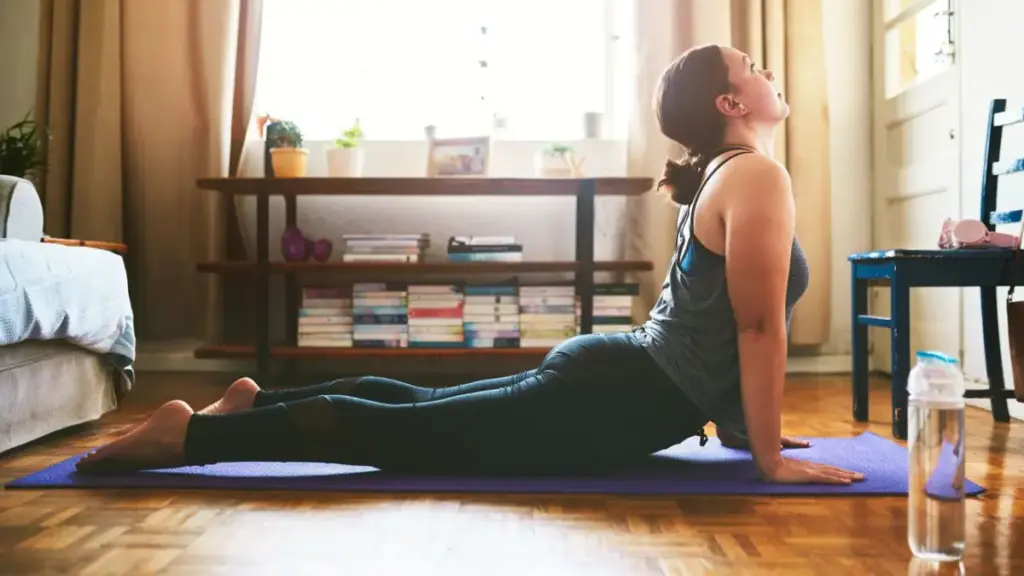
To transition to the opposite side without disrupting the breath-to-movement cadence, Bryant utilizes a classic vinyasa-style bridge: moving from the Eight-Limbed Pose (Ashtanga Namaskara) into Cobra (Bhujangasana), and briefly settling into Child’s Pose (Balasana) as a momentary neural sanctuary. - Phase 4: Mirroring the Left Side (3:30 – 4:30)
The sequence mirrors the exact same lower-body mechanics on the left side—moving through the Low Lunge, Forward Fold, and Twisted Low Lunge—ensuring muscular and structural symmetry. - Phase 5: Nervous System Integration (4:30 – 5:00)
The final moments are dedicated to a scaled integration phase, allowing the autonomic nervous system to shift from sympathetic (fight-or-flight/stress) activation back to parasympathetic (rest-and-digest) equilibrium, preparing the practitioner to re-enter their workday with renewed focus.
Supporting Context & Metrics: The Anatomy of Micro-Sessions
To fully understand why a five-minute routine yields tangible health benefits, one must examine the intersection of neurology, biomechanics, and habit formation.
Habit Stacking and Sustainable Consistency
Behavioral science demonstrates that complex lifestyle changes fail because they require high cognitive friction. Building a sustainable yoga practice from scratch often collapses under the weight of unrealistic expectations—such as carving out 60 minutes daily. Bryant emphasizes a core philosophy of habit architecture: "If you want to start a long-term practice, it has to be a sustainable and stackable habit within your life already."
By reducing the barrier to entry to just five minutes, practitioners eliminate the mental resistance associated with workout preparation. This micro-habit frequently acts as a gateway; individuals who commit to five minutes often find themselves organically expanding their practice or, at the very least, maintaining an unbroken chain of daily movement that compounds over weeks, months, and years.
Breakdown of Poses and Anatomical Benefits
Every posture integrated into Bryant’s mobility flow serves a distinct, scientifically validated biomechanical purpose:
- Cat-Cow (Marjaryasana-Bitilasana)
- Execution: On hands and knees, alternate between arching the back toward the ceiling (chin to chest) and dropping the belly toward the floor (gaze lifted).
- Biomechanical Benefit: Mobilizes every segment of the spine, enhances synovial fluid circulation around the vertebrae, improves posture, and gently stretches the back, chest, and neck while awakening the core musculature.
- Downward-Facing Dog (Adho Mukha Svanasana)
- Execution: Pressing through the palms and lifting the hips high to form an inverted "V" shape, grounding the heels toward the floor while keeping the spine long.
- Biomechanical Benefit: Strengthens the shoulder girdle, triceps, and wrists while delivering a comprehensive stretch to the hamstrings, calves, and entire posterior fascial line.
- Low Lunge (Anjaneyasana)
- Execution: Stepping one foot forward between the hands while dropping the back knee gently to the mat, reaching the arms overhead to lift the chest.
- Biomechanical Benefit: Directly targets the psoas and hip flexors—muscles notoriously shortened by prolonged sitting—while enhancing pelvic stability and single-leg balance.
- Forward Fold (Uttanasana)
- Execution: Bringing the feet together, hinging at the hips, and allowing the upper body to drape downward toward the floor with a soft bend in the knees.
- Biomechanical Benefit: Relieves gravitational compression on the spine, stretches the glutes and hamstrings, and induces an immediate calming effect on the central nervous system via mild inversion.
- Twisted Low Lunge (Parivrtta Utthita Ashwa Sanchalanasana)
- Execution: From the low lunge, planting one hand and rotating the torso to reach the opposite arm skyward.
- Biomechanical Benefit: Introduces spinal rotation (torsion), which is rare in linear daily activities; opens the pectoral muscles and shoulders; and engages the oblique abdominal muscles.
- Eight-Limbed Pose to Cobra (Ashtanga Namaskara to Bhujangasana)
- Execution: Lowering the chest and chin to the mat while keeping the hips elevated, then sliding forward to lift the chest into a gentle backbend.
- Biomechanical Benefit: Builds upper-body pushing and pulling strength, opens the anterior chain (chest and front shoulders), and reinforces spinal extension.
- Child’s Pose (Balasana) & Corpse Pose (Shavasana)
- Execution: Sitting hips back onto heels with arms extended forward, concluding with a flat-on-the-back total release.
- Biomechanical Benefit: Decompresses the lower back, slows the respiratory rate, and signals the vagus nerve to reduce heart rate and systemic inflammation.
Official Statements and Expert Insights
The movement philosophy championed by Bryant aligns with a growing chorus of physical therapists, kinesiologists, and wellness leaders who advocate for movement snacking—breaking physical activity into short, frequent bouts throughout the day.
"If you’re short on time, a five-minute yoga practice can help improve mobility and also leave you feeling better mentally," states Jack Bryant, emphasizing that physical rejuvenation does not require an exhaustive time investment.
Addressing the specific postural dysfunctions of modern life, Bryant notes: "These yoga poses can shift your energy and ease tight spots or physical tension. It’s perfect if you spend a lot of time sitting during the day."
Exercise physiologists and ergonomics experts frequently corroborate this sentiment. When individuals sit for hours, blood pooling in the lower extremities and chronic static loading of the spinal discs degrade tissue elasticity. Introducing dynamic mobility flows acts as an internal hydraulic pump, forcing nutrient-rich fluids back into avascular tissues like intervertebral discs and fascial sheaths.
Furthermore, mental health researchers point out the profound psychological reset triggered by synchronized breath and movement. Even a brief, five-minute mindfulness-in-motion sequence decreases cortisol production, lowers perceived stress levels, and enhances cognitive processing speed by breaking up monotonous cognitive loops.
Future Outlook: The Rise of Micro-Wellness in the Digital Age
As corporate wellness programs evolve and remote work becomes a permanent fixture for millions of professionals, the demand for accessible, time-efficient health interventions will continue to surge. The traditional model of fitness—requiring dedicated gym memberships, specialized clothing, and hour-long blocks of uninterrupted free time—is increasingly misaligned with the hyper-connected, fast-paced rhythm of modern life.
Looking ahead, the integration of micro-mobility routines like Bryant’s five-minute flow is poised to transform several sectors:
1. Corporate Ergonomics and Workplace Wellness
Forward-thinking corporations are beginning to recognize that employee productivity is inextricably linked to physical well-being. Rather than relying solely on ergonomic chairs and standing desks, progressive companies are introducing mandatory "movement breaks." Integrating structured five-minute yoga flows into digital calendar systems can serve as an institutional countermeasure to sedentary fatigue, reducing musculoskeletal disorders and lowering absenteeism.
2. Digital Fitness Platforms and Wearables
The fitness app and wearable technology markets are rapidly pivoting toward bite-sized programming. Algorithms embedded in smartwatches and fitness trackers are moving away from rigid daily step goals and are instead beginning to prompt users to perform mobility snacks when prolonged periods of inactivity are detected. Short-form video guides, similar to Bryant’s follow-along routines, will likely dominate wellness content consumption, catering to users who prefer high-density, low-friction digital instruction.
3. Preventive Healthcare and Longevity
In the medical community, the emphasis on healthspan—the number of years a person lives free from chronic disease and disability—is eclipsing mere lifespan. Mobility is increasingly recognized as a vital sign of biological aging. Individuals who maintain joint articulation, spinal flexibility, and dynamic balance late into life drastically reduce their risk of falls, chronic back pain, and joint degeneration. Protocols that make mobility training frictionless and accessible to everyone, regardless of schedule, represent a powerful tool in preventive public health.
Conclusion
Jack Bryant’s five-minute yoga flow for mobility transcends the realm of simple fitness trends; it represents a pragmatic adaptation to the realities of modern existence. By proving that transformative physical and mental shifts can be achieved in the span of a single song, Bryant has dismantled the intimidating barrier to entry that keeps so many people sedentary. Whether utilized as a morning energy activator, an afternoon desk reset, or a foundational building block for a lifelong movement practice, this concise sequence demonstrates that when it comes to human wellness, intentionality and consistency will always triumph over sheer volume.