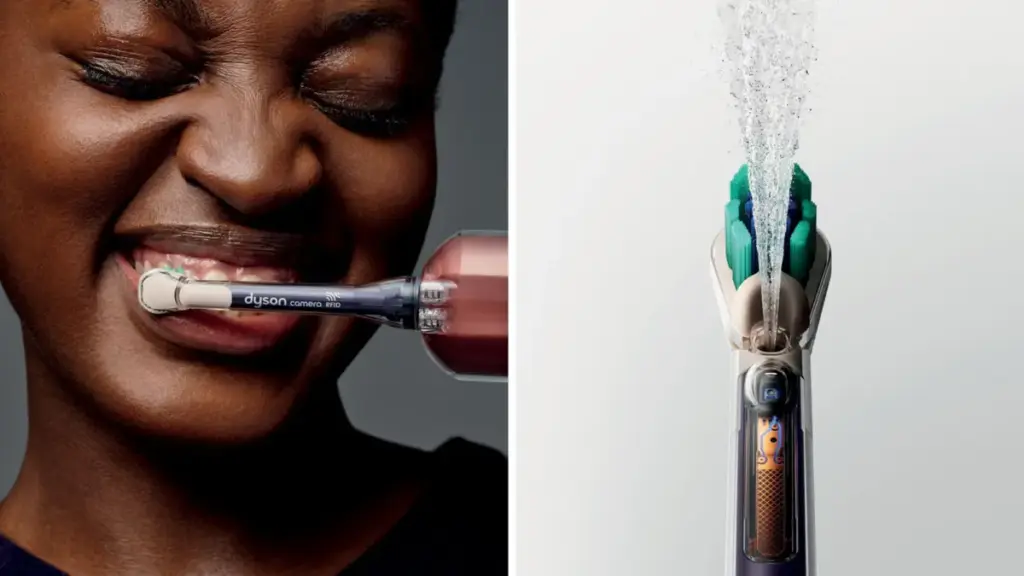
For nearly a decade, the British engineering powerhouse Dyson has systematically dismantled and redesigned the mundane appliances that populate our homes. Having conquered the living room floor with cyclonic vacuums and the vanity table with high-velocity hair tools, the company has officially turned its gaze toward the bathroom sink. Enter the CameraJet: a $499, internet-connected, camera-equipped, dual-action oral hygiene system that attempts to bridge the gap between traditional tooth-brushing and water flossing.
Announced following years of top-secret development at the company’s Cotswolds campus, the CameraJet is far more than a luxury electric toothbrush. It is a technological marvel driven by 16 million lines of code, an embedded macro camera capturing 28 frames per second, and a precision-engineered micro-jet system designed to eradicate plaque before it calcifies. Yet, it also arrives with a staggering price tag—matching the cost of a mid-tier flat-screen television—and raises complex questions about data privacy, clinical efficacy, and the limits of consumer gadgetry in personal health.

Detailed Chronology: From Secret Code "682" to Public Launch
The journey of the CameraJet is a testament to Dyson’s notoriously hermetic development cycle. Chronologically, the genesis of this ambitious device tracks a decade of rigorous engineering, institutional transformation, and obsessive prototyping:
- Nine Years Ago: The initial concept for an automated, targeted water-jet toothbrush was conceived within Dyson’s advanced research and development division. Engineers identified a glaring consumer flaw: humans are notoriously bad at basic oral hygiene. On average, Americans and Britons brush for a mere 45 seconds—far short of the dentist-recommended 120 seconds—and only about one-third of the population flosses daily.
- The Six-Year SPRINT: Dyson engineers spent six full years actively developing the mechanics, software, and fluid dynamics of the CameraJet. This development timeline actually eclipses the time spent on some of the company’s most famous historical releases, including its inaugural bagless vacuum and the 2016 Supersonic hair dryer.
- The "Proxy Plaque" Breakthrough (Five-Year Milestone): Recognizing that standard artificial plaque substitutes were insufficient for repeated prototyping, Dyson partnered with Singapore University to engineer a proprietary "proxy plaque." This five-year undertaking allowed engineers to run hundreds of iterations on simulated plaque without relying on continuous human clinical trials.
- Spring (Last Year): Selected international journalists were quietly flown to Dyson’s 50-acre Malmesbury campus in southwest England. Kept under strict non-disclosure agreements, they were whispered a single codename: 682. It was here that early prototypes were first demonstrated behind closed doors.
- The Pre-Launch Secrecy: For months, the product’s actual identity remained a closely guarded secret. Internal protocols at the "Dysonplex"—the company’s sprawling headquarters in the UK and its operational base shifted to Singapore in 2019—enforce intelligence-agency-level compartmentalization. Even legally wed Dyson employees are barred from discussing unreleased projects with one another unless bound by strict operational necessity.
- Today: The Dyson CameraJet officially launches to the public, retailing for $499 and available in two distinctive colorways: Ceramic Ultra Blue and Ceramic Pink. The package includes the base station, two specialized brush heads, a charging cable, a travel case, and a suite of proprietary accessories.
Engineering and Technology: How the CameraJet Works
To understand why the CameraJet commands a $499 price tag, one must look past its sleek silhouette and examine the micro-engineering embedded within its lightweight handle (which weighs just over eight ounces—equivalent to a roll of quarters).

1. The Dynamic Camera and LED Array
Nestled beneath the sonic-oscillating brush head and a secondary fluid jet sits a pencil-tip-sized macro lens paired with an integrated LED light to illuminate the dark recesses of the oral cavity. Operating at a blistering 28 frames per second, the 100mm pixel macro lens scans the structural topology of the teeth in real time. Rather than emitting a continuous, wasteful stream of water, the camera maps the boundaries of each tooth, instructing the internal system to fire the jet precisely when it aligns with an interdental gap.
This targeted approach explains why the handle’s internal reservoir requires less than half an ounce of fluid—a stark contrast to standalone, tankless cordless flossers like the Waterpik Cordless Plus (seven ounces) or the Philips Sonicare Cordless Power Flosser 3000 (eight ounces).

2. The Fluid Dynamics: Fan Spray vs. Needle Jet
Sir James Dyson has been publicly critical of conventional water flossers, noting that traditional models inflict an unpleasant, gum-abrasive sensation. Most market competitors rely on a "needle jet"—a high-pressure, piercing stream of water designed to blast debris away.
Dyson’s fluid mechanics team took a different route. The CameraJet deploys a fan-like spray sheet that sweeps across a broader surface area, effectively sweeping away plaque and sludgy bacteria rather than forcefully punching holes through it. Furthermore, a pressure-controlled reservoir eliminates internal air pockets, allowing the device to maintain uninterrupted fluid delivery whether held horizontally, vertically, or completely inverted.

3. Software, Connectivity, and the Camera Conundrum
The toothbrush is fully Wi-Fi and Bluetooth enabled, pairing directly with the Dyson app. Users can observe their brushing session live or review footage later—a feature pitched as a potential tool to share with dental professionals. For privacy-conscious consumers, Dyson maintains that these real-time video feeds are not permanently archived in the cloud or stored locally on the app. Beyond brushing, the camera can also be activated independently to investigate localized dental concerns, such as a shifting crown or a developing canker sore.
Engineering a camera inside an environment experiencing violent mechanical movement was among the team’s steepest hurdles. As Sir James Dyson notes, "The camera is on a brush head that’s moving about a thousand movements a second… You’re taking a film. Never mind the fact there’s a lot of water in the way, and a bit of foam." To counter the visual obstruction of traditional toothpaste, Dyson developed a specialized non-foaming formulation to ensure the optical lens retains a clear field of view.

Supporting Context, Metrics, and Clinical Data
When evaluating a luxury oral care investment, consumers naturally demand empirical proof of its superiority over traditional methods. Dyson has supplied internal laboratory metrics alongside initial clinical trial data to support the CameraJet’s market entry.
Clinical Trial Insights
Dyson provided Allure with data from a four-week clinical study comparing 60 subjects using either a standard manual toothbrush or the CameraJet. While the comparison effectively pits a legacy manual tool against an advanced hybrid machine, the preliminary metrics demonstrated noticeable improvements across several categories:

- Gum Inflammation: 17% of CameraJet users experienced reduced gum inflammation, compared to 9% of manual toothbrush users.
- Gum Bleeding: 65% reduction in bleeding was recorded for the CameraJet group, versus 37% for the manual group.
- Transition to "Healthy Gums" (defined as less than 10% bleeding upon probing): 74% of CameraJet users achieved this clinical benchmark, compared to just 6% in the manual cohort.
- Plaque Reduction: The gap narrowed slightly here; CameraJet users finished the trial with 19% less plaque buildup, while traditional brushers achieved a 12% reduction.
Comparative Market Analysis
While the CameraJet introduces a novel fusion of video guidance and automated mouthwash delivery, other brands have similarly explored multi-step hybrid systems. For comparison, the Soocas NEOS II Ultra Electric Toothbrush combines brushing and fluid flossing, holding 1.7 ounces in its handle for an 80-second flossing cycle. However, unlike Dyson’s pressure-controlled reservoir, lower-cost alternatives often struggle with fluid delivery when tilted horizontally, frequently running dry before the cycle concludes.
Official Statements and Industry Perspectives
The development of the CameraJet required cross-disciplinary collaboration between seasoned mechanical engineers and young minds cultivated directly within the company’s educational ecosystem.

- Sir James Dyson on Comfort vs. Pressure: Explaining the rationale behind the device’s unique spray pattern during a remote interview, Sir James emphasized user comfort: "Waterpik is not a pleasant sensation… We wanted a sweep rather than a blast, protecting the gums while maximizing plaque removal." He also dryly acknowledged testing the device’s structural versatility during early prototypes: "I’ve shoved it in my ear and it was very interesting. You get a very, very good image in your ear. But I’m not allowed to talk about that."
- Niamh Turney, Dyson Engineer and DIET Graduate: Reflecting on the five-year development of the proprietary proxy plaque, Turney highlighted the efficiency of internal testing: "We could do hundreds of iterations of a brush head and test them all on fake plaque and optimize without having to do a clinical in-mouth trial every time." Turney is a product of the Dyson Institute of Engineering and Technology (DIET), a tuition-free institutional framework established in Malmesbury in 2017 that combines salaried employment with higher education.
- First-Hand Media Impressions: During hands-on testing conducted in controlled environments (such as hotel suites in New York with beauty editors), reviewers noted that the device is surprisingly lightweight, remarkably quiet relative to standard water flossers, and intuitive to operate. While minor learning curves—such as managing initial drooling or ensuring adequate mouth opening for lower internal arches—were noted, the overarching sentiment was that the tool transforms a tedious routine into an engaging, high-tech ritual.
Future Outlook: Will Bathroom Counters Be Conquered?
The launch of the CameraJet on September 1 represents a pivotal stress test for Dyson’s luxury consumer strategy. At $499, the device invites heavy skepticism from consumers accustomed to spending under $100 for reliable electric toothbrushes and traditional nylon floss.
Yet, industry watchers recall a strikingly similar skepticism surrounding the debut of the Dyson Supersonic hair dryer in 2016. Critics questioned whether consumers would ever pay $400 for a hair dryer shaped like Thor’s hammer. That product went on to redefine the prestige beauty appliance market, paving the way for a broader commercial footprint that now includes styling wands, straighteners, and air purifiers.

As beauty and technology continue to converge, the Dyson CameraJet sits at the vanguard of "smart" personal care. Whether it ultimately revolutionizes daily hygiene habits on a global scale—or remains an ultra-exclusive luxury for early-adopting tech enthusiasts—remains to be seen. What is certain, however, is that Dyson is aggressively executing its vision to conquer the world’s bathroom counters, one hyper-engineered appliance at a time.