
Executive Overview
For anyone who has spent time in a gym, participated in a Pilates class, or followed an online fitness program, the instruction to “engage your core” is ubiquitous. Trainers repeat it endlessly before a heavy squat, a plank, or a rotational medicine ball throw. Yet, despite its frequency, this foundational cue remains deeply misunderstood. Millions of gym-goers interpret "engaging the core" as simply sucking in their stomachs, holding their breath, or performing a basic crunch.
This narrow misunderstanding can severely limit athletic performance, compromise posture, and—most importantly—open the door to injury. Engaging the deep core is an intricate neuromuscular process that requires intent, foundational stability, and deliberate practice.
According to Holly Fivian, a prominent personal trainer and founder of the strength-training platform Holsm, learning to authentically connect with the deep core should be the absolute prerequisite to any strength-training program. Proper core activation transforms how force is transferred through the kinetic chain, protecting the spine, enhancing stability, and boosting overall power output.
To demystify this process, Fivian advocates for a universal starting point: the dead bug exercise. Far from being a basic beginner movement, a properly executed dead bug serves as the gold standard for core control, teaching the central nervous system how to maintain spinal integrity under load. This article provides a comprehensive breakdown of why core engagement matters, the anatomy of proper activation, and an authoritative, step-by-step training routine featuring four progressive dead bug variations designed to bulletproof your midsection.
Detailed Chronology: Unpacking the Evolution of Core Training
To understand the modern approach to core stability, it is helpful to look back at how fitness philosophy has evolved over the past several decades.
The Era of Isolated Crunches (1980s–1990s)
For generations, physical conditioning viewed the "core" almost exclusively as the rectus abdominis—the superficial "six-pack" muscles. Fitness culture prioritized high-repetition abdominal crunches and sit-ups as the primary prescription for a strong midsection. While these movements do recruit the superficial abdominal layers, they largely ignore the deep stabilizing musculature that wraps around the spine and pelvis. Over time, sports scientists and physical therapists recognized that endless spinal flexion (bending the spine forward repeatedly under tension) contributed significantly to lower back pain and disc issues, offering very little functional transfer to real-world lifting, running, or rotational sports.
The Functional Core Revolution (2000s–2010s)
The turn of the century marked a paradigm shift in kinesiology and physical therapy. Pioneers in spinal mechanics began emphasizing the "core" as an integrated cylindrical unit—often referred to as the "core canister." This cylinder is bounded by the diaphragm at the top, the pelvic floor at the bottom, the transversus abdominis (TVA) wrapping horizontally around the midsection, and the multifidus muscles running along the spine. Fitness professionals shifted away from isolated aesthetic training toward functional stability, introducing planks, bird-dogs, and anti-rotation movements to train the core as a stabilizer rather than a prime mover.
The Modern Neuromuscular Approach (Present Day)
Today, elite trainers like Holly Fivian emphasize that core training is not about how long you can hold a rigid plank or how many crunches you can churn out. Instead, it is a neuromuscular skill. The focus has shifted toward intermuscular coordination: teaching the brain to fire the deep stabilizing muscles automatically whenever force is applied to the extremities. The dead bug has emerged as the premier diagnostic and training tool in this modern era because it exposes compensatory movement patterns—such as rib flare and lower back arching—immediately forcing the practitioner to regain absolute control over their pelvis and spine.

Supporting Context & Metrics: Why Deep Core Engagement Matters
When applied correctly, deep core engagement alters biomechanics across the entire body. The core acts as the central link in the kinetic chain, responsible for transferring energy between the lower and upper body. Without a stable foundation, power leaks out of the system, forcing surrounding joints to compensate.
The Anatomy of the Core Canister
To optimize core engagement, it helps to visualize the core as a pressurized pressure vessel or canister:
- The Roof (Diaphragm): Controls breathing mechanics and intra-abdominal pressure (IAP).
- The Floor (Pelvic Floor Muscles): Supports pelvic organs and works in synergy with the diaphragm and TVA.
- The Walls (Transversus Abdominis and Obliques): The TVA acts like a natural weightlifting belt, compressing the abdomen horizontally to increase spinal stiffness.
- The Back (Multifidus and Erector Spinae): Provides segmental spinal stability and resists unwanted rotation or flexion.
Performance and Injury Metrics
- Spinal Protection: Research in biomechanics indicates that proper intra-abdominal pressure generated by the deep core can reduce compressive loads on the lumbar spine by up to 40% during heavy lifting.
- Postural Alignment: Chronic slouching and anterior pelvic tilt often stem from an unengaged TVA, which allows the pelvis to tip forward and pulls the lower back into excessive extension. Mastering core engagement restores neutral pelvic alignment.
- Force Transfer: In dynamic athletic movements—such as sprinting, throwing, or heavy deadlifting—a stable core allows the limbs to generate maximum torque against a solid anchor, directly increasing maximal strength and velocity output.
Official Statements and Expert Insights
Holly Fivian’s methodology challenges the "no pain, no gain" mentality that often leads to sloppy form and injury in commercial gyms.
"Engaging the core muscles involves more than just tensing your stomach, and it takes practice," Fivian explains. "I encourage women—and all clients—to learn how to connect with their deep core before they start heavy strength training. Engaging it correctly can improve your performance, boost your posture, and lower your chance of injury."
According to Fivian, many individuals rush into advanced compound lifts without establishing basic neuromuscular control over their midsection. This oversight leads to common compensation patterns, where the hip flexors and lower back muscles take over work meant for the abdominal wall.
"This is where everybody starts," Fivian tells Fit&Well, referencing the dead bug. "How your core feels during a dead bug is how I want it to feel during your other movements too. A properly performed dead bug should never feel easy."
Fivian emphasizes that ease is often a symptom of poor form. If an exercise feels effortless in the midsection, the lifter has likely defaulted to passive skeletal support rather than active muscular engagement.
The Ultimate Dead Bug Core-Engagement Routine
To bridge the gap between theory and execution, Fivian has designed a progressive four-step routine. Each movement builds upon the last, progressively challenging your ability to maintain spinal stability while your limbs move independently.
- Structure: Perform each exercise for 30 seconds.
- Rest: Take 15 seconds of rest between sets.
- Volume: Complete 3 sets per exercise before progressing to the next variation.
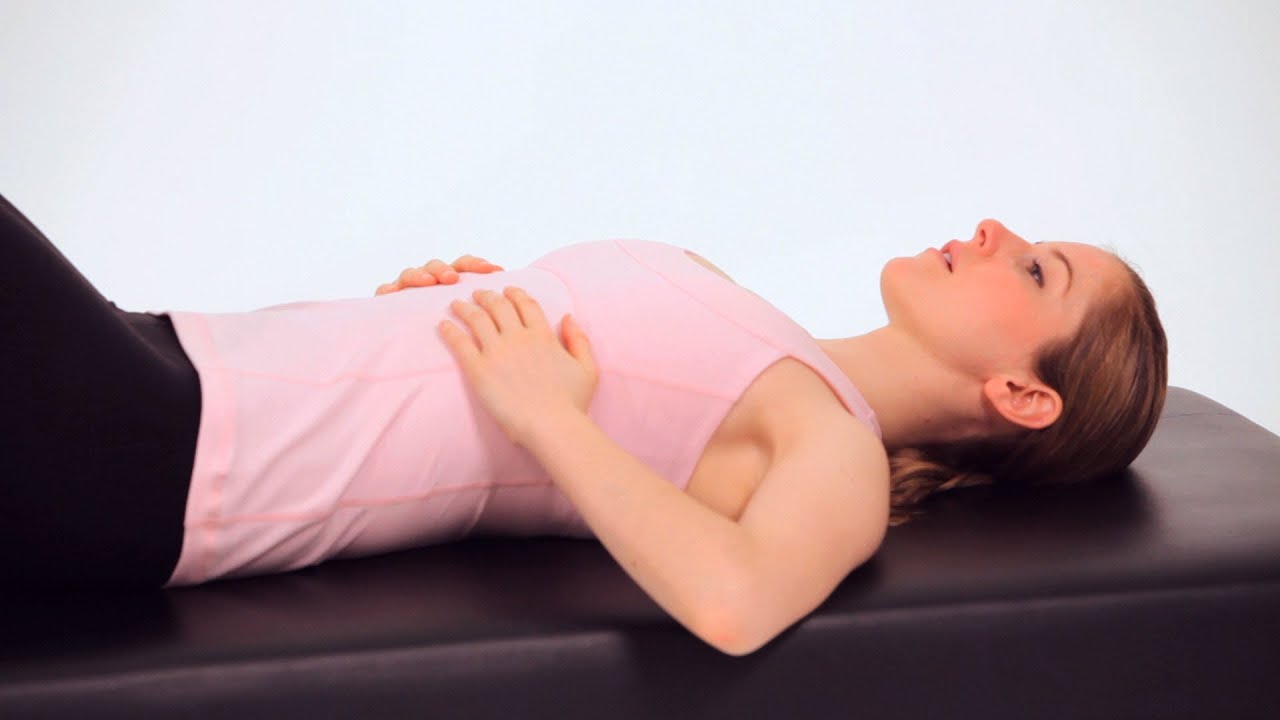
1. Diaphragmatic Breathing (The Foundation)
Before moving your limbs, you must master how to breathe into the core canister and create intra-abdominal pressure.
- How to Perform: Lie flat on your back with your knees bent and feet flat on the floor. Place one hand on your chest and the other on your rib cage/stomach. Inhale slowly through your nose, allowing your lower rib cage to expand outward in all directions (360-degree breathing) rather than just lifting your chest. As you exhale through pursed lips, gently draw your navel inward and upward.
- Trainer Tip: "Imagine there are magnets on your hip bones gently drawing towards one another while your navel gently draws inwards and upwards. Keep your neck, shoulders, and jaw relaxed," says Fivian.
2. The Classic Dead Bug
Once you can control your breathing, you introduce movement while keeping the torso entirely locked in place.
- How to Perform: Lie on your back with your arms extended straight up toward the ceiling over your shoulders. Lift your legs off the floor, bending your knees at a 90-degree angle so your shins are parallel to the floor (tabletop position). Press your lower back firmly into the floor by tilting your pelvis slightly backward.
- Trainer Tip: "Think about keeping your ribs and hips connected and in line, rather than allowing the ribs to flare upwards," says Fivian. Maintain this flat-back posture throughout the duration of the set.
3. Dead Bug Heel Taps
This variation introduces a subtle downward lever, challenging your ability to resist lower back arching as your legs approach the floor.
- How to Perform: Begin in the classic dead bug tabletop position with arms extended upward and lower back pressed flat into the floor. Keeping your right knee locked at a 90-degree angle, slowly lower your right leg until your heel lightly taps the floor, then return it to the starting position. Alternate sides with your left leg.
- Trainer Tip: "If your ribs begin to flare, your pelvis changes position, or your back starts to arch away as your heel lowers, shorten the movement and bring your knees closer to your chest," advises Fivian. Never sacrifice spinal position for range of motion.
4. Dead Bug Leg Extension
The pinnacle of this routine, extending a straight leg dramatically increases the mechanical load on your abdominal wall.
- How to Perform: Start in the standard tabletop dead bug position. As you lower one arm overhead toward the floor behind you, simultaneously extend the opposite leg straight out in front of you, hovering it just above the ground. Pause briefly at the bottom of the movement, then return to the starting position and switch sides.
- Trainer Tip: "The lower and straighter the leg travels, the greater the demand on the core," notes Fivian. If you feel your lower back beginning to arch off the floor, regress the movement by extending the leg higher toward the ceiling rather than straight out toward the floor.
Future Outlook: Integrating Core Mastery Into Your Broader Fitness Journey
Mastering core engagement is not a checkbox on a to-do list; it is a lifelong physical discipline that underpins every movement you make, inside and outside the gym. As fitness science continues to evolve, the emphasis on quality of movement over sheer quantity will only intensify.
By taking the time to master foundational diagnostics like Fivian’s dead bug routine, you rewire your neuromuscular pathways. Over time, the deliberate cues—ribs pulled down, hip bones drawing together, and 360-degree diaphragmatic breathing—will transition from conscious effort to automatic habit.
Whether you are preparing to pull a heavy barbell off the floor, carrying groceries up a flight of stairs, or simply maintaining an upright posture at a desk, a well-engaged core protects your spine and unlocks your body’s true physical potential. Commit to the basics, eliminate ego from your training ranges, and let deep core stability become the unshakeable foundation of your health and fitness journey.