Executive Overview
On Saturday, August 29, 2026, pop superstar Olivia Rodrigo etched her name into the upper echelons of music festival curation with the inaugural staging of the Daisy Chain Fields Festival. Held at the expansive Great Park in Irvine, California, the landmark one-day event transcended the traditional concert experience, operating as a celebration of alternative rock heritage, modern pop artistry, and grassroots female empowerment. Featuring an entirely female-led roster of performers—ranging from heavy-hitting riot grrrl pioneers to contemporary chart-toppers—the festival successfully merged cultural preservation with high-impact philanthropy.
By the time the gates closed, the festival had generated $10 million in direct ticket sales destined for women’s health and reproductive rights organizations, a figure that was subsequently doubled to a staggering $20 million through a matching grant from philanthropist Melinda French Gates. For Rodrigo, who spent the following days processing the emotional resonance of the event, Daisy Chain Fields was more than just a successful concert production; it was living proof of the unifying power of collective art and a generational commitment to social progress. With confirmations already locked in for a 2027 return, Daisy Chain Fields has instantly cemented its status as a foundational pillar on the contemporary live music calendar.
Detailed Chronology: Anatomy of a Historic Saturday
The genesis of Daisy Chain Fields was years in the making, born from Rodrigo’s desire to create a live music space explicitly centered around the artistic contributions of women. As the sun rose over Great Park in Irvine on August 29, 2026, thousands of fans—adorned in friendship bracelets, combat boots, and vintage band tees—converged on the grounds, signaling the start of an unforgettable day.
The Daytime Sets: Bridging Generations of Alternative and Pop
From the earliest afternoon slots, the festival grounds vibrated with a unique energy. The curation of the lineup was a masterclass in cross-generational musical lineage, placing foundational icons alongside contemporary visionaries.
- The Pioneers: Seminal punk and alternative acts like Bikini Kill and The Breeders delivered blistering, high-octane sets that reminded the audience of the structural groundwork laid by women in rock during the 1980s and ’90s. The visceral atmosphere birthed impromptu riot grrrl mosh pits on the grass, a sight that Rodrigo later cited as one of the defining images of her professional life.
- The Modern Heavyweights: Critical darlings and modern hitmakers such as Mitski, Doechii, and Chappell Roan commanded massive, adoring throngs. Each artist brought a distinct sonic palette—ranging from Mitski’s art-pop introspection to Doechii’s dynamic rap prowess and Roan’s theatrical pop spectacle—proving the remarkable versatility and dominance of women across the musical spectrum.
The Grand Finale: Rodrigo’s Headlining Triumph
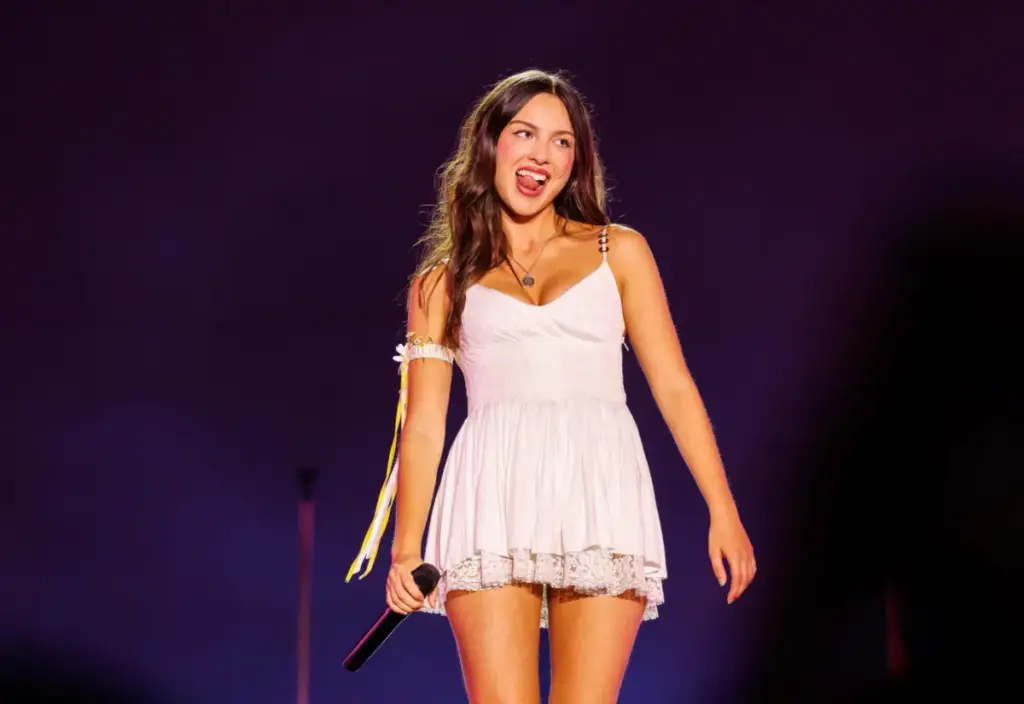
As dusk settled over Irvine, Olivia Rodrigo took the stage for her festival-closing headlining set. Rather than treating the slot as a standard solo performance, Rodrigo utilized the platform to honor the lineage of women who inspired her career by welcoming a series of legendary surprise guests.
The crowd erupted as rock godmother Stevie Nicks joined Rodrigo for a spellbinding collaboration, followed by an emotive appearance from Canadian singer-songwriter Sarah McLachlan. The ultimate surprise of the night arrived when alternative rock icon Alanis Morissette stepped onto the stage, locking arms with Rodrigo for a searing, emotionally charged rendition of a rock classic that sent decades of fans into raptures.
Post-Show Reflection and the Yoko Ono "Wish Tree"
Following the final notes of the evening, as the exhaustion of the day set in, Rodrigo and her inner circle did not immediately retreat to private green rooms. Instead, they spent hours roaming the festival grounds, attempting to process the scale of what they had achieved.
Their night of "frolicking" culminated at a prominent installation near the festival entrance: Yoko Ono’s famous Wish Tree. The interactive art piece invited festival-goers to pen personal hopes on paper tags and tie them to the branches of a living tree. While a subset of the tags featured whimsical, lighthearted wishes—such as hopes for pet longevity or hair growth—the overwhelming majority shared a unified thematic core.
As Rodrigo detailed in her reflections, thousands of tags echoed the exact same sentiments: a desperate hope for a more peaceful world, happiness for loved ones, and the desire to make a tangible difference. For the Grammy-winning artist, reading those tags served as a profound emotional anchor, validating the very ethos upon which Daisy Chain Fields was built.
Supporting Context & Metrics: Record-Breaking Philanthropy
While the artistic triumphs of Daisy Chain Fields would have been enough to secure its place in music history, the festival’s economic and philanthropic footprint elevated the event into an entirely different echelon. In an industry where major music festivals frequently struggle with corporate transparency and ethical giving, Rodrigo and her team established a gold standard for mission-driven entertainment.
100% Philanthropic Allocation
Every single dollar of profit generated from the festival’s operations and ticket sales was earmarked for external advocacy groups. The primary beneficiaries of the inaugural event included:
- Planned Parenthood: Supporting nationwide reproductive healthcare access, education, and community clinics.
- The Center for Reproductive Rights: Funding legal battles and advocacy to protect bodily autonomy at state and federal levels.
- Additional local and national organizations dedicated to the holistic advancement, safety, and health of women and girls.
The $20 Million Milestone
During a high-profile press conference held 24 hours prior to the festival’s doors opening, Rodrigo proudly announced that ticket sales alone had successfully raised $10 million in direct donations for the beneficiary organizations.
The financial success of the event caught the attention of prominent global philanthropists. Shortly after the festival concluded, renowned billionaire and philanthropist Melinda French Gates stepped forward to match the $10 million fund in its entirety. This matching grant brought the grand total of capital funneled into women’s advocacy organizations through the inaugural Daisy Chain Fields to an astronomical $20 million.
Official Statements and Curatorial Insights
The meticulous planning behind Daisy Chain Fields was further illuminated in a sweeping cover story published by Vogue Philippines on Monday, August 31, 2026. In the interview, Rodrigo pulled back the curtain on the artist-acquisition process, noting that building the all-female roster was characterized by a distinct lack of friction—a testament to the solidarity within the modern creative community.
"Nobody once was like, ‘Oh, like, do I have to do it for free?’ Or, ‘Oh, my gosh, it’s going to be too hard on my schedule,’ or, ‘Oh, I’m going to have to fly in from another place,’" Rodrigo shared with Vogue Philippines. "It makes me feel really proud to be a part of this generation of women."
This sentiment of collective empowerment was echoed across Rodrigo’s official social media channels the morning after the festival. In a vulnerable and widely shared Instagram dispatch accompanied by behind-the-scenes photography, she wrote:
"seeing daisy chain come to fruition yesterday was the greatest joy of my career… i am still in a bit of disbelief that it happened and i still feel incapable of properly expressing the gratitude that I feel for every person who believed in this vision and fought so hard to make it a reality."
Addressing the deeper philosophical takeaway of the event, Rodrigo tied the success of the festival back to humanity’s shared emotional core, inspired by her experience at the Yoko Ono Wish Tree:
"yesterday, daisy chain felt like just that. a collective hope that things can get better and a reminder of how much we really care about people at the end of the day. the artwork reminded me of how we are all much more alike than we are different. and how deep down, we all just want to help each other and make the world a better place."
Future Outlook: The Legacy of Daisy Chain Fields
As the temporary stages at Great Park are dismantled and the grass returns to its natural state, the cultural shockwaves of Daisy Chain Fields are only beginning to be felt across the broader entertainment landscape.
The festival has effectively dismantled the outdated music industry myth that all-female lineups lack broad commercial viability or mainstream drawing power. By selling out a massive multi-genre festival space, generating tens of millions of dollars for charitable causes, and seamlessly blending legendary heritage acts with contemporary superstars, Rodrigo has created a scalable blueprint for the future of socially conscious live music.
Crucially, the success of the inaugural event is not a one-off anomaly. In her closing statements to fans, the High School Musical: The Musical: The Series alum and multi-platinum recording artist confirmed that Daisy Chain Fields will return as an annual fixture, officially setting the stage for Daisy Chain Fields 2027.
As artists, fans, and advocacy groups look toward the horizon, Daisy Chain Fields has secured its legacy not merely as a high-profile concert series, but as a cultural movement—proving definitively that joy, community action, and artistic excellence can unite to form a powerful catalyst for global change.