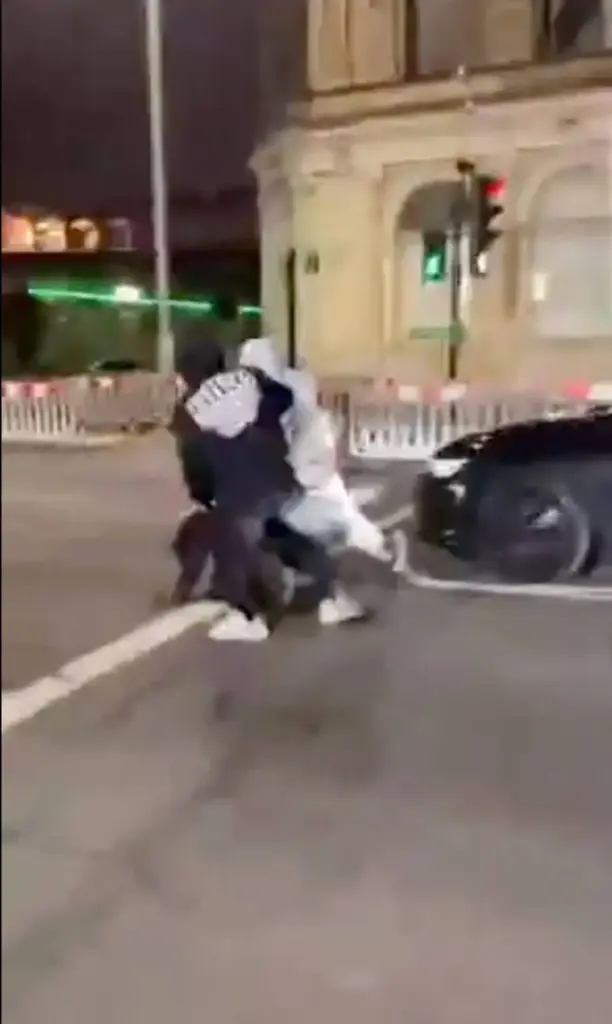
Glasgow is once again grappling with troubling questions regarding public safety after a horrifying, sustained gang assault erupted in the city’s Tradeston district. Unfolding late on a Thursday night—just moments away from a heavily policed "dispersal zone"—the incident saw a lone victim hunted down, cornered, and subjected to a vicious beating that included being stamped on and struck with a traffic cone. Captured on mobile devices and rapidly disseminated via Snapchat, the raw, unfiltered footage has ignited a fierce public debate over nocturnal safety, urban violence, and the true efficacy of municipal crime-reduction strategies in Scotland’s largest city.
While local authorities and crime statistics point toward an overall downward trend in recorded offenses across central Glasgow, harrowing street-level events like the Bridge Street attack paint a starkly contrasting picture. Residents, visitors, and law enforcement officials remain deeply divided over whether the city center is genuinely becoming safer or if violent elements have simply adapted their tactics. This incident underscores the persistent challenge of street-level lawlessness and highlights the chilling reality faced by those navigating Glasgow’s urban core after dark.
Detailed Chronology of the Attack
The violence began at approximately 11:00 PM on Thursday, August 27, 2026. According to eyewitness accounts and forensic digital evidence recovered from social media, the altercation commenced on Bridge Street in the Tradeston area, a bustling thoroughfare situated just south of the River Clyde and dangerously close to the city’s newly established anti-social behavior dispersal zones.
The Hunt Through the Streets
The harrowing episode began as a group of hooded youths aggressively pursued a single, unidentified male down the middle of a vehicular carriageway. The victim, attempting to flee his assailants, was swiftly cornered near a local bus stop. What followed was a merciless escalation of violence:
Initial Contact: The pack of masked individuals closed in, unleashing a flurry of heavy punches that caused the victim to stumble and collapse onto the unforgiving concrete pavement.
The Escalation: Though the victim managed a brief, desperate escape, the relentless mob hunted him down toward a local Spar convenience store.
The Brutalized Apex: Trapped outside the commercial premises, the victim was beaten to the ground once more. Video footage clearly shows members of the gang taking turns kicking the prone man in the head and torso, while one assailant picked up a heavy orange traffic cone and brought it down violently upon the victim.
Traffic Interruption and the Flashpoint
As the chaos spilled back out into the center of the road, oncoming motorists were forced to navigate around the surging brawl, narrowly avoiding striking the combatants. The tone of the recorded footage shifts dramatically near the conclusion of the street battle. A member of the attacking mob suddenly screams a frantic warning, realizing that someone within the vicinity—or perhaps the victim himself—is wielding a deadly blade.
"He’s got a knife! Get out of the f** way! Run for your life!" shouts the individual recording the video.
The gravity of the situation is further emphasized when one of the primary aggressors—dressed distinctively in a grey tracksuit—steps toward the camera, exposing bleeding slash wounds across his arm and torso, his top visibly stained with blood. Seemingly galvanized by the realization of the weapon, the gang makes one final, aborted attempt to re-engage the victim before breaking ranks and fleeing down a dark side street. The exact number of casualties and the severity of the injuries sustained by all parties remain under active police investigation.
Supporting Context & Metrics: The Battle for Glasgow’s Streets
The Bridge Street incident did not occur in a vacuum. It has detonated into the public consciousness against a backdrop of mounting anxiety regarding nighttime safety in central Glasgow. For months, local media and investigative reports—including a prominent BBC Disclosure documentary—have spotlighted brazen criminal activities, such as gangs operating on bicycles to peddle narcotics in broad daylight.
The Perception vs. Reality Gap
David Kennedy, general secretary of the Scottish Police Federation, recently voiced public sentiment, stating that many residents and potential visitors feel increasingly intimidated by escalating nocturnal disorder. According to Kennedy, large swathes of the city are effectively viewed by the public as "no-go areas" after sunset.
Yet, this dark perception clashes sharply with official data compiled by Police Scotland. Freedom of Information (FOI) disclosures reveal a different narrative regarding crime within the city center’s primary violent hotspots—specifically the "Four Corners" zone encompassing Union Street, Jamaica Street, St Enoch Square, and Argyle Street:
Overall Crime Decline: Recorded criminal activity across these key zones dropped by approximately 15 percent, falling from 2,726 incidents in 2024 to 2,302 incidents over the course of the following year.
Sexual Offenses: Minor fluctuations were noted in sexual offenses, dropping from 46 incidents in 2024 to 45 the subsequent year, with only six offenses recorded during the first four months of 2026.
Current Year Trajectory: Up to April 2026, authorities recorded 578 offenses, keeping the city on a broadly downward trajectory compared to previous years. These statistics span a wide spectrum of criminality, ranging from attempted murder and serious assault to theft and motoring violations.
The Impact of the Dispersal Zone
City officials credit the implementation of a targeted "dispersal zone," introduced in March to combat localized anti-social behavior, as a primary catalyst for these numerical improvements. Authorized under municipal and police guidelines, the zone grants officers the legal power to order groups of two or more individuals to disperse immediately and bans them from returning to the designated perimeter for 24 hours.
Since its rollout, police have utilized these sweeping powers on more than 1,700 occasions, driving down congregation points for known troublemakers.
Official Statements and Institutional Responses
In the wake of the Bridge Street violence, municipal leaders and law enforcement agencies have scrambled to reassure the public while defending their ongoing security measures.
A spokesperson for Glasgow City Council addressed the broader safety framework, emphasizing the city’s enduring economic and tourism appeal:
"The dispersal zone around the Central Station area gives the police additional powers to address the localised anti-social behaviour caused by a very small minority of people. To support the shared effort to ensure city centre safety, we are recruiting new CCTV staff that will allow for 24/7 monitoring of the city centre from September this year.
“The city centre is an increasingly popular destination with 31.5 million visitors welcomed into the city last year. Footfall figures show that almost 70 million residents, workers, and visitors in total moved through the city centre in 2025."
Meanwhile, Police Scotland has issued an official appeal for information regarding the specific events of that Thursday night. A force spokesperson stated:
"Around 11:10 PM on Thursday, August 27, 2026, officers received a report of a disturbance on Bridge Street, Glasgow. Enquiries to establish the full circumstances are ongoing."
Authorities are urging anyone with mobile phone footage, CCTV recordings, or direct knowledge of the identities of the individuals involved to come forward immediately to assist with the ongoing criminal inquiry.
Future Outlook: Can Glasgow Reclaim Its Streets?
The violent episode in Tradeston highlights a critical inflection point for Glasgow. While municipal strategies like the Central Station dispersal zone and upcoming 24/7 CCTV monitoring initiatives demonstrate a proactive administrative commitment to urban management, high-profile spectacles of savagery—such as a gang roaming the streets with traffic cones and blades—rapidly erode public confidence.
As Glasgow continues to market itself as a thriving, world-class destination pulling in tens of millions of visitors annually, the shadow of street-level violence remains its most persistent obstacle. Bridging the gap between statistical reductions in crime and the lived reality of citizens walking home after dark will require more than temporary police dispersals. It demands a sustained, comprehensive approach to youth intervention, knife crime eradication, and community policing to ensure that incidents like the BridgeStreet assault become relics of the past rather than recurring nightmares on Scotland’s streets.