Executive Overview
The intersection of literature and cinema frequently produces adaptations that either distill an author’s complex philosophical interiority or rely on the magnetic pull of anecdotal charm. Director Marc Turtletaub’s feature film Borges and Me, which celebrated its home-turf world premiere at the prestigious Edinburgh Film Festival, decidedly leans toward the latter. Based on American author Jay Parini’s acclaimed 2020 memoir, Borges and Me: An Encounter, the film captures a whimsical, highly improbable chapter from the early 1970s when Parini—then an unworldly doctoral student at St. Andrews University—found himself unexpectedly acting as driver, caretaker, and reluctant companion to the venerable Argentine literary titan Jorge Luis Borges on a winding road trip through the Scottish Highlands.
As a cinematic enterprise, Borges and Me operates as a trans-Atlantic co-production blending British, South American, and North American talent. It stars Chilean veteran actor Luis Gnecco (Neruda) as the twinkling, idiosyncratic genius Borges, and Fionn Whitehead (Dunkirk) as Parini, an earnest, wide-eyed American academic thrust far beyond his comfort zone. While the picture occasionally stretches a classic literary anecdote past its natural narrative capacity—feeling at once like a tall tale and a thin one—it compensates with an abundance of good-natured charm, dewy autumnal cinematography, and a mellow, quietly sentimental tone. Positioned for a robust festival circuit run prior to global arthouse-crossover distribution, the film trades rigorous literary deconstruction for an affectionate, buoyant meditation on the vulnerabilities, naivety, and intellectual awakening of youth.
Detailed Chronology: From St. Andrews to the Scottish Highlands
The Inciting Incident: An Academic Translation and an Unexpected Houseguest
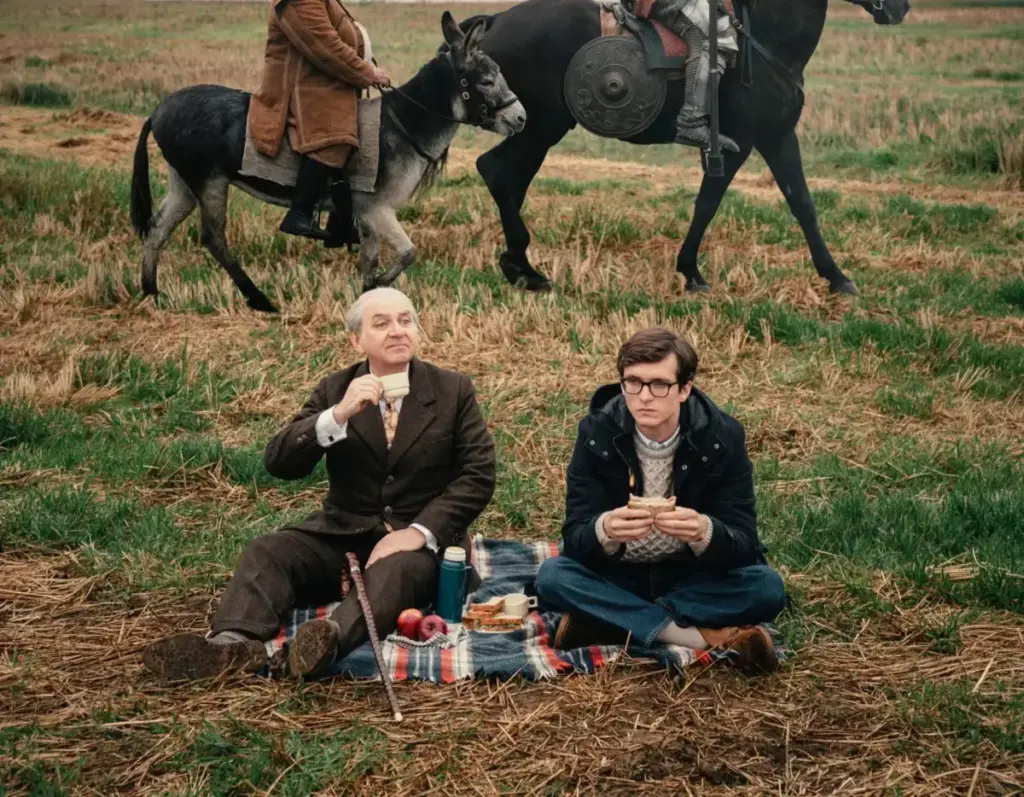
The narrative timeline of Borges and Me opens in the early 1970s within the historic, windswept confines of St. Andrews University in Scotland. Fionn Whitehead portrays a young Jay Parini: a native Pennsylvanian Ph.D. candidate in English literature whose outward appearance—characterized by slightly askew tortoiseshell glasses and an oversized duffel coat—projects an unworldly, fish-out-of-water freshman quality despite his advanced studies. Parini’s earnest shyness makes him an ideal target for affectionate, good-humored ribbing by his supervisor, the poet Alastair Reid. Played with characteristic mischief by Alan Cumming, Reid is both a prominent scholar of South American literature and a leading translator of Borges’s legendary works.
The catalyst for the film’s central journey occurs when Reid invites the septuagenarian Borges to stay at his ramshackle coastal cottage. Parini, summoned to assist, finds himself simultaneously bewildered and enraptured by the brilliant, eccentric, and sightless visitor. However, the academic’s brief encounter quickly escalates into a test of endurance. When Reid receives an urgent, last-minute summons to London, he abandons his post, leaving Parini with little more than a set of vague medical instructions for Borges and zero preparation for full-time caretaking duties.
The Odd-Couple Road Trip and Detours into the Mist
The timing of Reid’s departure could not be more inconvenient. Parini has meticulously scheduled a solitary drive up into the rugged Scottish Highlands to interview his dissertation subject: the elusive, hermetic Scottish poet George Mackay Brown, brought to life through a mischievous extended cameo by Peter Mullan. Left with no alternative, Parini packs the blind Argentine icon into his car, setting the stage for a cross-generational, odd-couple road journey defined by unexpected detours and escalating comedic friction.
Though Borges is entirely sightless, he experiences the majestic Scottish landscape through every other available sense, relentlessly demanding that his young driver articulate his surroundings in rich, lyrical detail. While the American finds this constant descriptive burden wearisome, Luis Gnecco’s performance endows Borges with an infectious, impish wisdom, an earthy vulgarity, and a childlike wonder. The screen bursts with vitality whenever the narrative momentarily breaks away from the elder writer’s relentless chatter—such as when Parini, previously unacquainted with the visceral reality of romantic passion, steals away with Ailith (played by a luminous Freya Mavor), a smart and kindly pub worker whose presence allows the film to temporarily breathe in the old man’s absence.
Supporting Context & Metrics: Production, Cast Dynamics, and Literary Legacy
Transatlantic Collaboration and Aesthetic Choices
Borges and Me is a masterclass in cross-cultural casting and atmospheric world-building. Director Marc Turtletaub brings a measured, empathetic eye to the material, building directly upon the heightened reality of Parini’s memoir. The production’s aesthetic success rests heavily on the cinematography of Christopher Norr, whose lens captures the tawny, textured splendor of the Scottish Highlands with a dewy, autumnal crispness that elevates the film from a standard road-trip comedy into a visually poetic travelogue.
| Production Element | Key Contributor / Detail | Impact on the Film |
|---|---|---|
| Director | Marc Turtletaub | Infuses the narrative with good-natured charm and emotional resonance. |
| Cinematography | Christopher Norr | Utilizes autumnal crispness to showcase the tawny splendor of Scottish locations. |
| Lead (Borges) | Luis Gnecco (Neruda) | Delivers an impish, earthy, and vocally relentless portrayal of the literary icon. |
| Lead (Parini) | Fionn Whitehead (Dunkirk) | Anchors the film with nervous, endearing stillness and youthful anxiety. |
| Supporting Cast | Alan Cumming, Peter Mullan, Freya Mavor | Provide rich texture, bohemian flair, and grounded romantic counterweights. |
Balancing Fact, Myth, and Cinematic Sentiment
Screenwriter Oren Moverman—adapting an earlier draft initially penned by Jay Parini and Ross Clarke—manages a delicate tonal balancing act. The screenplay fluctuates between whimsical, slightly hallucinatory vignettes (such as a bumbling boat excursion on Loch Ness and a fantastical visit to an overgrown, ancient battlefield) and grounding moments of quiet interior anxiety.
Notably, Whitehead’s restrained performance prevents the film from descending into pure shtick. Parini’s internal struggles—amplified by his worries regarding his brother’s perilous service as a soldier in the Vietnam War—ground the whimsical narrative in genuine human stakes. Nevertheless, the final cinematic balance tips slightly toward feel-good sentimentality. The script largely bypasses rigorous engagement with Borges’s dense philosophical writings, treating the author instead as an expansive, heavily imagined spirit rather than a strictly biographical subject. For audiences seeking deep literary analysis, complementary projects like the extensive documentary Life of Jorge Luis Borges provide the necessary academic counterweight.
Official Statements and Critical Reception
The world premiere of Borges and Me at the Edinburgh Film Festival generated considerable buzz among critics and festival attendees alike, establishing the film as a prime candidate for international arthouse-crossover distribution. Industry observers have lauded the film’s ability to transcend its inherently slight premise through sheer stylistic and performative charm.
Speaking on the challenges of adapting a memoir famous in literary circles, production insiders noted the intentional effort to honor the spirit of Parini’s recollections rather than enforcing strict historical verisimilitude.
"We were not setting out to construct a dry, academic historical document," noted representatives close to the production team during festival press panels. "Parini’s memoir operates in the realm of memory, myth, and magical realism—elements that Borges himself championed throughout his storied career. Our goal was to capture that specific lightning-in-a-bottle friction between youthful academic anxiety and the boundless, chaotic imagination of an aging master."
Critics have similarly highlighted the film’s transatlantic chemistry. Reviews published across major trade publications emphasize that while the narrative occasionally stretches thin across feature-length dimensions, the interplay between Gnecco’s flamboyant, talkative Borges and Whitehead’s buttoned-up, exasperated Parini sustains audience engagement from the opening frame to the final credits.
Future Outlook: Festival Trajectory and Arthouse Distribution
As Borges and Me navigates the global film festival circuit, its commercial and critical outlook remains distinctly promising. Positioned squarely within the sweet spot for specialty distributors, the film appeals to a sophisticated demographic of literature enthusiasts, travel romantics, and aficionados of cross-cultural character studies.
Industry analysts project that the film will perform exceptionally well in North American and European arthouse markets, aided by the international recognition of its principal cast members—Whitehead’s post-Dunkirk following, Cumming’s established theatrical and cinematic appeal, and Gnecco’s commanding presence in world cinema. Furthermore, distributors are reportedly exploring complementary marketing strategies that pair theatrical screenings of Turtletaub’s feature with retrospective literary events and documentary screenings dedicated to Borges’s actual corpus.
Ultimately, Borges and Me succeeds because it embraces the porous, knowledge-gathering naivety of youth and mirrors it against the mythic legacy of one of the 20th century’s greatest minds. By prioritizing emotional warmth and nostalgic resonance over encyclopedic fidelity, Turtletaub has delivered a cinematic postcard that celebrates the transformative power of unexpected encounters along life’s winding roads.