Executive Overview
Few cinematic moments in twenty-first-century comedy are as instantly recognizable—or as shockingly uninhibited—as the confessional opening sequence of Greg Mottola’s 2007 coming-of-age classic, Superbad. In the scene, a youthful Seth (played by Jonah Hill) attempts to explain to his lifelong best friend, Evan (Michael Cera), the root of his peculiar psychological hang-ups. What begins as an awkward adolescent heart-to-heart quickly snowballs into a surreal, deadpan monologue detailing a compulsive childhood obsession with drawing male genitalia.
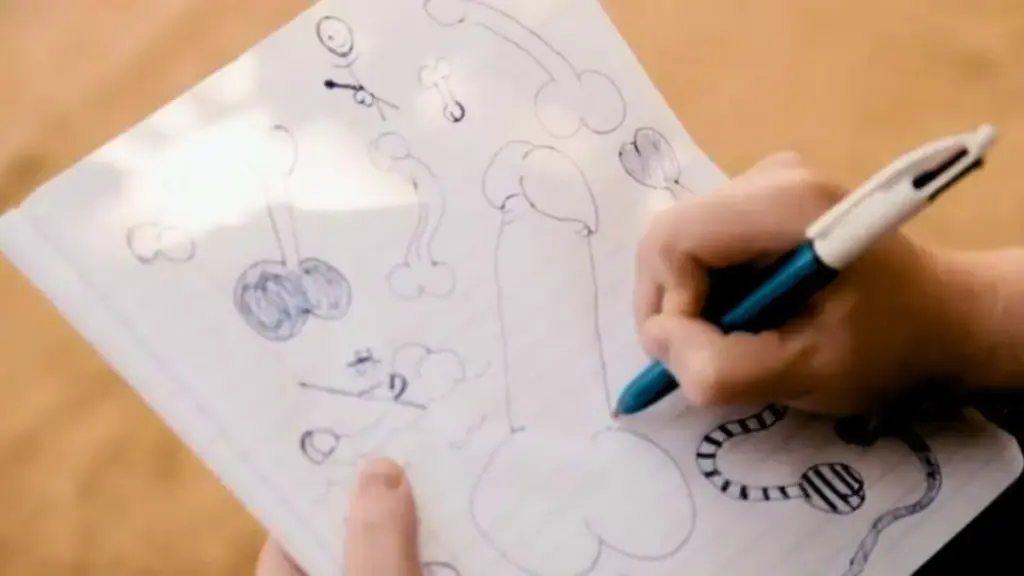
As the film cuts to a rapid-fire montage of crude, stylistic, and surprisingly varied anatomical illustrations, viewers are treated to the foundational lore of Seth’s deeply secretive artistic output. The sequence serves as a masterclass in modern comedic screenwriting—penned by real-life childhood friends Seth Rogen and Evan Goldberg—establishing the film’s blend of profound vulnerability and utter absurdity.
However, behind this brief yet unforgettable cinematic gag lies a fascinating, albeit bizarre, production undertaking. Most audience members watching Superbad in theaters or streaming it at home never stopped to consider the logistics of the prop department. Someone, somewhere, had to sit down and systematically render hundreds of distinct phallic doodles to populate Seth’s notebooks, lockers, and childhood memories.
That someone was David Goldberg, an artist and the older brother of co-writer Evan Goldberg. Tasked by the production team with generating an overwhelming volume of explicit artwork, David approached the assignment not as a half-hearted joke, but as a rigorous artistic pursuit. His methodology involved visiting museums, studying historical texts, and analyzing medical literature to ensure an eclectic, museum-grade portfolio of "phallographics."
The resulting archive was so vast—spawning nearly a thousand unique pieces of art—that only a fraction could make it into the final theatrical cut. This surplus of illicit imagery ultimately found a second life outside of Hollywood, culminating in the 2008 publication of a dedicated companion book, Superbad: The Drawings. This deep-dive investigative report examines the genesis of the famous Superbad opening sequence, the meticulous artistic process behind the prop design, and the surreal cultural footprint left by one of comedy’s most infamous running jokes.
Detailed Chronology
To understand how Superbad’s infamous drawing montage came to be, one must trace the timeline of the film’s creation from its conceptual roots in the late 1990s to its theatrical explosion in the summer of 2007, and finally, its unexpected literary spin-off.
Phase 1: The Writing Room Origins (1994–2006)
Long before Jonah Hill and Michael Cera brought the characters of Seth and Evan to life, the script was written by Seth Rogen and Evan Goldberg during their teenage years in Vancouver, British Columbia. Conceived when the writing duo were just thirteen and fourteen years old, the screenplay was heavily autobiographical in spirit—if not entirely in factual accuracy.
The obsession with drawing male genitalia was an exaggerated nod to the universal awkwardness of male adolescence, where boundaries of humor are tested in the margins of school notebooks. For years, the script floated around Hollywood, championed by producer Judd Apatow, before finally securing a green light at Sony Pictures. As the production ramped up under director Greg Mottola, the creative team realized that the running joke about Seth’s childhood artistic fixation required tangible, visual execution on a massive scale.
Phase 2: The Production and Prop Design (Late 2006)
With cameras rolling, the prop and art departments faced a distinct logistical challenge: they needed a continuous, believable stream of lewd drawings that could plausibly be passed off as the work of an obsessive child, a troubled pre-teen, and a frantic high school student.
Rather than outsourcing the job to a generic graphic designer, the production tapped David Goldberg. Entrusted with creating what he would playfully coin "phallographics," David was given free rein over the visual style of Seth’s secret artwork. Operating behind the scenes, he spent weeks generating hundreds of individual sketches. The sheer volume was necessary not only for the montage sequence in which Becca (Martha MacIsaac) exposes Seth’s stash to the principal, but also for background set dressing throughout the film.
Phase 3: The Theatrical Release and Cultural Impact (August 2007)
Released on August 17, 2007, Superbad became an instant cultural phenomenon, grossing over $170 million worldwide against a modest $20-million budget. While audiences quoted lines about McLovin and debated the intricacies of high school social strata, the opening penis-drawing montage cemented itself as a defining moment of shock comedy. Critics praised the film for its authentic capture of male friendship, juxtaposing its crude humor with genuine emotional resonance. Yet, the sheer volume of hidden artwork left many wondering about the unseen labor required to bring Seth’s childhood fixation to the screen.
Phase 4: Publication of the Companion Book (2008)
Recognizing that a goldmine of unused material was sitting in storage, the creators decided to immortalize David Goldberg’s artistic output. In 2008, Superbad: The Drawings was published by Newmarket Press. The 96-page collection gathered more than 60 of the most intricate, bizarre, and outright artistic renderings that failed to make the theatrical cut. Complete with an introductory foreword by Seth Rogen and Evan Goldberg, the book transformed a throwaway cinematic punchline into a bizarre, collectible piece of pop-culture ephemera.
Supporting Context & Metrics
The economics and scale of the Superbad art production reveal an extraordinary commitment to a seemingly juvenile joke. To fully appreciate the scope of David Goldberg’s contribution, one must examine the metrics and contextual data surrounding the project.
- Total Artistic Output: During pre-production and production, David Goldberg generated approximately 1,000 distinct pieces of phallic art.
- The Theatrical Cut: Out of the thousand-plus drawings created, only a small fraction—estimated between 50 and 100 pieces—appeared across the opening montage, classroom scenes, and the principal’s office discovery sequence.
- The Published Archive: Superbad: The Drawings (ISBN-13: 978-1557048082) preserves over 60 exclusive photographs and illustrations that were left on the cutting-room floor.
- Format and Specifications: The published companion book spans 96 pages, featuring high-resolution glossy prints of the artwork, providing fans with an unfiltered look at the prop department’s labor-intensive output.
The Methodology of "Phallographics"
What elevates David Goldberg’s work from mere high school bathroom graffiti to an authentic prop-design achievement is his academic approach. According to behind-the-scenes accounts, Goldberg did not simply sit down with a Sharpie and doodle away. He treated the commission as a serious artistic assignment.
His research phase reportedly included visits to local museums to study classical sculptures and historical depictions of the human form, alongside reviews of medical texts to understand anatomical variations. This dedication ensured that the drawings featured in the film ranged wildly in style—from primitive, stick-figure scribbles reminiscent of an eight-year-old to surprisingly sophisticated, shaded sketches that hinted at a latent, albeit deeply misdirected, artistic talent.
This juxtaposition is precisely what makes the montage work comedically. When Seth explains that his childhood obsession was eventually unmasked by Becca—after a stray drawing was knocked to the floor of a classroom—the audience is forced to contemplate the sheer embarrassment of having a sophisticated, museum-quality rendering of a dong publicly displayed for an entire high school class to see.
Official Statements & Industry Perspectives
The creative team behind Superbad has frequently spoken about the chaotic, organic writing process that defined the film’s early days, as well as the surreal nature of turning childhood daydreams into a major Hollywood motion picture.
In their joint foreword to Superbad: The Drawings, co-writers Seth Rogen and Evan Goldberg reflected on the bizarre journey of their script from a teenager’s basement to the silver screen:
"When we wrote this movie as teenagers, we had no idea that a major motion picture studio would actually fund a multi-million-dollar production centered heavily around adolescent anxiety, fake IDs, and an industrial-scale portfolio of phallic art. When it came time to populate Seth’s world with his lifelong artistic output, we knew we needed someone with a very specific, highly unhinged dedication to the craft. Enter David Goldberg. What he produced went above and beyond every expectation we ever had."
Director Greg Mottola noted in retrospective interviews that maintaining the authenticity of the characters’ world required immense attention to detail, even in the most absurd comedic sequences. The prop department’s willingness to lean into the joke—hiring an artist to study classical forms for crude comedy props—exemplifies the meticulous craftsmanship that separates enduring comedies from forgettable ones.
Furthermore, industry analysts point to Superbad as a turning point for the R-rated teen comedy genre in the 2000s, proving that audiences would embrace films that combined vulgarity with deeply vulnerable, character-driven storytelling. The willingness of the production to invest time and resources into background details like David Goldberg’s drawings contributed heavily to the lived-in, authentic feel of the fictional high school.
Future Outlook & Cultural Legacy
As Superbad continues to age into a certified classic of modern American cinema, its cultural footprint remains remarkably intact. In an era where streaming algorithms dictate the homogenization of comedy, the unhinged, idiosyncratic brilliance of films from the Apatow era is frequently celebrated with nostalgic reverence.
The legacy of the Superbad penis drawings extends far beyond the runtime of the film. Superbad: The Drawings has achieved cult status among collectors of rare movie memorabilia. Copies of the out-of-print book frequently command attention on secondary marketplaces, serving as a bizarre conversation piece for die-hard fans of the film.
Moreover, the film’s enduring popularity highlights a shift in how modern comedies are consumed and merchandised. While traditional companion books often focus on behind-the-scenes photographs, script drafts, and standard promotional materials, Superbad leaned into its own absurdity by releasing a coffee-table art book dedicated entirely to prop genitalia. It remains a singular achievement in prop design—a testament to the fact that no detail is too small, and no joke is too juvenile, when executed with absolute commitment.
In conclusion, what began as a crude adolescent daydream scrawled in the margins of a Vancouver high school notebook evolved through a chain of creative collaborations into cinematic history. Thanks to the exhaustive artistic efforts of David Goldberg, Seth’s "secretive d–k operation" was brought to life with a level of dedication that continues to amuse, shock, and fascinate audiences nearly two decades later.