Executive Overview
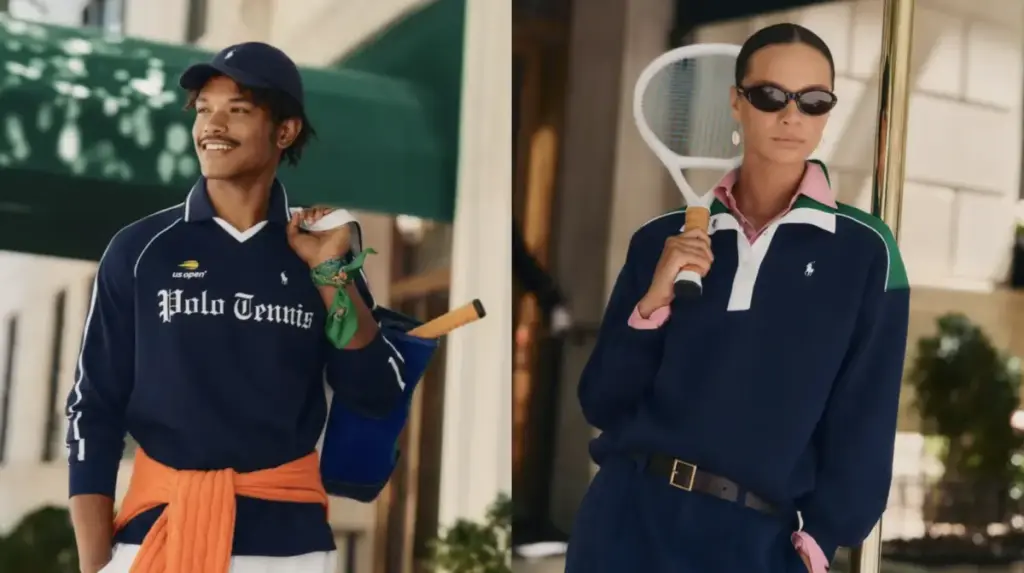
For decades, sports sponsorships operated under a predictable, transactional playbook: brands paid a rights fee, secured prominent logo placement on courtside banners or athlete uniforms, and hoped for passive brand awareness. Today, that traditional model is obsolete. Nowhere is this evolution more apparent than at the U.S. Open, where legacy American prep titan Ralph Lauren has rewritten the rules of engagement.
As the brand’s marketing investment reaches an all-time high of 8.2% of sales, Ralph Lauren is no longer treating the iconic two-week tennis tournament as a short-term activation. Instead, the company has successfully transformed a sporting event into a nearly two-month-long retail season. By integrating immersive physical retail takeovers, high-end hospitality, advanced product personalization, and a debut entry into certified vintage merchandising, Ralph Lauren is proving that modern sports marketing requires a 360-degree lifestyle ecosystem.
At the same time, the broader luxury market is experiencing a philosophical reckoning. In an era dominated by generative artificial intelligence—where digital campaigns can be whipped up in seconds at a fraction of the cost—luxury houses are aggressively pivoting in the opposite direction. Brands like Dior Beauty and Hermès are doubling down on hand-drawn animations, stop-motion films, and visible human craftsmanship to combat the threat of generic, soulless digital imagery.
This deep dive investigates how Ralph Lauren is maximizing its U.S. Open partnership through strategic retail expansion and surging marketing spend, while examining the parallel movement toward tactile authenticity across the luxury sector.
Detailed Chronology: The Extended Timeline of the U.S. Open Retail Season
The traditional window for a tournament sponsorship is rigid: the event begins, the world watches for fourteen days, and the marketing machine shuts down as soon as the final championship point is scored. Ralph Lauren, serving as the official outfitter of the U.S. Open for over two decades, has systematically dismantled this timeline.
The Six-Week Retail Takeover
The U.S. Open officially runs from late August through mid-September. However, Ralph Lauren’s commercial calendar began nearly three weeks before the first serve.
- August 4: Ralph Lauren launched an extensive, multi-level retail takeover of The Corner at Nordstrom’s flagship New York City location.
- August 23 – September 13: The U.S. Open tournament takes place at the USTA Billie Jean King National Tennis Center in Flushing Meadows, Queens, where Ralph Lauren outfits hundreds of officials and ball-crew members while running massive on-site experiential booths.
- September 20: The Nordstrom flagship installation is scheduled to close, extending the retail activation to a full six weeks—nearly double the operational window of the tennis tournament itself.
By widening the temporal aperture of the event, Ralph Lauren captures early-bird tennis enthusiasts arriving in New York for the preliminary rounds, as well as post-tournament shoppers looking to extend the cultural momentum of late summer.
On-Court Presence Meets Off-Court Lifestyle
Beyond the flagship takeover and tournament grounds, the brand’s chronological rollout includes coordinated digital drops, localized VIP dinners, and targeted media pushes. The strategy relies heavily on blurring the line between functional sportswear and luxury lifestyle goods.
At Arthur Ashe Stadium, Ralph Lauren’s hospitality suite has been expanded into a multi-zone destination featuring distinct areas for viewing, dining, and gathering. Outfitted entirely with pieces from Ralph Lauren Home, the suite operates as both a functional private lounge for VIPs and an immersive showroom for the brand’s interior design division.
Supporting Context & Metrics: Fueling the Elevation Strategy
Ralph Lauren’s aggressive expansion at the U.S. Open is not an isolated marketing experiment; it is the physical manifestation of a broader corporate pivot toward brand elevation and customer acquisition.
The Numbers Behind the Elevation
Under CEO Patrice Louvet, Ralph Lauren has systematically increased its marketing budget as a percentage of overall sales to drive long-term brand equity:
- Fiscal 2027 (Q1): Marketing investment reached 8.2% of total sales.
- Previous Year: Marketing sat at 7.5% of sales.
- Earlier Stage of Elevation: Marketing hovered at approximately 3.5% of sales.
Skeptics often warn that pumping money into marketing can erode margin health if forced through heavy discounting. However, Ralph Lauren’s financial results contradict this concern. During the same quarter that marketing investment hit 8.2%, the company reported:
- Quarterly Revenue Growth: Increased 13% in constant currency to $1.96 billion.
- Pricing Power: Average unit retail (AUR) rose 15%.
- Customer Acquisition: Recruited 1.5 million new direct-to-consumer (DTC) customers.
Capturing the Resale and Vintage Demand
A critical component of Ralph Lauren’s strategy at this year’s U.S. Open is the introduction of its certified vintage program to the tournament grounds for the very first time.
Launched initially in September 2024, the program features authenticated archival pieces priced anywhere from $150 to $3,500. By placing authenticated vintage items directly alongside customizable, contemporary tournament merchandise, Ralph Lauren achieves two distinct commercial goals:
- It injects an element of scarcity and collectibility into the retail environment, appealing to younger, sustainability-minded consumers who prize unique heritage pieces.
- It allows the brand to monetize its own secondary market demand, capturing revenue from archival interest that would otherwise flow exclusively to independent third-party resale platforms.
Additionally, the brand expanded its Create Your Own product personalization stations on-site at the tournament, allowing attendees to customize apparel using specialized patches, prints, and embroidery.
Official Statements and Industry Insights
The transformation of sporting events into pop-culture retail festivals has changed how sports properties and brands evaluate ROI.
Leadership Perspectives
Reflecting on the brand’s performance during the company’s August earnings call, CEO Patrice Louvet emphasized the tangible returns of their investments:
"Our marketing teams are really doing a fantastic job around the world, building brand desirability, recruiting new customers. We are generating really good returns from our increased marketing investment."
According to Joe Favorito, a prominent sports-marketing consultant and former USTA executive, brands can no longer treat major sporting events as passive billboard opportunities.
"The U.S. Open is a pop-culture happening," Favorito explained. "It becomes the front porch for the right brands to engage — not just for two weeks, but for life. You can no longer just buy sponsorship visibility and hope that you win. The event must be integrated across retail and marketing channels with specific commercial and customer-acquisition goals."
The Broader Tennis Retail Boom
The commercial power of tennis as a lifestyle aesthetic extends far beyond apparel. Fine jewelry brand Aurate reports that its tennis bracelet and necklace category now accounts for approximately 50% of the New York-based brand’s annual sales. Since launching in 2021, the category has expanded by more than 60% year-over-year.
Aurate’s marketing director, Zoé Macias, noted that the brand experiences a reliable 10% sales spike in its tennis jewelry category specifically during the U.S. Open. Outside of major gifting holidays like Mother’s Day and the winter holiday season, September stands as Aurate’s strongest performing month for tennis-themed designs.
To bridge accessible luxury with high-end price points, Aurate offers tiered pricing within the category:
- Accessible Tier: Stainless-steel and lab-grown white-sapphire bracelets starting at $198 (or $388 for vermeil versions).
- Fine Jewelry Tier: 14-karat gold bracelets with lab-grown diamonds starting at $1,748, scaling up to $2,588+ for natural diamond designs.
The Luxury Counter-Revolutions: Why Brands Are Embracing Animation Over AI
While athletic partnerships and retail takeovers dominate physical commerce, the digital and creative strategies of major luxury houses are undergoing a parallel shift.
The Anti-AI Movement in Luxury Marketing
As generative artificial intelligence tools democratize the creation of hyper-slick, glossy digital imagery, the luxury sector faces an existential branding crisis. When any brand can generate a photorealistic campaign in seconds using text prompts, perfection becomes commoditized, cheap, and ultimately suspect.
Recent creative executions highlight a concerted industry retreat toward human imperfection:
- Dior Beauty recently released a hand-painted animated film chronicling the narrative history of Miss Dior.
- Hermès populated its official website and social media channels with surreal pen-and-ink sea creatures drawn by artist Linda Merad.
According to Hana Shimizu, managing partner of creative studio Hornet—which has collaborated with luxury icons such as Tiffany & Co., La Mer, Longchamp, and Loewe—the primary fear for modern brands is losing their soul.
"The fear for any brand is now about feeling generic, feeling AI or feeling like it is without a soul," Shimizu noted.
Craftsmanship, Authorship, and Asset Longevity
Historically, animation was often relegated to a minor social media add-on or dismissed as too juvenile for high-end heritage houses. Today, mediums like hand-drawing, felt crafting, and stop-motion animation are being leveraged to explicitly signal core luxury attributes: craftsmanship, authorship, and authenticity.
Brands are even leaning heavily into "process proof"—showcasing behind-the-scenes footage of artists sketching frames by hand to assure consumers that real human labor went into the final product.
Furthermore, these commissioning strategies are shifting away from short-term metric tracking toward long-term asset utility. Rather than ordering isolated digital clips for a single campaign, luxury houses are commissioning fully realized visual universes. These assets are engineered for maximum operational flexibility, designed to run seamlessly across physical store installations, e-commerce websites, social media platforms, and large-format outdoor advertising.
Shimizu emphasizes that modern luxury marketing directors are looking past vanity metrics like simple views and clicks, focusing instead on:
- Asset longevity
- Cross-channel reuse
- Retail adaptability
- Visual consistency and long-term brand recall
Future Outlook: What Lies Ahead for Sports Retail and Luxury Content
The convergence of heritage sports, experiential retail, and tactile craftsmanship points to clear trajectories for the luxury and retail sectors over the coming years.
- The Extension of Sports Calendars: Expect more luxury and lifestyle brands to follow Ralph Lauren’s lead by stretching event sponsorships into elongated retail seasons. As events like the U.S. Open, Formula 1 Grand Prix races, and global golf championships transform into pop-culture fashion weeks, the traditional two-week activation window will become entirely obsolete.
- The Premiumization of Resale and Heritage: Integrating certified vintage programs directly into temporary retail takeovers will likely become a standard playbook for heritage brands. It solves multiple problems simultaneously: it captures secondary-market revenue, appeals to eco-conscious Gen Z and millennial shoppers, and reinforces the timeless durability of archival goods.
- The Premium on Human-Centric Artistry: As generative AI tools saturate the internet with synthetic media, the value of visible human effort will skyrocket. Luxury houses that invest in hand-crafted animation, tactile storytelling, and transparent artistic processes will command higher pricing power and stronger emotional loyalty from consumers desperate for authenticity in an increasingly automated world.