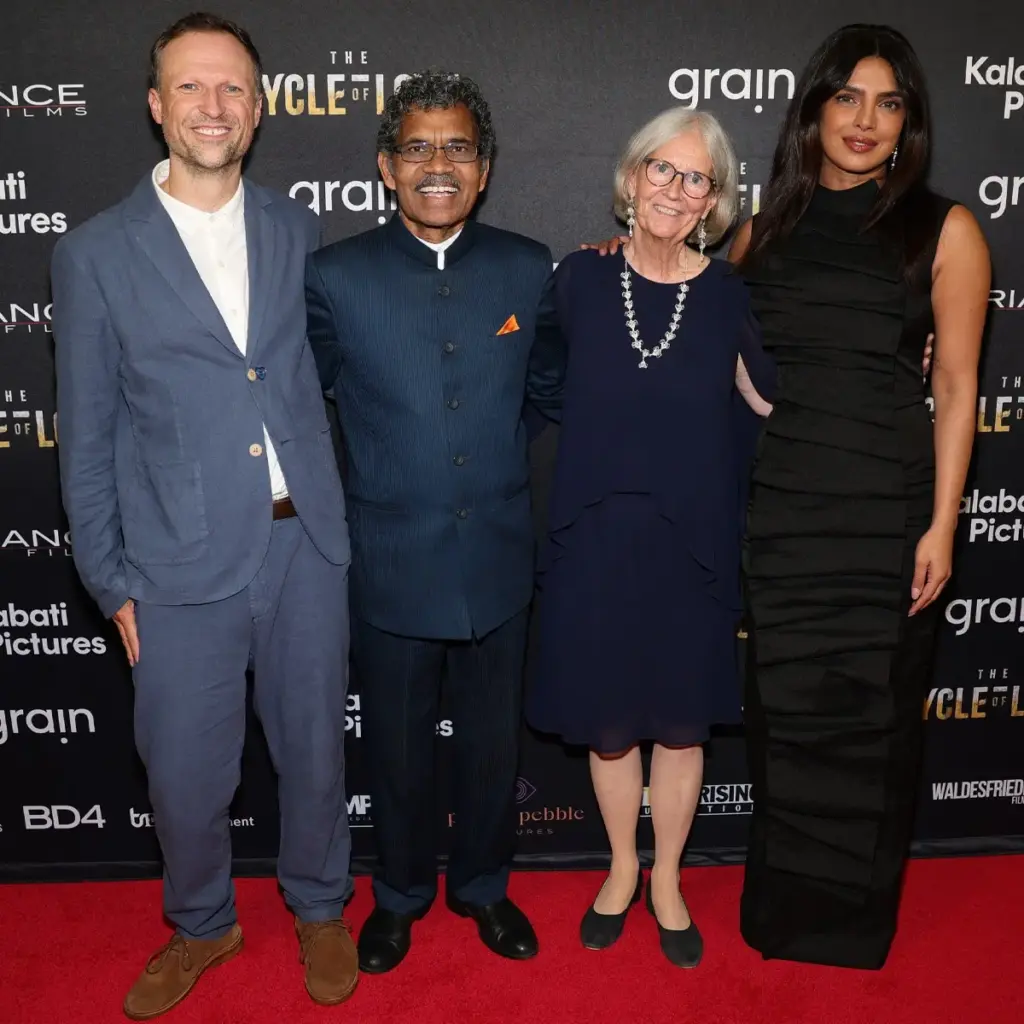
In an era characterized by digital superficiality and rapid-fire algorithmic courtships, genuine narratives of enduring devotion occupy a rare and cherished space in contemporary culture. Few figures understand the architecture of a high-profile modern romance quite like actress, producer, and global icon Priyanka Chopra Jonas. Following her own whirlwind courtship with pop sensation Nick Jonas—which culminated in a breathtaking three-day multicultural celebration in her native India in late 2018—Chopra Jonas has continually sought out narratives that challenge the cynical parameters of modern relationships.
Her latest endeavor in this space is executive producing The Cycle of Love, a deeply moving feature documentary directed by Orlando Von Einsiedel. The film breathes cinematic life into Per J. Andersson’s acclaimed 2017 book, The Amazing Story of the Man Who Cycled From India to Europe for Love. It chronicles the astonishing true story of Pradyumna Kumar "PK" Mahanandia and Lotta Von Schedvin. In 1975, Lotta, a Swedish art student visiting New Delhi, crossed paths with PK, a struggling street portraitist. What began as a routine sketch by a city center fountain blossomed into an extraordinary, boundary-defying bond. When Lotta was forced to return to Sweden, PK refused to let distance terminate their connection. Lacking a passport, a reliable map, or adequate funds, he traded his meager savings for a used ladies’ bicycle, packed a tent, and embarked on a grueling 6,000-mile odyssey across multiple continents to reunite with the woman who had captured his heart.
At its New York premiere, Chopra Jonas championed the documentary as a vital cultural antidote. "Everything about it is so heartwarming," she told reporters, "and just makes me feel like, in a crazy world right now, it’s a ray of sunlight." The Cycle of Love transcends a traditional travelogue or romantic drama. It serves as a sprawling exploration of cross-cultural resilience, socio-political emancipation, and the transformative power of self-actualization. As Hollywood continues to mine literature for screen adaptations, this project stands out not merely as an incredible feat of human endurance, but as a timely reminder that foundational love can dismantle systemic barriers.
Detailed Chronology: From the Fountains of Delhi to the Forests of Borås
The narrative arc of The Cycle of Love spans nearly five decades, defined by pivotal milestones that trace PK and Lotta’s improbable convergence across geographical, economic, and cultural divides.
1975: The Fateful Encounter in New Delhi
The story begins in the heart of India’s bustling capital. PK Mahanandia was pursuing his master’s degree in fine arts at the Delhi College of Art. To sustain his studies and hone his craft, he worked as an itinerant street portraitist near the central plaza’s fountain, quickly gaining local renown for his uncanny ability to capture human likenesses with startling emotional depth.
Into this vibrant, chaotic landscape drove Lotta Von Schedvin, a young Swedish student traveling through India with friends. Drawn to PK’s open demeanor and artistic skill, Lotta approached him to commission a portrait. Legend—and subsequent historical accounts—notes that upon first meeting her gaze, PK experienced an immediate, profound conviction. He later recounted telling her that she was destined to be his wife, a bold declaration rooted in an ancient Indian belief that those who meet by a fountain are cosmically linked. Remarkably, Lotta was unfazed. She returned the following day for another sitting, and by the end of her visit, the pair had forged an unbreakable mutual commitment, with Lotta writing home to inform her astounded parents that she had found her lifelong partner.
The Immediate Separation and the Decision to Ride
Following their initial courtship, Lotta traveled with PK to his ancestral village of Kandhapada, situated in the eastern Indian state of Odisha. There, enveloped by local traditions, PK’s father officiated an informal marriage ceremony, solidifying their spiritual union.
However, temporal realities soon interrupted their idyllic romance. Lotta was required to return to Sweden to complete her university education, while PK remained in Delhi to finish his fine arts degree. Despite plans to reunite post-graduation, PK faced a debilitating financial barrier: a commercial airline ticket to Europe was entirely beyond his means. Refusing to accept a permanent separation dictated by socio-economic constraints, PK made a radical decision. He sold his few remaining possessions, purchased a secondhand ladies’ bicycle, packed a sleeping bag, a tent, and his cherished art supplies, and pointed his handlebars toward Europe.
The 6,000-Mile Odyssey
PK’s journey was as much an internal psychological excavation as it was a physical trek. Growing up as a member of the Dalit community—historically designated by India’s ancient caste system as the lowest social stratum, or "untouchables"—PK had endured a lifetime of systemic discrimination, bullying, and social alienation. Director Orlando Von Einsiedel notes that the cycle in the documentary’s title represents not just the mechanical vehicle of transport, but PK’s profound internal journey of "learning to love himself so he can love others."
Equipped with virtually no geographical knowledge of the vast expanse between South Asia and Scandinavia, PK relied entirely on the kindness of strangers. In a particularly colorful anecdote featured in the film, PK recounts meeting "a Belgian hippie" equipped with an actual map—an item PK had neglected to bring. Upon inspecting the map, he discovered that Borås, the Swedish town where Lotta resided, was located in Sweden, not Switzerland, as he had initially assumed. "It was a bit of a blow," PK admitted with characteristic humor, "to realize I had to go even farther than I thought."
When bureaucratic hurdles prevented him from obtaining a visa to cycle through Pakistan, PK experienced his first-ever airplane flight, bypassing a dangerous geopolitical zone before resuming his cycling trek across the Middle East and Europe. Approximately four months after departing from the fountains of Delhi, a dust-covered, exhausted, yet triumphant PK pedaled into Borås, completing a legendary 6,000-mile pilgrimage that transformed local folklore into international history.
Supporting Context & Metrics: Sociological and Cinematic Dimensions
The documentary adaptation of Per J. Andersson’s literary work arrives at a critical juncture in global media consumption, prompting both sociological analysis and industry scrutiny.
The Dynamics of Cross-Cultural Romance
The union of PK and Lotta challenges foundational paradigms of 20th-century sociology. The couple’s backgrounds could not have been more disparate. Lotta hailed from Swedish nobility, her grandfather being a prominent landowner, while PK emerged from the historically marginalized Dalit community in rural Odisha.
| Metric / Dimension | PK Mahanandia’s Background | Lotta Von Schedvin’s Background |
|---|---|---|
| Geographic Origin | Kandhapada, Odisha, India | Borås, Sweden |
| Socio-Economic Status | Historically marginalized (Dalit community) | Swedish nobility/landowning class |
| Primary Vocation | Fine Arts student and street portraitist | University student |
| Method of Reunion | 6,000-mile bicycle trek across continents | Academic relocation and familial support |
| Post-Reunification Base | Borås, Sweden | Borås, Sweden |
As Lotta reflected in interviews with The Telegraph, their relationship became an intentional socio-political statement: "We met—East and West, he was untouchable, I was from nobility. He was ashamed of the caste system, I was ashamed to be part of the nobility—but we are a unifying force."
Cinematic Production and Distribution Metrics
The Cycle of Love is structured not merely as a biography, but as a masterclass in modern documentary filmmaking. Directed by Emmy- and Academy Award-nominated filmmaker Orlando Von Einsiedel, the film utilizes a hybrid of cinematic re-enactments—with PK portrayed in his youth by actor Chirag Lobo—and present-day documentary footage of the septuagenarian couple.
The project’s production pedigree is equally robust. Executive produced by Priyanka Chopra Jonas, the film also features PK and Lotta’s children, Karl Mahanandian Von Schedvin and Emilie Von Schedvin, as co-producers. Following its high-profile screening at New York’s Angelika Film Center, the documentary secured a multi-city theatrical rollout, targeting major North American cultural hubs including Los Angeles, signaling a growing commercial appetite for substantive, non-fiction love stories that bridge historical epic with intimate character study.
Official Statements and Industry Commentary
The cultural impact of The Cycle of Love has been amplified by passionate commentary from its creative stewards and the subjects themselves.
Priyanka Chopra Jonas, whose personal and professional life frequently bridges Eastern and Western sensibilities, articulated the core motivation behind her involvement with the project during its New York premiere press cycle:
"Everything about it is so heartwarming and just makes me feel like, in a crazy world right now, it’s a ray of sunlight… PK made this insane gesture of love that sounds almost unbelievable, but isn’t. When you look at them today, they are so cute together. They hold hands, they’re affectionate. I want that after 50 years, it’s amazing."
Director Orlando Von Einsiedel emphasized the psychological dimensions that elevate the narrative beyond a conventional adventure story:
"The cycle isn’t just about the physical distance covered across nations; it’s about PK learning to love himself so he can love others. The journey was a physical manifestation of inner healing from the profound scars of systemic discrimination."
Reflecting on their legacy and the educational upbringing of their children, Emilie Von Schedvin noted the intentionality behind maintaining a connection to both Swedish society and Indian heritage:
"The values we were brought up with are something we want to share, because we are so privileged to have that foundation—of seeing people for who they are and not the labels that they carry."
Future Outlook: The Resurgence of Literary Adaptations on Screen
The Cycle of Love exists within a massive, rapidly expanding ecosystem of page-to-screen adaptations that currently dominate the global entertainment landscape. As streaming platforms and traditional studios compete for viewer retention, literary adaptations—ranging from historical non-fiction memoirs to contemporary romantic fiction—have become the primary currency of cinematic greenlights.
In tandem with the theatrical release of The Cycle of Love, the entertainment industry is preparing for a monumental slate of high-profile adaptations spanning the next several years:
- Literary Epics and Historical Dramas: Projects like Christopher Nolan’s blockbuster cinematic interpretation of Homer’s The Odyssey (headlined by an ensemble cast including Matt Damon, Anne Hathaway, and Zendaya) and Denis Villeneuve’s concluding installment, Dune: Part 3 (adapted from Frank Herbert’s Dune Messiah), demonstrate Hollywood’s continued appetite for monumental source material.
- Contemporary Romance and BookTok Phenomena: The cultural dominance of online reading communities has accelerated the adaptation of best-sellers. Upcoming releases include film and television versions of Emily Henry’s Beach Read (starring Phoebe Dynevor and Patrick Schwarzenegger) and Funny Story, Ali Hazelwood’s fan-favorite The Love Hypothesis, and Tessa Bailey’s It Happened One Summer (starring Nina Dobrev and Tyler Hoechlin).
- Serialized Franchise Revitalizations: Prestige television continues to invest heavily in multi-year adaptations, most notably HBO’s forthcoming decade-long television series adaptation of J.K. Rowling’s Harry Potter universe, alongside continued expansions of Netflix’s Bridgerton franchise into its fifth season.
Within this crowded ecosystem of fictional spectacle and fantasy, The Cycle of Love occupies a unique, grounding niche. By anchoring its narrative in the verifiable, extraordinary lived experience of two individuals who dared to defy socio-economic gravity, the film challenges audiences to reconsider the limits of human commitment. As Priyanka Chopra Jonas noted, in a fractured and cynical media landscape, stories of sustained, radical devotion remain cinema’s most powerful currency—proving that while bicycles rust and empires fall, the fundamental human drive to connect across the miles remains truly indestructible.