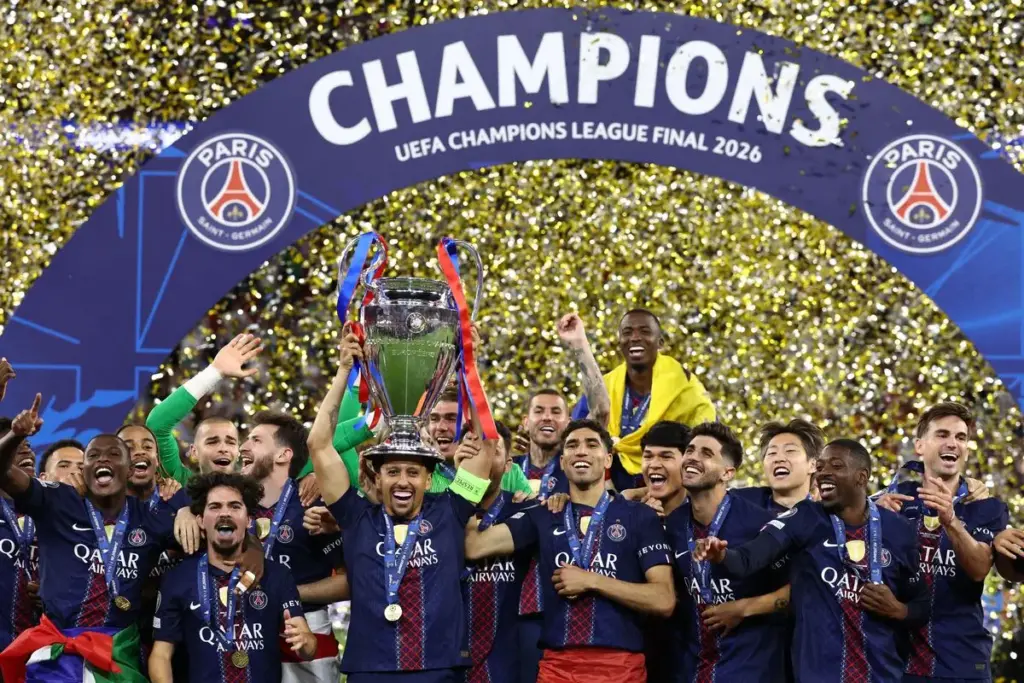
The grandeur of European club football’s premier competition reached fever pitch on August 27, 2026, as the grand draw for the UEFA Champions League league phase unfolded. Broadcast live from the heart of European football governance, the ceremony brought together club executives, football legends, and millions of supporters worldwide to chart the course for the continent’s elite 36-team landscape. Under the watchful eye of UEFA officials and powered by advanced digital pairing algorithms, the evening established a breathtaking blueprint for the autumn and winter fixtures ahead.
This season’s competition carries immense weight. Reigning champions Paris Saint-Germain enter the fray aiming for a historic third consecutive European crown—a feat achieved only by an exclusive pantheon of clubs including Real Madrid, Bayern Munich, and Ajax. Meanwhile, a staggering contingent of five Premier League clubs has qualified for the tournament proper, buoyed by stellar coefficients earned through dominant runs across all three major European competitions the previous year.
As the balls were drawn and the supercomputer processed the intricate matrix of pot combinations, blockbusters emerged instantly. Arsenal face a daunting trip to face Real Madrid at the Santiago Bernabéu, Manchester United prepare for heavyweight tests against Bayern Munich and Atlético Madrid, and Aston Villa brace themselves for historic clashes at the Camp Nou against Barcelona and at home against holders PSG. With new regulations preventing the repetition of fixtures for three consecutive seasons and the road to the Estadio Metropolitano in Madrid officially underway, the 2026/27 Champions League campaign promises to be one of the most fiercely contested in modern history.
Detailed Chronology of the Draw Ceremony
Pre-Ceremony Prelude and Awards
As the clock struck 5:00 PM BST, the unmistakable, spine-tingling Champions League anthem echoed through the auditorium, signaling the commencement of the official ceremony. Co-hosts Pedro Pinto and Reshmin Chowdhury welcomed attendees, setting a tone of reverence and celebration before the technical work of the draw began.
The early stages of the event turned the spotlight onto sportsmanship and legendary status. UEFA President Aleksander Ceferin took to the stage to deliver a powerful address, emphasizing the unifying power of the sport: "Football is about showing children how you should behave towards others."
The ceremony quickly moved to its prestigious accolades. Paris Saint-Germain defender Marquinhos was announced as the inaugural winner of the UEFA Respect: Beyond the Game Award. The accolade recognized his exemplary display of sportsmanship when he consoled Arsenal’s Gabriel Magalhães on the pitch moments after the French side secured the title in the previous season’s dramatic final in Budapest. PSG President Nasser Al-Khelaïfi graciously accepted the award on behalf of the Brazilian center-back.
Shortly after, Arsenal icon Thierry Henry was honored with the UEFA President’s Award in recognition of his illustrious career, charitable contributions, and tireless work in the fight against discrimination. Interviewed on stage about his former club’s continental prospects, Henry radiated confidence, pointing out that Mikel Arteta’s side had reached the quarter-finals, semi-finals, and final in consecutive campaigns. "Just wait until this season," Henry remarked, fueling optimism among the North London faithful.
The Mechanism of the New Format
With formalities concluded, attention shifted to the technical execution of the draw. Joined by tournament icons David Villa and Thierry Henry—overseen by UEFA’s director of competitions Giorgio Marchetti—the procedure combined traditional manual ball drawing with automated supercomputer processing.
Under the modern 36-team single-league format, each club is handed eight distinct opponents, playing four matches at home and four away. Crucially, teams must face two opponents from each of the four seeding pots, eliminating traditional groups in favor of a expansive league table where every goal and point dictates progression directly to the round of 16 or the ensuing knockout play-offs.
High-Stakes Pairings Unfold
The draw generated immediate shockwaves across the continent as Pot 1 fixtures were unsealed:
Real Madrid were handed an immediate blockbuster, scheduled to host Inter Milan at the Santiago Bernabéu while making a heavyweight trip to North London to face Arsenal at the Emirates Stadium.
Manchester City discovered they would cross paths with former talisman Rodri, who now anchors the midfield for Barcelona following a high-profile transfer.
Manchester United, re-entering the elite stage under the guidance of manager Michael Carrick, learned their first major pairings: a marquee home tie against German giants Bayern Munich and a demanding away fixture against Atlético Madrid at the Metropolitano—a venue carrying fond knockout memories from 2022.
Aston Villa, riding high after their historic successes, were treated to a glamorous fixture list featuring a pilgrimage to Camp Nou to face Barcelona, alongside a high-stakes home encounter against reigning champions Paris Saint-Germain.
Supporting Context & Metrics
The Premier League’s Coefficient Dominance
The English top flight’s unprecedented representation of five teams—Manchester City, Arsenal, Liverpool, Aston Villa, and Manchester United—underscores the overwhelming strength of the Premier League in UEFA competitions.
This surplus of qualification spots is a direct byproduct of a remarkable 2025/26 European campaign. Last season witnessed English clubs reaching the finals of all three major UEFA competitions:
Aston Villa triumphed in a thrilling campaign to lift the UEFA Europa League trophy in Istanbul.
Crystal Palace etched their name in history by conquering the UEFA Europa Conference League.
Arsenal reached the pinnacle of the Champions League, only to suffer a heartbreaking defeat on penalties to Paris Saint-Germain in the final.
This collective excellence caused the Premier League’s UEFA coefficient to soar, granting a coveted extra Champions League berth. Liverpool capitalized on this safety net, securing passage to Europe’s top table despite missing out on the Premier League’s top four under Arne Slot, while Aston Villa secured their qualification both via their Europa League triumph and a stellar fourth-place domestic finish.
Pot Distribution Breakdown
The 36 competing clubs were distributed into four performance-based pots ahead of the draw:
Pot 1: Paris Saint-Germain (FRA), Bayern München (GER), Real Madrid (ESP), Liverpool (ENG), Inter Milan (ITA), Manchester City (ENG), Arsenal (ENG), Barcelona (ESP), Atlético Madrid (ESP).
Pot 2: Borussia Dortmund (GER), Roma (ITA), Sporting CP (POR), Aston Villa (ENG), FC Porto (POR), Manchester United (ENG), Club Brugge (BEL), Real Betis (ESP), PSV Eindhoven (NED).
Pot 3: Feyenoord (NED), Lille (FRA), Bodø/Glimt (NOR), Napoli (ITA), RB Leipzig (GER), Villarreal (ESP), Fenerbahçe (TUR), Shakhtar Donetsk (UKR), Galatasaray (TUR).
Pot 4: Slavia Praha (CZE), Slovan Bratislava (SVK), VfB Stuttgart (GER), AEK Athens (GRE), LASK (AUT), Como (ITA), RC Lens (FRA), Viking (NOR), Sabah (AZE).
Tactical Innovations and Regulatory Adjustments
UEFA introduced a vital regulatory amendment ahead of the 2026/27 draw to prevent fixture fatigue and monotony. Under the new rule, identical fixtures cannot be repeated in the league phase for three consecutive seasons. Consequently, repeat fixtures such as Liverpool hosting Real Madrid or Arsenal playing away against Inter Milan—staples of the prior two tournament cycles—were automatically flipped to take place at the Santiago Bernabéu and the Emirates Stadium respectively, preserving competitive freshness.
Official Statements and Reactions
The aftermath of the draw elicited strong reactions from managers, executives, and pundits alike, reflecting the high stakes of the expanded league phase.
UEFA President Aleksander Ceferin emphasized the broader educational and social values upheld by the institution during his opening remarks:
"Football is about showing children how you should behave towards others. The moments of respect we witness on our pitches, from players supporting their peers in defeat to communities coming together, are what truly define the spirit of European competition."
Arsenal Legend and Draw Assistant Thierry Henry spoke passionately about his former side’s maturation on the European stage:
"People always look at Arsenal and wonder if they have the psychological edge to go all the way. Just wait until this season. Reaching the quarter-finals, the semi-finals, and then the final over the last three campaigns wasn’t a fluke—it was the building of a machine. Mikel Arteta and his players know what it takes now."
Manchester United Manager Michael Carrick, preparing his squad for a demanding return to Europe’s elite tier under the league-phase format, noted the importance of squad depth:
"Missing out on the Champions League over the past couple of seasons hurt everyone associated with the club, but our resurgence has put us back where we belong. Playing eight different opponents, including the calibre of Bayern Munich and Atlético Madrid, demands absolute perfection. Our target is a top-eight finish to bypass the play-offs and manage our domestic ambitions effectively."
Future Outlook: The Road to Madrid
As the final fixtures are locked in and the complete match schedules are published, attention pivots immediately to the pitch. The league phase matches will kick off in September, spanning an intense winter schedule that will test the physical and mental limits of every squad.
For defending champions Paris Saint-Germain, the objective is historic: securing a third consecutive European Cup—a milestone that would cement Luis Enrique’s side alongside the immortal dynasties of Real Madrid, Bayern Munich, and Ajax. However, the path is fraught with peril. With the expanded 36-team league table leaving zero room for complacency, slip-ups against Pot 3 and Pot 4 opponents could prove fatal to automatic qualification dreams.
England’s quintet enters the fray with genuine aspirations of continental dominance. Whether Manchester City’s tactical mastery, Arsenal’s tactical evolution, Liverpool’s European pedigree, Aston Villa’s fearless momentum, or Manchester United’s tactical rebirth under Carrick will prevail remains one of the season’s most compelling storylines.
Ultimately, all roads lead to the Spanish capital. The Estadio Metropolitano in Madrid—home to Atlético and the stage of unforgettable English triumph in 2019—awaits its new royalty. When the curtain falls on the league phase in January and the knockout rounds commence in the spring, only the most resilient, tactically adaptable, and mentally resolute clubs will survive the gauntlet on the road to the 2027 Champions League final.