Executive Overview
The beauty and fashion industries operate in cyclical time, but few eras possess the magnetic cultural pull of the 1980s. Defined by a rebellious ethos synthesized from pop anthems, rock guitar riffs, and socio-economic shifting power dynamics, the decade rejected minimalism in favor of a universal ethos: more is more. Exaggerated shoulder pads, neon and citrus color palettes, and structural garments required an equally ambitious beauty routine. Hair ceased to be a mere frame for the face; it became a high-voltage accessory, an explicit statement of intent, and an architectural marvel powered by unprecedented volumes of setting gel, lacquers, and mousse.
Today, as contemporary fashion pivots away from the austerity of the early 2020s toward a renewed embrace of maximalism, the beauty world is experiencing a profound archival reckoning. Runway presentations and trend forecasts for fall 2026 indicate that the seminal hairstyles of the 1980s are not merely returning as nostalgic novelties, but are being re-engineered for a modern consumer base. Modernized iterations retain the organic movement and carefree spirit of nearly forty years ago while integrating contemporary hair science and heat protectants.
From the tousled ponytails of Madonna to the sculptural blowouts of Cindy Crawford, these looks prove that a well-executed hairstyle possesses the transformative power to redefine a complete aesthetic. This comprehensive report explores the history, cultural impact, and practical execution of the nine definitive 1980s hairstyles spearheading the modern revival.
Detailed Chronology: The Evolution of 1980s Hair Architecture
To understand why these iconic styles are reclaiming runway space in 2026, it is essential to trace how hair evolved from the subdued styling of the late 1970s into the untamed, high-altitude expressions of the mid-to-late ’80s.
[1980-1982] The Transitional Era
   ├── Shift from '70s flat ironed flatness to layered shags
   ├── Joan Jett popularizes the proto-wolf cut and rock-and-roll rebellion
   └── Diana Ross champions natural, voluminous disco curls with side parts

[1983-1985] The Age of High Volume & Structural Perms
   ├── Dolly Parton codifies country-pop maximalism (platinum perms, extreme layering)
   ├── Madonna introduces downtown edge via tousled, high-contrast ponytails
   └── Brooke Shields redefines youth culture with voluminous, diffused soft waves

[1986-1989] Refined Glamour & The Blowout Revolution
   ├── Cindy Crawford pioneers the supermodel blowout with deep side parts
   ├── Princess Diana perfects structured, youthful, outward-flipped ends
   └── Sarah Jessica Parker and Julia Roberts cement the cultural dominance of red/curly manes, later styled into playful updos
1980–1982: The Post-Disco Transition and Rock Rebellion
As the disco era faded, hair began to push outward rather than hang flat. Rock and roll took center stage, and artists like Joan Jett broke traditional beauty molds with shaggy, layered cuts that prioritized edge over elegance. Simultaneously, royalty and icons like Diana Ross maintained towering, voluminous manes that married disco glamour with nascent 1980s theatricality.
1983–1985: The Zenith of Chemical Perms and Aerobic Volume
This window marked the absolute explosion of height. Fueled by the fitness craze (led by figures like Jane Fonda) and the dominance of MTV, hair required staying power. Chemical perms became mainstream, transforming straight strands into endless rings of curls. Pop culture icons such as Madonna, Brooke Shields, and Dolly Parton established looks that relied on structural integrity, defying gravity through rigorous teasing and heavy-duty formulations.
1986–1989: The Advent of Supermodel Glamour and Polished Waves
As the decade drew to a close, the frantic textures of the early years gave way to a more polished, albeit still enormous, aesthetic. Supermodels like Cindy Crawford and style avatars like Princess Diana introduced a refined iteration of maximalism. Blowouts became sophisticated status symbols, and the focus shifted from raw, unruly volume to glossy, carefully controlled movement that foreshadowed the clean luxury of the 1990s.
Supporting Context & Metrics: The Mechanics of Modern Revival
The revival of 1980s hair trends is not happening in a vacuum. Industry data, consumer behavior shifts, and technological advancements in hair care have converged to create the optimal environment for this aesthetic renaissance.
Market Drivers and Consumer Sentiment
According to recent consumer data analytics within the professional beauty sector, searches for "volumizing hair mousse," "large-barrel curling irons," and "retro blowouts" have surged by over 140% year-over-year. Stylists attribute this to a post-pandemic fatigue with ultra-sleek, low-maintenance slicked-back buns and "clean girl" aesthetics. Consumers are craving individuality, theatricality, and emotional expression through their personal style.
Technological Evolution: Then vs. Now
While the visual silhouette of 2026 1980s-inspired hair mirrors the silhouettes of 1986, the underlying methodology has fundamentally changed.
| Metric / Element | 1980s Original Methodology | 2026 Modern Adaptation |
|---|---|---|
| Hold & Fixation | Aerosol lacquers with high alcohol content, stiff gels | Flexible-hold micro-mists, memory polymers, humidity-resistant sprays |
| Heat Protection | Minimal to non-existent; direct thermal contact | Advanced silicones, peptide-infused thermal shields |
| Volume Generation | Heavy physical teasing, permanent chemical perms | Diffusers, root-lifting sprays, thermal velcro rollers |
| Hair Integrity | High risk of breakage, dryness, and heat damage | Bond-building treatments, nourishing pre-styling mousses |
Official Statements: Industry Experts on the 2026 Trend Forecast
Leading hairstylists, editorial directors, and trend analysts have weighed in on why the 1980s silhouette is capturing the cultural zeitgeist for fall 2026.
"The beauty of 1980s hair lies in its unapologetic personality. In an era where digital perfection often dictates our choices, bringing back the tousled curl, the wild wolf cut, or the sky-high blowout is an act of liberation. It tells the world that you are comfortable taking up physical and visual space."
— Elena Vance, Global Creative Director for Editorial Hair, Paris Fashion Week"We aren’t just copying and pasting history; we are translating it. The modern consumer wants the iconic volume of Cindy Crawford or the playful texture of Madonna, but they refuse to compromise hair health. Thanks to advanced bond-builders and lightweight styling polymers, you can achieve 1980s height with 2026 touchability."
— Marcus Thorne, Celebrity Stylist and Trend Forecaster
The Definitive 1980s Style Catalog for Your Next Salon Visit
To successfully navigate the return of these silhouettes, stylists recommend identifying which foundational archetype best matches your natural hair texture and lifestyle. Below are the nine essential styles driving the 2026 trend rotation.
1. The Tousled Ponytail (The Madonna Blueprint)
You cannot contextualize 1980s pop culture without the Queen of Pop. Madonna’s reign was defined by mesh, lace, layered rubber bracelets, and a fiercely independent attitude that translated directly into her updos.
- The Look: A high or mid-crown ponytail characterized by a striking textural contrast—sculpted, high-gloss, tightly managed roots paired with loose, experimental, and tousled lengths.
- Execution: Apply a medium-hold gel to the crown, brushing sleekly back. Secure the base, and use a texture spray on the tail to give it an effortless, downtown-cool finish.
2. The Deep-Parted Blowout (The Cindy Crawford Blueprint)
Long before the 1990s "Rachel" cut claimed fame, the art of the round-brush blowout was perfected on the runways and magazine covers of the mid-1980s. Cindy Crawford cemented this technique as the gold standard of supermodel glamour.
- The Look: Extreme volume, a dramatic deep side part, cascading movement, and a mirror-like glossy finish.
- Execution: Channel modern muses like Kaia Gerber by blow-drying damp hair upside down to maximize root lift. Set sections in heated ceramic rollers, rolling away from the face for 20 minutes, then mist with a flexible-hold hairspray.
3. Messy Curls (The Julia Roberts Blueprint)
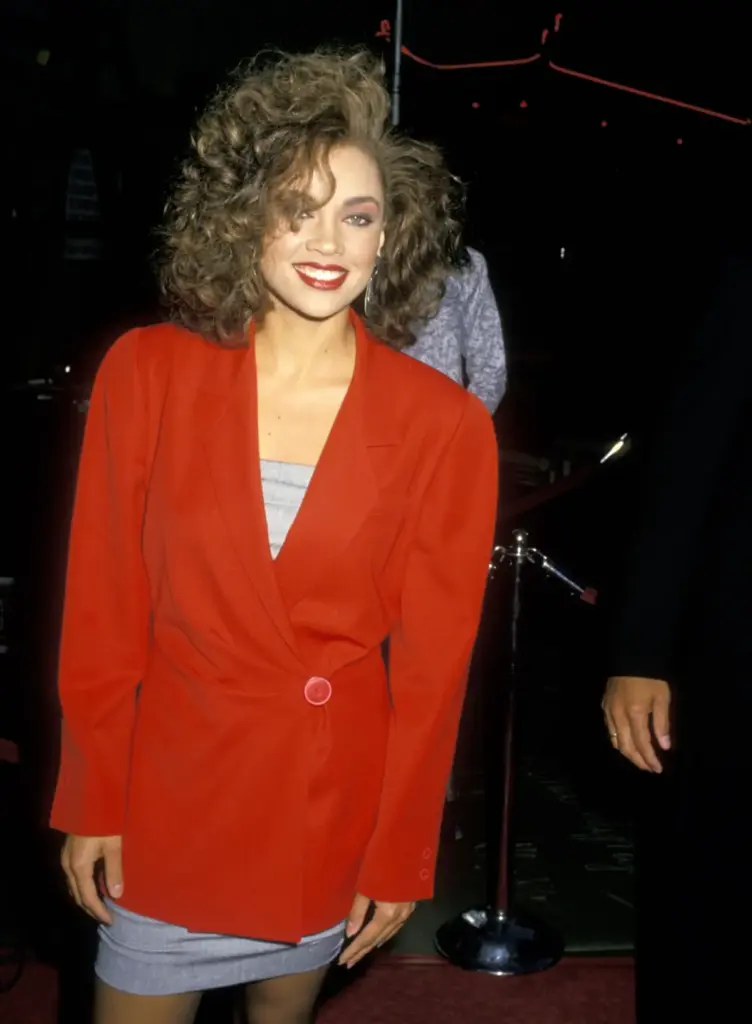
The defining texture of late-’80s cinema belonged to Julia Roberts, whose wild, cascading red curls became an instant cultural touchstone before her definitive 1990 breakout in Pretty Woman.
- The Look: Unbridled, voluminous curls that appear effortless yet intentional, carrying an aura of youthful warmth.
- Execution: Work a volumizing mousse through damp hair. Use a medium-barrel curling iron to reinforce waves starting right from the root. Gently break up the pattern using your fingers rather than a brush, sealing the look with a light misting of finishing spray.
4. Soft Waves and Diffused Volume (The Brooke Shields Blueprint)
Moving away from the rigid, sculpted perfection of the 1970s, Brooke Shields introduced a fresh, organic approach to hair that prioritized natural texture enhanced by calculated volume.
- The Look: Soft, expansive waves that frame the face with understated luxury.
- Execution: Apply a heat protectant, dry hair using a diffuser attachment on your blow dryer to encourage natural wave formation, and refine select pieces with a large-barrel iron. Tousle gently for a lived-in feel.
5. The Pineapple Updo (The Sarah Jessica Parker Blueprint)
Sarah Jessica Parker proved that curly hair did not have to be worn loose to command attention. The pineapple updo became the ultimate casual-glam staple of the late ’80s.
- The Look: Curls gathered high on the crown, allowed to cascade forward over the forehead like a playful, organic fringe.
- Execution: Gather all curls toward the top of the head and secure loosely. Allow natural ringlets to fall forward across the brow. Embellish with retro fabric scrunchies or oversized velvet bows for an authentic period touch.
6. The Wolf Cut / Shag (The Joan Jett Blueprint)
Long before modern TikTok trends rediscovered the shag, rock icon Joan Jett weaponized the layered, texturized cut as a badge of counter-cultural defiance.
- The Look: Short, heavily layered crown volume tapering down into unstructured, piece-y ends paired with dark, dramatic eye makeup.
- Execution: Keep the roots smooth or slightly lifted, while aggressively texturizing the mid-lengths and ends with styling paste to create a signature rocker-chic finish.
7. Permed Maximalism (The Dolly Parton Blueprint)
Country-pop royalty Dolly Parton established a global standard for theatrical, unapologetic glamour. Her platinum blonde mane remains an enduring masterclass in hyper-volume.
- The Look: Maximum-capacity, cloud-like curls, towering height, and brilliant, light-reflecting blonde tones.
- Execution: While many modern interpreters rely on specialized wigs for theatrical styling, achieving this at home requires rigorous setting, targeted root-lifting sprays, and meticulous curling with small-diameter irons.
8. Natural Disco Curls (The Diana Ross Blueprint)
The queen of disco carried her signature majestic volume straight into the 1980s, proving that natural texture could be scaled up to monumental proportions.
- The Look: Long, voluminous natural curls worn with a dramatic side part and often adorned with floral or metallic headpieces.
- Execution: Honor your natural pattern (much like her daughter, Tracee Ellis Ross) by prioritizing moisture, using diffusing attachments, and allowing the hair to expand freely without flattening the crown.
9. Outward-Flipped Ends (The Princess Diana Blueprint)
Concluding the spectrum of 1980s styling is the iconic short cut worn by Diana, Princess of Wales. It balanced aristocratic poise with youthful accessibility.
- The Look: Controlled crown volume, neat side-swept bangs, and signature ends flipped definitively outward.
- Execution: Requires a precision-layered short haircut as a structural base. Apply a root lifter, and use a round brush to direct each strand outward during the final stages of the blowout.
Future Outlook
As we look toward the culmination of the 2026 style cycle, the return of 1980s hair trends signals a deeper cultural shift in how we approach personal presentation. The era of uniform, ultra-straight, hyper-processed hair has yielded to an era of textural celebration, structural experimentation, and individual expression.
Whether consumers opt for the subtle sophistication of a Crawford-esque blowout or the roaring rebellion of a Jett-inspired wolf cut, the message is clear: hair is once again our most dynamic canvas. By marrying archival silhouettes with modern, hair-safe formulations, the 1980s renaissance proves that true glamour never genuinely fades—it merely waits for the right moment to scale new heights.