Executive Overview
In an era dominated by sedentary desk jobs, chronic screen time, and hyper-accelerated daily schedules, the traditional expectation of dedicating an hour or more to daily wellness has become a significant barrier to entry. For millions of professionals, students, and remote workers, finding 60 uninterrupted minutes for physical self-care is a logistical impossibility. However, contemporary exercise science and holistic health experts are challenging the paradigm that more time automatically equates to better results.
Enter Jack Bryant, a recognized yoga instructor and the founder of Wellness With La Rue. Bryant has introduced a streamlined, high-efficiency movement paradigm: a dynamic, five-minute mobility yoga flow designed to target every major muscle group, lubricate the joints, alleviate physical tension, and reset the nervous system in the time it takes to brew a cup of coffee.
Rather than diluting the ancient practice of yoga, this micro-session distills its core biomechanical and mental benefits into a rapid sequence. Moving through roughly a dozen distinct asanas (postures) in quick succession, the routine is strategically crafted for individuals with some familiarity with yoga who are comfortable executing fluid, breath-synchronized transitions.
This article provides an investigative look into the anatomy of the five-minute flow, the physiological mechanisms driving micro-workouts, expert insights on building sustainable wellness habits, and a complete chronological breakdown of how to integrate this rapid sequence into even the most demanding daily routine.
Detailed Chronology: The Anatomy of the Five-Minute Mobility Flow
Bryant’s routine is not a random assortment of stretches; it is a meticulously engineered sequence designed to systematically warm up, mobilize, challenge, and finally restore the human body. To maximize the efficiency of every second, the routine follows a logical physiological progression, moving from spinal articulation to unilateral loading, central transitions, and deep nervous system recovery.
Phase 1: The Spinal Warm-Up
The flow begins on the hands and knees, immediately engaging the core and axial skeleton through Cat-Cow (Marjaryasana-Bitilasana).
- Execution: Practitioners alternate between arching the back toward the ceiling (Cat) while tucking the chin, and dropping the belly toward the floor while lifting the chest and gaze (Cow).
- Purpose: This primal movement unlocks vertebrae stiffness, lubricates spinal discs, and immediately establishes the foundational rule of the practice: syncing movement with deep, conscious breathing.
From Cat-Cow, the sequence elevates into Downward-Facing Dog (Adho Mukha Svanasana). By pressing the hips upward and backward, the practitioner forms an inverted ‘V’ shape. This posture engages the shoulders, core, and arms while delivering a profound, lengthening stretch to the hamstrings, calves, and entire posterior chain.
Phase 2: Unilateral Loading (Right Side)
With the body warmed up, the flow shifts focus to the right side of the body, targeting areas most prone to stiffness from prolonged sitting—specifically the hips and hip flexors.
- Low Lunge (Anjaneyasana): Stepping the right foot forward between the hands, the practitioner drops the back knee or keeps it elevated, sinking into the hips. This pose stretches the hip flexors and deepens core stability.
- Forward Fold (Uttanasana): Transitioning weight forward, the body drapes over the legs, relieving tension in the lower back and hamstrings.
- Twisted Low Lunge (Parivrtta Utthita Ashwa Sanchalanasana): Returning to a lunge position, the torso rotates toward the front leg, extending one arm to the sky. This rotational component unlocks thoracic spine mobility, opens the chest and shoulders, and engages the oblique muscles.
Phase 3: The Central Transition
To reset the body before addressing the left side, Bryant incorporates a tripartite transition sequence:
- Eight-Limbed Pose (Ashtanga Namaskara): A lower-body-to-upper-body transition where knees, chest, and chin touch the floor.
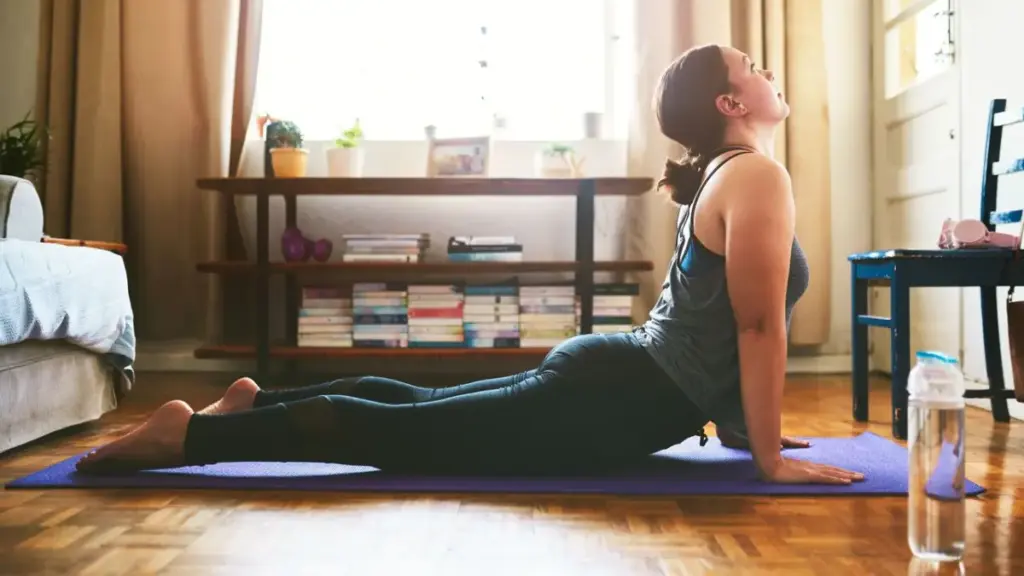
- Cobra Pose (Bhujangasana): A gentle, prone backbend that strengthens the erector spinae and opens the anterior chest wall.
- Child’s Pose (Balasana): A resting posture that deactivates the nervous system, resting the glutes on the heels and extending the arms forward to decompress the spine.
Phase 4: Unilateral Loading (Left Side)
Replicating the exact sequence executed on the right, the practitioner steps the left foot forward into the Low Lunge, folds into the Forward Fold, and opens the torso via the Twisted Low Lunge. Maintaining bilateral symmetry is critical in a mobility routine, ensuring that muscular imbalances cultivated during asymmetric daily tasks (such as driving or mouse navigation) are actively counteracted.
Phase 5: The Cool-Down and Nervous System Reset
The sequence concludes with a second transition through foundational postures before settling into the ultimate restorative shape: Corpse Pose (Shavasana) or a seated meditative seat. This final phase allows the cardiovascular system to normalize, grants the central nervous system permission to transition from "fight or flight" to "rest and digest," and ensures the body fully absorbs the kinetic benefits of the practice.
Supporting Context & Metrics: Why Micro-Workouts Work
The cultural shift toward micro-workouts is supported by an expanding body of exercise physiology and behavioral psychology research. For decades, fitness culture operated under an "all-or-nothing" fallacy: if a workout wasn’t 45 to 60 minutes long, it wasn’t worth doing. Modern data, however, tells a different story.
Combating Sedentary Syndrome
According to occupational health metrics, the average office worker spends between 7 to 10 hours a day sitting. Prolonged sitting leads to adaptive shortening of the hip flexors, deactivation of the gluteal muscles, kyphosis (rounding of the upper back), and reduced circulation.
A five-minute mobility flow directly counteracts these pathologies:
- Joint Lubrication: Movement stimulates the secretion of synovial fluid, the natural lubricant that nourishes cartilage and keeps joints moving smoothly.
- Fascial Release: Dynamic transitions stretch the fascial webs that encase muscles, preventing the body from locking into rigid, seated patterns.
- Blood Flow Augmentation: Even short bursts of movement increase cardiac output, delivering fresh oxygen and nutrients to oxygen-starved muscle tissue.
The Power of "Stackable" Habits
From a psychological perspective, large time commitments are vulnerable to friction—the mental and logistical barriers that prevent people from starting a task. By reducing the time barrier to just 300 seconds, Bryant’s routine removes virtually all excuses.
In behavioral science, this aligns with the concept of "habit stacking." When a micro-routine is attached to an existing daily trigger—such as immediately after waking up, right before lunch, or as soon as a computer is shut down at the end of the workday—it bypasses the friction of decision fatigue. Over time, these small investments compound into measurable improvements in long-term flexibility, joint health, and mental clarity.
Official Statements & Expert Analysis
Jack Bryant emphasizes that the primary objective of his five-minute flow is accessibility and sustainability. In professional statements regarding the routine, Bryant highlights the dual psychological and physical dividends of micro-yoga:
"If you’re short on time, a five-minute yoga practice can help improve mobility and also leave you feeling better mentally," Bryant explains. "These yoga poses can shift your energy and ease tight spots or physical tension. It’s perfect if you spend a lot of time sitting during the day."
Bryant notes that while advanced practitioners can use the flow as an energizing warmup or an active recovery session, beginners or intermediate students can leverage it as a gateway drug to a lifelong mindfulness habit.
"If you want to start a long-term practice, it has to be a sustainable and stackable habit within your life already, so this is a great place to start and see the benefits," he adds.
Physical therapists and kinesiologists have largely validated this philosophy, pointing out that frequency often trumps duration when it comes to mobility. Mobilizing a joint for five minutes every single day yields vastly superior long-term tissue adaptation compared to mobilizing it intensely for 45 minutes once a week. Furthermore, the mandatory focus on breathwork during the sequence stimulates the vagus nerve, immediately down-regulating cortisol production and mitigating acute work-related stress.
Future Outlook: The Micro-Fitness Movement
As modern life grows increasingly fast-paced and digitized, the fitness industry is undergoing a structural decentralization. The traditional brick-and-mortar gym model, while still dominant, is rapidly sharing space with decentralized, bite-sized wellness solutions designed for the home, the office, and transitional spaces.
The popularity of routines like Bryant’s five-minute mobility flow signals a broader cultural maturation in how humans view physical health. Wellness is no longer perceived as a punishing, sweat-drenched ritual performed in isolation, but rather as an accessible, integrated practice of somatic maintenance.
Looking forward, experts predict an explosion of micro-dose programming across corporate wellness initiatives, educational institutions, and digital platforms. Employers, recognizing the correlation between physical stiffness, mental fatigue, and diminished productivity, are increasingly encouraging employees to take micro-movement breaks throughout the day.
Ultimately, the five-minute yoga flow serves as a powerful reminder that profound physiological and mental shifts do not require massive amounts of time—just intentional, focused execution. Whether used as a morning activator, a midday cognitive reset, or an evening decompression ritual, this rapid sequence proves that when it comes to movement, every single second counts.