Executive Overview
In what local authorities have described as an extraordinarily complex and harrowing domestic tragedy, multiple people—including children—have died following a horrific combination of a shooting and a massive residential fire in Billings, Montana. The incident, which unfolded on Sunday evening at a property located on White Star Circle in the city’s West End, has sent shockwaves through the local community and mobilized a massive multi-agency law enforcement and emergency response.
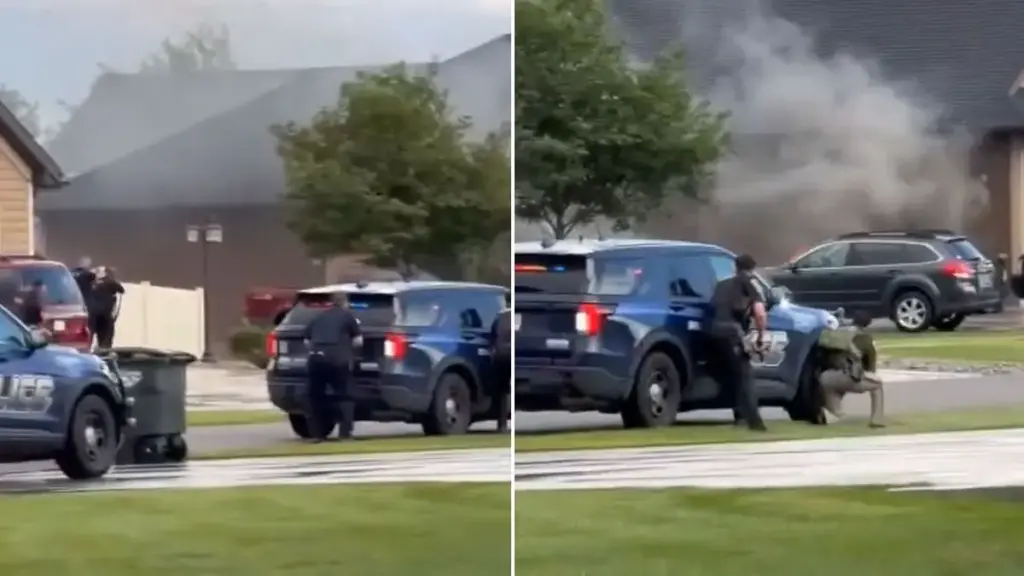
Initial 911 calls placed from the residence alerted emergency dispatchers not only to a rapidly spreading blaze but also to the unmistakable sounds of gunfire echoing in the background. When first responders arrived, they were immediately met with hostile gunfire, complicating fire suppression efforts and turning a standard emergency call into an active-shooter and hostage-style crisis.
Montana police and county officials confirmed during a subsequent press briefing that the male suspect, believed to be responsible for both the shooting and the initiation of the fire, succumbed to a self-inflicted gunshot wound. While investigators have successfully identified all individuals involved in the incident—including the victims and the deceased suspect—authorities have withheld their specific identities pending the notification of extended family members.
Interim Yellowstone County Sheriff Kent O’Donnell expressed profound sorrow over the tragedy, noting that the incident originated as a violent family disturbance. Law enforcement agencies from across the region, including deputies from neighboring Stillwater and Carbon counties, converged on the scene as the situation escalated. As federal, state, and local investigators sift through the charred debris of the home, the broader community is left grappling with the profound loss of innocent lives, raising critical questions regarding domestic dispute escalations, firearm access, and the unprecedented dangers faced by modern emergency responders.
Detailed Chronology of Events
The sequence of events that transformed a quiet Sunday evening on White Star Circle into a catastrophic crime scene began shortly after 6:00 p.m. local time. The following detailed timeline outlines how the crisis unfolded, the immediate tactical response, and the hours of uncertainty that followed:
1. The Initial 911 Call and Gunfire
At approximately 6:00 p.m. on Sunday, emergency dispatchers in Billings received a panicked call reporting a fire at a residential home located at 315 White Star Circle. According to law enforcement logs, as the caller spoke with dispatch, distinct gunshots could be heard echoing in the background. The realization that a domestic disturbance was actively turning lethal prompted an immediate, high-priority dispatch of both police units and fire suppression teams.
2. Arrival of First Responders and Active Threat
Billings Fire Chief Matt Hoppel reported that the first fire engine arrived at the scene at precisely 6:02 p.m. However, instead of being able to immediately hook up hoses and deploy personnel to combat the flames, firefighters were confronted with active gunfire emanating from and around the property.
Recognizing that the scene was unsecure and intensely dangerous, fire crews were forced to hold back from standard tactical formations. The presence of an active shooter forced emergency personnel to prioritize perimeter containment and civilian safety over immediate structural fire suppression.
3. The Firefighting Struggle and Lack of Infrastructure
Compounding the tactical nightmare was the physical geography of the neighborhood. Chief Hoppel noted that the area surrounding White Star Circle suffered from a critical lack of nearby fire hydrants. Firefighters were forced to rely exclusively on the limited water supply carried within their pumper trucks, severely hampering their ability to suppress a blaze of that magnitude.
Despite these compounding challenges, firefighters worked valiantly to prevent the inferno from leaping to adjacent properties. While the target home was ultimately consumed entirely by the flames, neighboring houses sustained only minor heat damage, averting a much broader neighborhood catastrophe.
4. Discovery of the Suspect and Conclusion of the Threat
As law enforcement agencies swarmed the West End neighborhood—with reinforcements arriving from Yellowstone, Stillwater, and Carbon counties—tactical teams secured the perimeter. Billings Assistant Police Chief Shawn Mayo confirmed that a man was discovered lying outside the heavily damaged home suffering from a critical, self-inflicted gunshot wound.
Emergency medical personnel immediately intervened, transporting the suspect to a local hospital. Despite life-saving efforts, the man was pronounced dead shortly after arrival. With the primary threat neutralized, emergency crews were finally able to enter the structural remains to begin the grim task of recovering victims and preserving evidence.
Supporting Context & Metrics: The Anatomy of a Complex Investigation
The investigation into the Billings West End tragedy is classified by local and state officials as one of the most intricate and harrowing crime scenes in the region’s recent history. The convergence of multiple homicides, an active-shooter scenario, a catastrophic structural fire, and multiple crime scene perimeters demands an exhaustive forensic accounting.

Multi-Agency Coordination
Given the scale of the devastation, standard local police resources were rapidly overwhelmed, necessitating a coordinated regional response. The operation drew personnel from:
- The Billings Police Department: Handling primary investigative leads, witness interviews, and tactical containment.
- The Yellowstone County Sheriff’s Office: Providing command-level oversight and jurisdictional support.
- Stillwater and Carbon County Sheriff’s Departments: Deploying tactical deputies to assist with perimeter security and rural backup integration.
- The Billings Fire Department: Spearheading structural containment and hazardous materials management amidst active gunfire.
- State and Federal Forensic Units: Assisting with ballistic analysis, fire origin investigation, and human remains recovery.
The Forensic Challenges of Fire and Ballistics
Forensic investigators face a uniquely difficult challenge when processing a crime scene where both gunfire and high-intensity fire have occurred. Intense structural fires can alter ballistic evidence, destroy biological traces, and compromise the structural integrity of the home, making the reconstruction of the timeline exceptionally difficult.
Furthermore, because the home was fully consumed by flames, forensic anthropologists and odontologists are frequently required to assist medical examiners in positively identifying victims and determining the exact cause of death for each individual inside the residence.
Official Statements and Community Impact
The weight of the tragedy has prompted emotional responses from city leaders, law enforcement commanders, and community advocates, all of whom are struggling to process the scope of the violence.
Interim Sheriff Kent O’Donnell
Addressing reporters during a tense Monday morning press briefing, Interim Yellowstone County Sheriff Kent O’Donnell struggled to maintain his composure while discussing the nature of the call.
"As you can see, just by the amount of agencies involved in this, this is a very, very complex investigation," O’Donnell stated. "When the call went out last night for assistance, the cavalry was coming."
O’Donnell confirmed that the incident was rooted in a domestic dispute, noting that he had spoken directly with surviving family members of the victims. Visibly shaken, he admitted to being "deeply saddened" by the preventable loss of life, particularly noting the inclusion of children among the deceased.
Billings Fire Chief Matt Hoppel
Chief Matt Hoppel praised the extraordinary bravery of his firefighting personnel, who faced an active-shooter situation without the defensive armaments typically carried by law enforcement officers.
"Because the scene could not be immediately confirmed as secure, our firefighters were unable to operate as we normally would," Hoppel explained. "Our crews showed immense courage, holding the line, managing water scarcity from truck tanks alone, and ensuring that this horrific fire did not claim the homes of neighboring families."
Assistant Police Chief Shawn Mayo
Assistant Police Chief Shawn Mayo provided logistical updates regarding the suspect’s status, confirming that the male individual found outside the residence with critical injuries was transported to a medical facility, where he subsequently died from a self-inflicted gunshot wound. Mayo emphasized that while all parties have been accounted for, the department is maintaining a strict information quarantine to protect the integrity of the ongoing investigation and respect the privacy of grieving relatives.
Future Outlook and Ongoing Inquiries
As the Billings community begins the long and painful process of healing, several critical phases of the investigation remain pending:
- Identification and Public Disclosure: Sheriff O’Donnell has indicated that a comprehensive update, including the official release of the names of the victims and the deceased suspect, will be provided to the public on Wednesday. This delay allows law enforcement time to ensure all extended family members—some of whom may reside out of state—have been notified in person.
- Origin and Cause Determination: Fire investigators from the state and local levels are continuing their meticulous sift through the ash and rubble of 315 White Star Circle. While the connection between the shooting and the fire is clear, the exact mechanism used to ignite the blaze remains under formal investigation.
- Domestic Violence and Mental Health Advocacy: Local support networks and community organizations in Billings have mobilized to offer grief counseling and crisis intervention resources to neighbors, first responders, and school districts affected by the tragedy. The incident has once again sparked regional conversations regarding the vital importance of early intervention in domestic disturbances and the critical need for accessible mental health services throughout Montana.
The tragedy on White Star Circle serves as a grim reminder of the volatility of domestic disputes and the immense dangers confronting frontline emergency workers who run toward danger when every instinct commands retreat. As official findings are released later in the week, the community of Billings will undoubtedly demand answers while standing united in mourning for the innocent lives cut short.